




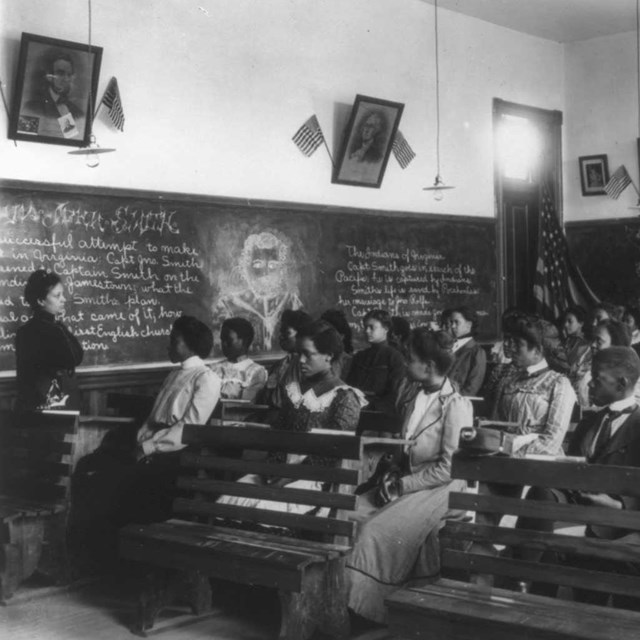
Facilities had been segregated since the American Civil War and had hardly lived up to the “Separate But Equal” decision from the Plessy v. Ferguson case just before the turn of the century. While Black schools were so overcrowded, they had to begin holding classes in shifts, neighboring white schools were half empty. School authorities responded to the overcrowding by allowing students at Browne Junior High School to hold satellite classes in former white primary schools that were in disrepair. The school’s PTA demanded that Black students be allowed to attend white schools, which had plenty of space. Meanwhile Gardner L. Bishop, a local barber and father of a student at Browne Junior High School called on parents to boycott the school. With others, he formed the Consolidated Parent Group to file a grievance with the school board. Bishop and the Consolidated Parent Group organized and crusaded against the school board for years. On September 11, 1950, Bishop led a group of 11 students to the newly constructed John Pilip Sousa Junior High School and demand their enrollment. Despite having several empty classrooms in the new building, the students were denied enrollment at the new facility. Bishop then reached out to attorney Charles Hamilton Houston, the special counsel to the NAACP, who began to build a case against the school. Unfortunately, Houston suffered a heart attack, and asked a colleague, James Nabrit, Jr., to lead the case instead. Rather than focusing on differences between the facilities, Nabrit chose to challenge segregation itself. It was a risky position. Bolling v. Sharpe was filed in U.S. District Court in 1951, named for Spottswood Bolling, one of the 11 children that had accompanied Bishop the year before. The U.S. District court dismissed the case based on a recent ruling by the Court of Appeals in Carr v. Corning that segregated schools were constitutional in the District of Columbia. Nabrit filed an appeal and was awaiting a hearing when the U.S. Supreme Court sent word that it was interested in considering the case along with the other four school segregation cases already pending. Nabrit, along with a colleague from Howard University, George E.C. Hayes, would argue the case before the U.S. Supreme Court during the first round of arguments, and Hayes alone presented their argument during the second round. The U.S. Supreme Court rendered a separate opinion on Bolling v. Sharpe based on the Fifth Amendment because the Fourteenth Amendment to the U.S. Constitution was not applicable in the District of Columbia. Citations: Kluger, Richard. 2004. Simple justice: The History of Brown V. Board of Education and Black America’s Struggle for Equality. Vintage. African American Experience FundThe mission of the African American Experience Fund of the National Park Foundation is to preserve African American history by supporting education programs in National Parks that celebrate African American history and culture. There are 26 National Parks identified by the African American Experience Fund: |
 |
|


Last updated: March 5, 2026