



You are viewing ARCHIVED contentThis content was published online before January 20, 2025. Please note that this content is NOT UPDATED, and links may not work. For current information, visit https://www.nps.gov/aboutus/news/index.htm. 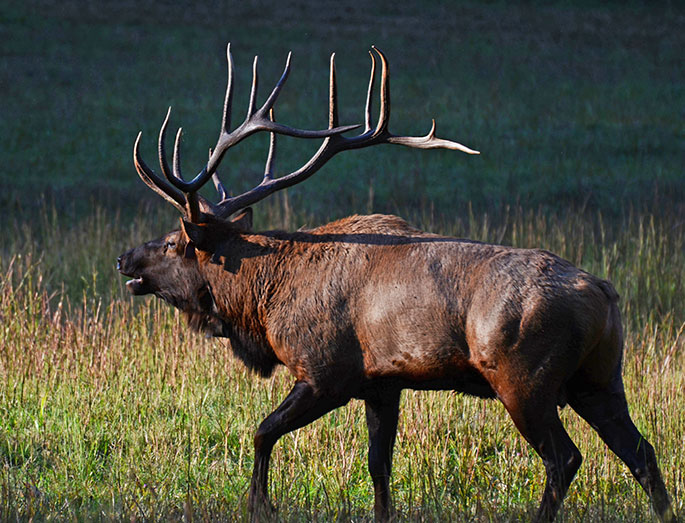
Jim Bennett
News Release Date: September 10, 2014 During the rut, male elk make bugling calls to challenge other bulls and attract cows. Dominant bulls use the fields to gather and breed with harems of up to 20 cows. Bull elk actively defend their territory by charging and sparring with competitors using their antlers to intimidate and spar with other males. Encroaching too close may lead a bull to perceive you or your vehicle as a threat causing them to charge. “We ask that people help protect the elk herd by honoring the field closures to ensure that elk are not disturbed during this important breeding season,” said Park Wildlife Biologist Bill Stiver. “Bull elk, which can weigh nearly 1,000 pounds, are wild animals with unpredictable behavior. To help ensure your own safety, make sure you have parked in a safe location and remain close to your vehicle so that you can get inside if an elk approaches.” Park Rangers encourage visitors to use binoculars, spotting scopes, or cameras with telephoto lenses to best enjoy wildlife. Feeding, touching, disturbing, and willfully approaching wildlife within 50 yards (150 feet), or any distance that disturbs or displaces wildlife, are illegal in the park. If approached by an elk, visitors should slowly back away to put distance between the animal and themselves creating space for the animal to pass. If elk are near the roadways, remain in or next to your vehicle at a safe distance from the animal. Park volunteers, through the Elk Bugle Corp, Oconaluftee Rover, and Roadside Assistance volunteer programs, provide on-site information and assist in traffic management at both Cataloochee and Oconaluftee during the rut season. Funds to support these programs are provided by Friends of the Smokies. For more information on how to safely view elk, please see https://www.nps.gov/grsm/planyourvisit/wildlifeviewing.htm . |
Last updated: April 14, 2015