




NPS The Quarry Exhibit Hall allows visitors to view the wall of approximately 1,500 dinosaur bones in a refurbished, comfortable space. Here, you can gaze upon the remains of numerous different species of dinosaurs from the Late Jurassic period, including Allosaurus, Apatosaurus, Camarasaurus, Diplodocus, and Stegosaurus, along with several others. There are even several places where you can touch real 150 million year old dinosaur fossils! Rangers are available to answer questions, help kids complete their Junior Ranger booklets, and occasionally provide talks on different topics related to the quarry or dinosaurs during the summer.
Visit our keyboard shortcuts docs for details
The Quarry Exhibit Hall is where you can see a wall of approximately 1,500 dinosaur bones. Join a ranger to learn the story behind the fossils, their discovery, and the creation of the building.
Image Gallery
Image Gallery
Image Gallery
Image Gallery
What You'll SeeThe Quarry Exhibit Hall is a large indoor building with glass windows that provide sweeping views of the landscape. Outside, you can see part of a geological anticline (uplift) with many rock layers exposed at an angle. One of these layers, the Morrison Formation, is also exposed inside the Quarry Exhibit Hall. This section contains over 1,500 fossilized bones of dinosaurs from the Late Jurassic Period, approximately 150 million years old. There are 8 different species of dinosaur remaining in the Quarry Wall, including a few fan favorites like Stegosaurus and Allosaurus. Some of the skeletons are articulated (connected in the right order), but most of them are loose and unconnected. A few even bear signs of scavenging. In addition to the fossil wall, there are many other exhibits around the museum to explore. You can see displays showcasing fossils of small mammals, clams, amphibians, reptiles, and plants of the Morrison Environment. Rangers staff the Quarry Exhibit Hall yearround to orient visitors and answer questions, as long as road access to the Quarry remains clear.Visit our Operating Hours and Seasons page to learn when the Quarry Exhibit Hall is open. See our Current Conditions page to determine if the road to the Exhibit Hall is open. Getting to the Quarry Exhibit HallThe Quarry Exhibit Hall is a separate building from the Quarry Visitor Center, but it's only a 3-minute drive away by road. During the summer season, we ask that visitors take the free park shuttle from the Visitor Center to the Exhibit Hall because of limited space in the parking lot. In seasons when the shuttle isn't running, visitors may drive their personal vehicle to the Exhibit Hall. When conditions allow, you may also hike from the Visitor Center to the Exhibit Hall along the Fossil Discovery Trail (1.2 miles or 2 km one-way).Accessibility: Visitors who would have trouble hiking or boarding the park shuttle are always welcome to drive a personal vehicle from the Visitor Center to the Exhibit Hall. There is about 12 inches (31 cm) of clearance between the first shuttle step and the ground. Once at the Exhibit Hall, an ABA compliant ramp connects the first and second floors, both indoors and outdoors. There is no elevator. A wheelchair is available to borrow upon request. Please visit our Accessibility page for more information. Pets: Since pets aren't allowed on the shuttle or on the Fossil Discovery Trail, visitors travelling with pets are welcome to drive a personal vehicle to the Exhibit Hall. Pets and animals who provide only comfort or emotional support aren't allowed inside the Quarry Exhibit Hall or in any other federal buildings. It's also against park rules to leave a pet unattended or tied to an object. Instead, party members travelling with pets are asked to take turns waiting with them. You may choose to wait with your pet in your car, relax under the shade shelter, or enjoy a walk along the sidewalk that surrounds the Exhibit Hall parking lot. Please remember that pets must be on a leash no longer than 6 feet (2 meters) at all times, and handlers must clean up after them. Visit our Pets page for more information about where you can go with furry friends. 
Paleontology
Paleontology, the study of ancient life, helps us understand our planet's past. Learn more about Dinosaur's contributions to the field. 
Morrison Formation
The Morrison Formation is a rock unit from the Late Jurassic Period. This rock layer is where most of the monument's dinosaurs were found. 
Dinosaurs of Dinosaur
In a time before grass and flowers, before bees and butterflies, and even before the Rocky Mountains rose, dinosaurs called this place home. 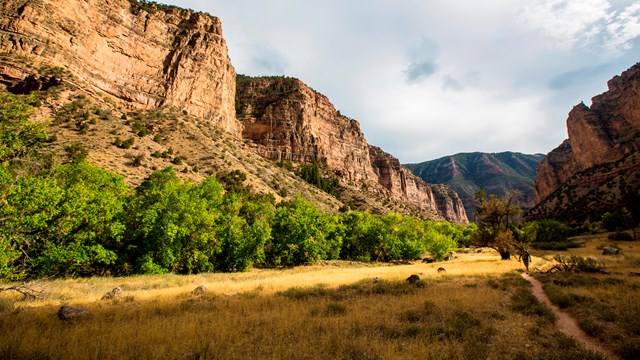
Places to Go
Covering over 210,000 acres, Dinosaur National Monument offers a wealth of places to explore. 
Things To Do
Whether you enjoy scenic drives, hiking, fishing, stargazing, or rafting, Dinosaur offers much to explore! 
Traveling with Pets
Pets are welcome at Dinosaur National Monument, but you should know where they are allowed and where they are not. |
Last updated: November 13, 2025