



With its unique geothermal features and diverse wildlife, Yellowstone National Park has drawn the curiosity of many scientific researchers. Ferdinand V. Hayden led the first official scientific expeditions, a series of US Geological Surveys, in the area during the 1870s. Almost one hundred years later, Vincent J. Schaefer, director of the Atmospheric Sciences Research Center at the State University of New York in Albany, also felt drawn to conduct research within the park’s boundaries. Schaefer was well-known for his development of cloud seeding, a technique which allowed scientists to induce precipitation. This technique involves spreading a chemical through air, which provides molecules around which moisture can condense to form droplets of precipitation. Though cloud seeding cannot produce precipitation from air that does not already contain moisture, it can greatly increase the efficiency of a cloud’s precipitation release.
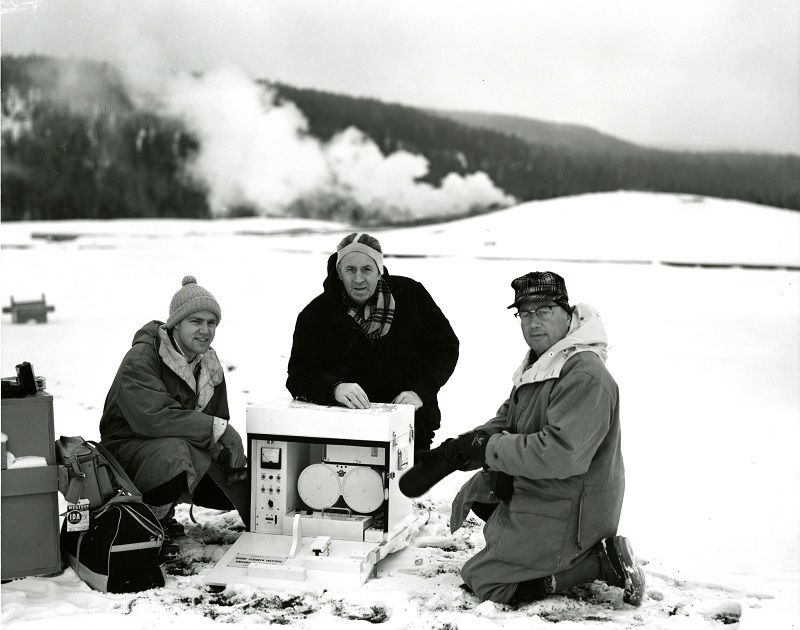 YELL 114672: Expedition members used a sky camera to capture the visual effects produced by cloud seeding. Leader Vincent Schaefer is pictured in the middle.
When looking for an ideal environment for cloud seeding experiments, Schaefer knew that he needed moist, cold air to produce supercooled clouds. Yellowstone National Park not only provided an extremely cold winter environment, but also rich sources of moisture from the park’s geysers and hot springs. After a visit to the park in February of 1960 accompanied by forester Maynard Barrows, Schaefer determined that Yellowstone was indeed an ideal environment for cloud seeding studies. Schaefer also concluded that the combination of supercooled air with heat from hydrothermal features in the area could result in other unique atmospheric phenomena worth investigating. He planned to return the next year along with other atmospheric scientists to conduct research during the winter in the Old Faithful area. This seminar, the first Yellowstone Field Research Expedition, was productive and successful enough to spawn a decade-long program during which researchers gained immense knowledge about atmospheric science, microbiology, and wildlife biology.
The majority of the research that Schaefer himself conducted during the expeditions focused on various methods of cloud seeding. More specifically, Schaefer and his team explored the differences between crystals seeded using silver iodide (AgI) and crystals seeded using dry ice. Researchers induced dry ice seedings by swinging a basket of the material through moist air, producing a supercooled cloud. A propane burner generated silver iodide seeded clouds by burning a mixture of silver iodide and sodium iodide. Both methods were successful in producing dense clouds of ice crystals, but Schaefer determined through his experiments that silver iodide was more efficient. In fact, many continue to use silver iodide in modern cloud seeding. However, Schaefer noted that the crystals produced by dry ice seedings are much more similar to natural snow crystals than crystals grown on lead or silver iodide, which tended to be much more symmetrical and structurally detailed.
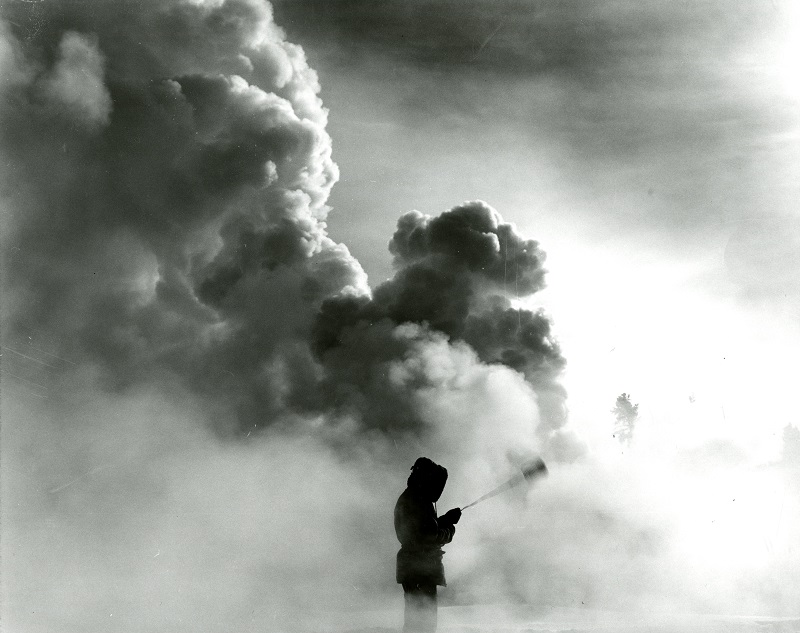 YELL 114666: By swinging a basket of dry ice, this man seeded an ice crystal cloud.
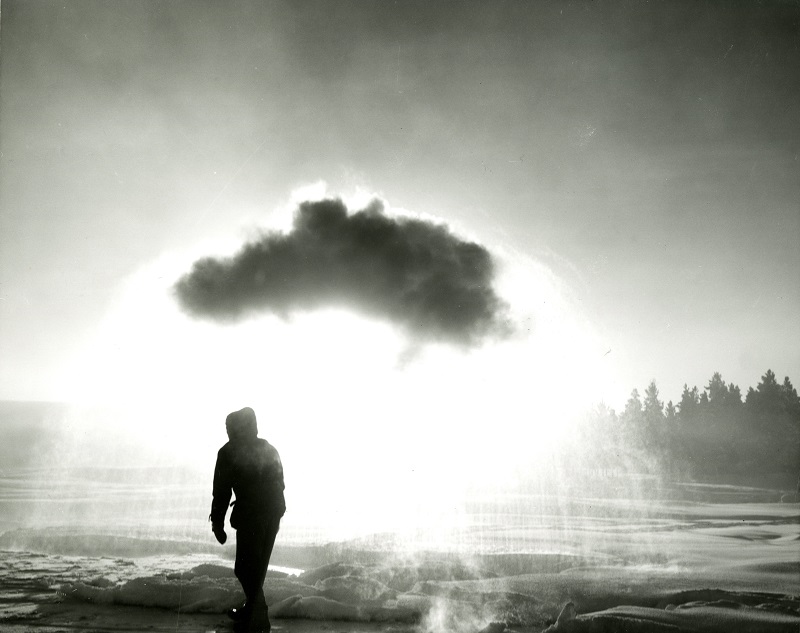 YELL 114670: A researcher threw hot water into super cooled air, producing the pictured vapor effect.
Other atmospheric research conducted by Schaefer and his team focused on preserving samples of both naturally and artificially seeded ice crystals. Previously, researchers used a plastic replica method to preserve crystals. However, this technique limited scientists’ ability to preserve liquid cloud droplets and ice crystals smaller than a micron wide. Schaefer developed a new technique, dubbed the vapor method, to allow the replication of these droplets that could not previously be well preserved for research. The vapor method involves depositing the particles to be replicated on a dry film surface, where researchers expose it to the film’s solvent in gaseous form. Schaefer used this method extensively during the Yellowstone Field Research Expeditions, producing over 300 slides during only one of the seminars. The Heritage and Research Center houses eight of these slides in its museum collection, including a slide of crystals Schaefer seeded using silver iodide.
Despite ethical controversy regarding whether humans should be allowed to control the weather, government and commercial entities have applied Schaefer’s cloud seeding experiments in many contexts. For example, areas where recreational skiing is popular, as well as areas where the primary source of water is snow melt, often use winter cloud seeding to increase snowfall. China famously used cloud seeding to fulfill their promise that there would be no rain during the 2008 Beijing Olympics. Even before the Olympics, Northern China relied heavily on cloud seeding to produce water due to the area’s lack of natural rainfall.
More information on the Yellowstone Field Research Expeditions and Vincent Schaefer’s atmospheric research can be found in the Heritage and Research Center’s library, which houses all of the Yellowstone Field Research Expedition Final Reports. Thomas Brock, who participated in two of the expeditions, also published articles describing the expeditions in detail in Yellowstone Science Volume 10 Number 4 and Yellowstone Science Volume 11 Number 1. In his journal article “The Vapor Method for Making Replicas of Liquid and Solid Aerosols” published in the September 1962 edition of the Journal of Applied Meteorology, Schaefer describes in detail his vapor preservation method. Information about China’s history of cloud seeding can be found in Volume 32, Issue 2 of Advances in Atmospheric Science in the article “Advances in cloud physics and weather modification in China.”
|
August 20, 2026
|
Last updated: August 20, 2026