



You are viewing ARCHIVED contentThis content was published online before January 20, 2025. Please note that this content is NOT UPDATED, and links may not work. For current information, visit https://www.nps.gov/aboutus/news/index.htm. 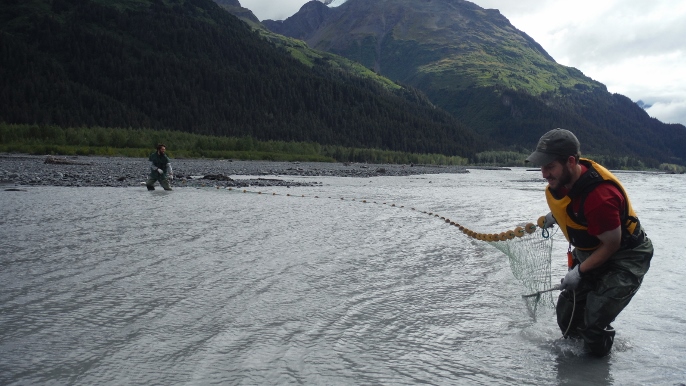
NPS Photo/ James Kramer
News Release Date: October 23, 2014 For the past two months, the field crew from Lake Clark National Park could be seen seining through the low-flow eddies adjacent to swift glacial water of the Resurrection River just downstream from Exit Glacier.The crew leader, Andrew Kirby, noted his surprise in catching more fish than expected in what he describes as the "dynamic, glacial part of the system where you can't really see the fish."Despite these limitations, Andrew and the crew captured and tagged 90 adult coho salmon this season.While seining, they quickly removed captured fish, identified fish to species and then, if a coho, determined sex, measured length, and inserted a radio tag into its stomach.After tagging, the coho were released into the stream with the long, radio-tag antenna hanging from the corner of the fish's mouth.The crew monitored the movements of tagged fish using a combination of tracking stations located along the river corridor, hand held telemetry receivers, and the occasional aerial flight.Location data will be used to identify migration corridors and spawning areas throughout the drainage.
In addition, the crew collected fin clips from a subset of all salmon captured in the river.Samples will be analyzed by the Alaska Department of Fish and Game and will provide a baseline of genetic variation for the wild stock of salmon in the Resurrection River drainage.
This season has proven challenging and exciting for the field crew.From dealing with high flows and frigid water to catching fish and discovering where they spawn, every day provided a new adventure.The crew even found one of their telemetry tags onshore, most likely the remnant of a bear's dinner.Kirby smiles as he recollects this season, calling himself, "an opportunist in an unpredictable environment!"
The Ocean Alaska Science and Learning Center promotes NPS research activities, synthesizes results of research, and aids in public engagement of Alaskan coastal and marine ecosystems.
-- NPS –
|
Last updated: December 19, 2017