• View of Grand Canyon National Park at sunset from the South Rim

    Grand Canyon

    National Park Arizona

Brochures

Grand Canyon National Park Site Bulletins and Trail Brochures may be downloaded from this page. Park Newspapers are here.

The free Adobe Acrobat Reader is required for viewing. For best results, we suggest that you download the file to your computer before viewing or printing.

Many more publications are available through the park's bookstores.


Site Bulletins
Things to Know
Nearest Available Lodging for both the South and North Rim
(207kb PDF File, Mar 2010)
Lightning Danger (188kb PDF File, Jun 2008)

Sunrise/Sunset Information
Sunrise/Sunset for South Rim (103kb PDF File, Jun 2005)

Trail Information
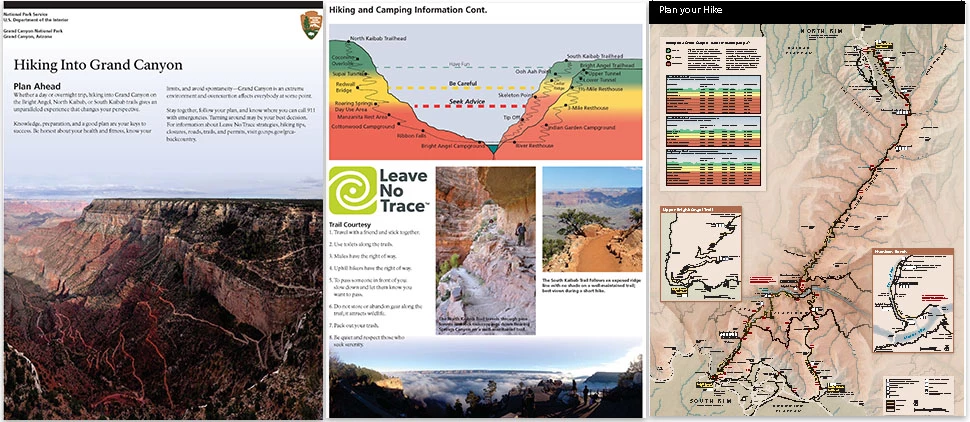
Corridor Trails - color brochure (1mb PDF File, Sept 2009)
More detailed trail descriptions can be found at Day Hiking and Trails and Use Areas
 

South Rim Trail Brochures

Life Along The Rim/ Grand Canyon Geology
(579kb PDF File)
The South Rim of Grand Canyon marks the northern edge of a high plateau whose gray-green forests stand out in vivid contrast to the arid lands below the rim. From here the cliffs of Grand Canyon drop 5,000 feet/ 1,500 meters to the Colorado River, crossing several biotic zones.

Nowhere on this planet are the scope of geologic time and the power of geologic processes as superbly and beautifully exposed as in these canyon walls.

 
cover of Hermit Road greenway plant guide

Plants Living on the Edge: Hermit Rd. Greenway
(1.7 MB PDF)
Walk the Hermit Road portion of the Greenway Trail to learn about the South Rim's plant communities and how they thrive in this challenging environment.

This section of the Greenway Trail starts at Monument Creek Vista and ends at Hermits Rest, a distance of 2.8 miles/4.5 km. The paved trail is relatively level with some slight up and downhill sections.


cover of Bright Angel Trail Plant Identification Guide

Bright Angel Trail Plant Identification Guide
From rim to Mile-and-a-Half Resthouse (364kb PDF)

Starting at the Bright Angel Trailhead, this guide points out some of the plants you pass. Trail descriptions (written in red) help you find where different plants first start to appear along the trail. You will not only identify common plants, but also discover interesting facts about each. Record how many plants you can find by checking off the box next to each name.


Cover of CCC Grand Canyon Village Trail Guide.

Civilian Conservation Corps Walking Tour
(1.15 MB PDF file)
During the 1930's severe economic depression challenged the confidence of the people of the United States. One in four people was unemployed. Many were homeless. The Civilian Conservation Corps was created in 1933 to put young men to work on worthwhile projects. At Grand Canyon the CCC built roads, trails, walls, shelters and much of the infrastructure that still is in use today.

The walking tour travels a circular route in the Historic District of Grand Canyon Village of approximately 1.5 miles (2.4 km), although you can begin at any point and walk as much of the loop as you wish.


Desert View brochure cover showing the Watchtower.

Desert View - with map (1.0 MB PDF)

From ancient nomadic hunters to today's visitors, human experience has shaped Desert View's cultural landscape.

A short ¼-mile (½-km) walk leads from the parking area, past historic buildings, to the rim. From Desert View Point you can see the Colorado River make a big bend to the west. Climb the stairs to the top of the watchtower for outstanding views of the canyon.


Tusayan Ruin (821kb PDF File)

Welcome to Tusayan Pueblo Ruin at Desert View. (South Rim) People have lived on the Colorado Plateau for thousands of years. The Paleo-Indians, nomadic hunter/gatherers who lived here 5,000-10,000 years ago, left the earliest evidence. With the introduction of agriculture about 2000 years ago, villages (pueblos) like this one developed.


Phantom Ranch

Phantom Ranch (1.60 MB PDF File)

Welcome to Phantom Ranch. Having descended more than a vertical mile below the rim of Grand Canyon, you have reached the bottom of one of the largest canyons in the world. Carved by the Colorado River and sculpted by water from innumerable storms, the canyon reveals an unparalleled record of Earth's history in the cliffs above you.


North Rim Trail Brochures

Bright Angel Point (1.65MB PDF)

Arrival at Bright Angel Point by the Grand Canyon Lodge on the North Rim places you on the edge of a vastness of scenery, time, and opportunity. The view confirms the tremendous uplift that has occurred, leaving the canyon's North Rim 1,000 feet/300 meters higher than the South Rim. Walk slowly and pace yourself; Bright Angel Point is 8,148 feet/2,484 meters above sea level (5,780 feet/1,762 meters above the Colorado River)

 
Widforss Trail (1.75MB PDF)

The Widforss Trail starting from the North Rim Village, follows the canyon rim for approximately 2 1/2 miles/ 4 kilometers then heads into the forest to emerge at Widforss Point - a distance of 5 miles/ 8 kilometers one way (10 miles/ 16 kilometers round trip). The entire round trip takes most people 4 to 5 hours. There are no restrooms or drinking water along the trail.

 
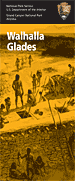
Walhalla Glades Pueblo (1.73MB PDF)

Nine hundred years ago, people were living on the North Rim at Walhalla Glades. The site was a summer home for families for over 100 years. Walhalla Plateau is "peninsula" surrounded on three sides by the
Grand Canyon. The elevation in this area is a bit lower than most of the North Rim of Grand Canyon, and updrafts of warm air from the inner canyon allow the winter snows to melt early, making Walhalla a favorable place for ancestral people to farm.


Toroweap - Tuweep

Cover of Tuweep Brochure showing drop to river below. Toroweap - Tuweep (498 kb PDF) Jan. 2011

The View from Toroweap Overlook, 3000 vertical feet / 915 m above the Colorado River, is breathtaking; the sheer drop, dramatic! Equally impressive are the volcanic features, cinder cones and lava flows, which make this viewpoint unique in Grand Canyon National Park.

A visit to this remote area can be challenging, but rewarding. Since the National Park Service manages the area for its primitive values, improvements and services are minimal.

Did You Know?

UNKAR DELTA IN GRAND CANYON

In Grand Canyon,one of the broad, sandy areas on the north bank of the Colorado River is Unkar Delta, composed of rock debris carried from the North Rim by Unkar Creek. Prehistoric Pueblo people occupied numerous sites on Unkar Delta and along Unkar Creek for about 350 years (A.D. 850 to A.D. 1200)