



You are viewing ARCHIVED contentThis content was published online before January 20, 2025. Please note that this content is NOT UPDATED, and links may not work. For current information, visit https://www.nps.gov/aboutus/news/index.htm. 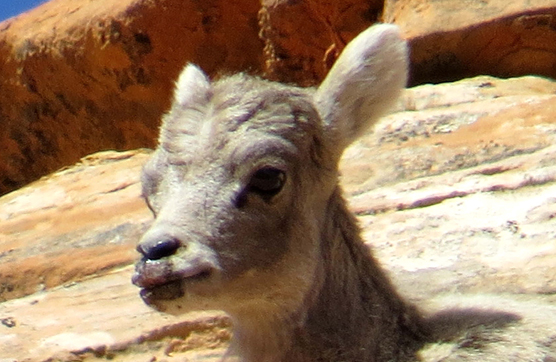
News Release Date: April 4, 2013 Sore Mouth Disease (also known as contagious ecthyma) is thought to be responsible for the illness observed among the bighorn sheep population at Zion National Park. Sore Mouth Disease is a virus similar to chicken pox, and like chicken pox is typically self-limiting and usually a mild disease. It is transmittable to people if direct contact with infected sheep occurs. The park is reminding visitors not to approach or touch wildlife.
Sore Mouth Disease is common throughout the world in wild and domestic sheep and goats. Spread from ewes to lambs, it can manifest itself in sores around the mouths of lambs and cause mastitis of the ewes' teats. Lesions typically disappear in 2-4 weeks. It has the greatest effect on lambs, which because of sore mouths, refuse to suckle. Though rarely fatal, park biologists expect to see some mortality. Since the incubation period is 1-2 weeks, visitors could possibly see sick animals for many months as the disease moves through the population.
There is no cure for Sore Mouth Disease in sheep; only supportive treatment can be given. Treatment is not a viable option due to the number of animals involved and the stress sedation puts on sick animals. Sore Mouth Disease is not eradicable but subsequent outbreaks are usually less severe.
Sore Mouth Disease is a zoonotic disease, meaning it can spread from infected sheep to humans. People exposed to the virus, especially those with poor immune systems, can develop sores on their hands after touching the saliva or open sores of infected sheep. In humans, the sores are painful but usually resolve on their own without treatment. To date, there have been no reported human cases.
"People should never be approaching wildlife at Zion National Park, so we do not expect to have any issues with visitors contracting this disease from the bighorn sheep," said park superintendent Jock Whitworth. "It is hard to watch a disease spread through a population, but we need to let nature take its course."
If visitors inside the park do see a dead or dying bighorn sheep, please notify the park dispatch at 435-772-3256. |
Last updated: February 24, 2015