An official website of the United States government
Here's how you know
Official websites use .gov A
.gov website belongs to an official government
organization in the United States.
Secure .gov websites use HTTPS A
lock (
) or https:// means you've safely connected to
the .gov website. Share sensitive information only on official,
secure websites.
National Park Service
U.S. Department of the Interior
River Raisin National Battlefield Park
Superintendent's Compendium of Designations, Closures, Permit Requirements and Other Restrictions Imposed Under Discretionary Authority.
River Raisin NBP
333 North Dixie Highway, Monroe, MI 48162
743-243-7136 phone 734-244-5501 fax
Approved April 24, 2026
Geoffrey Avery, Superintendent
A. INTRODUCTION
1. Superintendent’s Compendium Described
The Superintendent’s Compendium is the summary of park specific rules implemented under 36 Code of Federal Regulations (36 CFR). It serves as public notice, identifies areas closed for public use, provides a list of activities requiring either a Special Use Permit or reservation, and elaborates on public use and resource protection regulations pertaining specifically to the administration of the park. The Superintendent’s Compendium does not repeat regulations found in 36 CFR and other United States Code and CFR Titles, which are enforced without further elaboration at the park level.
The regulations contained in 36 CFR, Parts 1-7, are the basic mechanism used by the National Park Service (NPS) to preserve and protect the natural and cultural resources of the park and to protect visitors and property within the park. Parts 1 through 6 are general regulations applicable to all areas of the National Park system, and Part 7 contains special regulations specific to individual parks. Each of these Parts has many sections and subsections articulating specific provisions. Within some of these Part 1-7 sections and subsections, the Superintendent is granted discretionary authority to develop local rules to be responsive to the needs of a specific park resource or activity, park plan, program, and/or special needs of the general public.
As an example, 36 CFR 1.5(a) Closures and Public Use Limits provides the Superintendent certain discretion in allowing or disallowing certain activities. The authority granted by the Section, however, requires the Superintendent to comply with the Administrative Procedures Act (6 USC Section 551), which requires public notice on actions with major impact on visitor use patterns, park resources or those that are highly controversial in nature.
Another example is 36 CFR 1.6 Permits, which allows the Superintendent to require a permit for certain uses and activities in the park. This Section, however, requires that a list of activities needing a permit (and a fee schedule for the various types of permits) be maintained by the park.
A final example is 36 CFR 2.1(c) (1) Preservation of Natural, Cultural and Archeological Resources, which provides the Superintendent the authority to designate certain fruits, nuts, berries or unoccupied seashells which may be gathered by hand for personal use or consumption. This activity can occur, however, only if a written determination shows that the allowed activity does not adversely affect park wildlife, the reproductive potential of a plant species, or otherwise adversely affect park resources.
This Compendium should be used in conjunction with Title 36 CFR, Parts 1-7, to more fully understand the regulations governing the use and enjoyment of all the areas of the national Park System.
A copy of Title 36, CFR, can be purchased from the U.S. Government Printing Office at: www.gpo.gov
OR
Superintendent of Documents
P.O. Box 371954
Pittsburgh, PA 15250-7954
2. Laws and Policies Allowing the Superintendent to Develop This Compendium
The National Park Service (NPS) is granted broad statutory authority under Title 54 United States Code (U.S.C.) §100101(a) (formerly 16 U.S.C. 1a-1, “Organic Act”) to “….regulate the use of the National Park System by means and measures that conform to the fundamental purpose of the System units, which purpose is to conserve the scenery, natural and historic objects, and wild life in the System units and to provide for the enjoyment of the scenery, natural and historic objects, and wild life in such manner and by such means as will leave them unimpaired for the enjoyment of future generations.” In addition, Title 54 U.S.C. §100751(a) allows the NPS, through the Secretary of the Interior, to “prescribe such regulations as the Secretary considers necessary or proper for the use and management of System units.”
In 1970, Congress amended the NPS Organic Act to clarify its intentions as to the overall mission of the NPS. Through the General Authorities Act of 1970, Congress brought all areas administered by the NPS into one National Park System and directed the NPS to manage all areas under its administration consistent with the Organic Act of 1916.
In 1978, Congress amended the General Authorities Act of 1970 and reasserted System-wide the high standard of protection defined in the original Organic Act by stating “Congress further reaffirms, declares, and directs that the promotion and regulation of the various areas of the National Park System, as defined by Section 1 of this Title, shall be consistent with and founded in the purpose established by Section 1 of this Title, to the common benefit of all people of the United States.”
In addition to the above statutory authority, the Superintendent is guided by established NPS policy as found in the NPS Management Policies (2006). The Superintendent is also guided by more specific policies promulgated by the Director, National Park Service, in the form of Director’s Orders. As stated in the Management Policies, the primary responsibility of the NPS is to protect and preserve our national natural and cultural resources while providing for the enjoyment of these resources by visitor and other users, as long as use does not impair specific park resources or overall visitor experience. The appropriateness of any particular visitor uses or recreational experience is resource-based and will vary from park to park; therefore, a use or activity that is appropriate in one park area may not be appropriate in another. The Superintendent is directed to analyze overall park use and determine if any particular use is appropriate. Where conflict arises between use and resource protection, where the Superintendent has a reasonable basis to believe a resource is or would become impaired, then that Superintendent is obliged to place limitations on public use.
3. Consistency of This Compendium with Applicable Federal Law and Requirements
The Superintendent’s Compendium is not considered a significant rule requiring review by the Office of Management and Budget under Executive Order 12866. In addition, this Compendium
will not have a significant economic effect on a number of small entities nor impose a significant cost on any local, state or tribal government or private organization, and therefore does not fall under the requirements of either the Regulatory Flexibility Act or the Unfunded Mandates Reform Act.
The actions and requirements described in this Compendium are found to be categorically excluded from further compliance with the procedural requirements of the National Environmental Policy Act (NEPA) in Department of the Interior (DOI) Guidelines 516 DM 6 and as such, an Environmental Assessment will not be prepared.
4. Development of the Requirements of the Superintendent’s Compendium
As outlined above, the NPS has broad authority and responsibility to determine what types of uses and activities are appropriate in any particular National Park System area. The requirements of the Superintendent’s Compendium are developed through an analysis and determination process. The decision criteria used during this process are:
Is the use or activity consistent with the NPS Organic Act and NPS policy?
Is the use or activity consistent and compatible with the park’s enabling legislation, management objectives, and corresponding management plans?
Will the use or activity damage the park’s protected natural and cultural resources and other protected values?
Will the use or activity disturb or be in conflict with wildlife, vegetation, and environmental protection actions and values?
Will the use or activity conflict with or be incompatible with traditional park uses and activities?
Will the use or activity compromise employee or public safety?
5. Applicability of the Compendium
The rules contained in this Compendium apply to all persons entering, using, visiting or otherwise present on Federally owned lands, including submerged lands, and waters administered by the NPS within the legislative boundaries of the park. This includes all waters subject to the jurisdiction of the United States, including all navigable waters.
6. Enforcement of Compendium Requirements
NPS Law Enforcement Park Rangers enforce the requirements of the United State Code, 36 CFR, and this Superintendent’s Compendium.
7. Penalties for Not Adhering to the Compendium Requirements
A person who violates any provision of the regulations found in 36 CFR, Parts 1-7, or provisions of this Compendium, is subject to a fine as provided by law (18 U.S.C. 3571) up to $5,000 for individuals and $10,000 for organizations, or by imprisonment not exceeding six months (18 U.S.C. 3559), or both, and shall be adjudged to pay all court costs associated with any court proceedings. You may receive a list of fines associated with any particular provision by contacting the Chief Ranger at the park address found below.
8. Comments on the Compendium
The Compendium is reviewed annually and revised as necessary. The park welcomes comments about its program and activities at any time.
Written comments on the Compendium may be submitted to:
Superintendent
River Raisin National Battlefield Park
333 N. Dixie Highway
Monroe,Michigan 48162
9. Effective Date of the Superintendent Compendium
The Superintendent’s Compendium is effective on the approval date listed on the first page of this document and remains in effect until revised for a period up to one year.
10. Additional Information
Some of the terms used in this Compendium may have specific meaning defined in 36 CFR 1.4 Definitions.
11. Availability
Copies of the Compendium are available at River Raisin NBP, 333 N. Dixie Highway, Monroe, MI 48162. The compendium can also be found online.
B. SUPERINTENDENT’S COMPENDIUM
accordance with regulations and the delegated authority provided in Title 36, Code of Federal Regulations (“36 CFR”), Chapter 1, Parts 1-7, authorized by Title 54 U.S.C. §100751, the following provisions apply to all lands and waters administered by the National Park Service, within the boundaries of River Raisin National Battlefield Park. Unless otherwise stated, these regulatory provisions apply in addition to the requirements contained in 36 CFR, Chapter 1, Parts 1-7.
Written determinations, which explain the reasoning behind the Superintendent’s use of discretionary authority, as required by Section 1.5(c), appear in this document identified by italicized print.
I. 36 CFR §1.5 – VISITING HOURS, PUBLIC USE LIMITS, CLOSURES, AND AREA DESIGNATIONS FOR SPECIFIC USE OR ACTIVITIES
(a)(1) The following visiting hours and public use limits are established for all or for the listed portions of the park, and the following closures are established for all or a portion of the park to all public use or to a certain use or activity:
Visiting Hours:
Visitor use of the park grounds is limited to daylight hours, defined as one half hour before sunrise to one half hour after sunset.
The River Raisin Unit Visitor Center is open daily from 9 a.m. to 5 p.m. from May 1st through September 30th and from 10 a.m. to 5 p.m. from October 1st through April 30th except Thanksgiving, Christmas and New Year’s Day when the visitor center is closed.
The River Raisin library, curatorial and archives facilities are available to researchers by appointment only.
The River Raisin Unit visitor center drive may be used by local commuter traffic after established daily closure hours for driving through only. There is no stopping, standing or parking along the entrance road, parking lots, or pull-offs during park closure hours.
Determination: Visitation in other than daylight hours is incompatible with the educational and memorial purposes for which the park was established, The Superintendent makes exceptions for evening programs, approved special use permits, or approval on an individual basis. Emergency closures will be posted and/or announced through the media.
The park was established to permanently preserve and protect and interpret areas of great historic and memorial interest relating to the events of the Battles of the River Raisin and its Aftermath that occurred within Monroe and Wayne Counties, Michigan. There are no overnight camping facilities in the park, and except for scheduled evening interpretive programs and special events, there is no valid scientific or educational reason to allow visitor use after dark. After dark the Battlefield is vulnerable to looting or vandalism. Visiting is therefore limited to daylight hours.
Public Use Limits:
Parking, Overnight Parking or Camping: During established park closure hours there is no parking, overnight parking or camping.
Closures:
Launching, landing, or operating an uncrewed aircraft system (UAS) or remotely piloted aircraft from or on lands and waters administered by the National Park Service within the boundaries of River Raisin National Battlefield Park is prohibited except as approved in writing by the superintendent.
Definition: The term “uncrewed aircraft system” means a device that is used or intended to be used for flight in the air without the possibility of direct human intervention from within or onboard the device, and the associated operational elements and components that are required for the pilot or system operator in command to operate or control the device (such as cameras, sensors, communication links.) This term includes all types of devices that meet this definition (e.g., model airplanes, quadcopters, and drones) that are used for any purpose, including for recreation or commerce.
Determination: The unmanaged or unrestricted recreational use of UAS within the boundaries of River Raisin National Battlefield Park has the potential to conflict with, or impact, a variety of park uses including visitor experience or unimpaired viewsheds; the disturbance or harassment of park wildlife to include threatened and endangered species and presents a public safety hazard.
A section of the Battlefield across the entrance road from the Visitor’s Center to the East is posted as closed to visitors.
The area is closed due to hazardous conditions caused by dumping prior to the establishment of the Battlefield. The area has contaminated soil, algae growth on broken slabs of concrete, and is generally unsafe to foot traffic. The area is posted with signs.
Public buildings at River Raisin National Battlefield Park are closed Thanksgiving, Christmas, and New Year’s Day.
“Ghost Hunting”, “Paranormal Investigations”, “Ghost Tours”, and other similar activities are prohibited.
Determination: The River Raisin National Battlefield Park is the final resting place for many who paid the ultimate price to defend their Nations and people. The Battlefield is considered sacred soil by many. Many people from multiple Nations with differing religious and after-life beliefs died in the battles and in many cases their physical remains are likely still present at the Battlefield. In addition, areas of the Battlefield have been traditionally used as the final sacred resting place of ancestors of Tribal Nations since time immemorial.
After in-person consultations with representatives of five Federally Recognized Indian Tribes in 2019, it was determined that allowing activities that could disturb or call on the spirits of those killed during the Battles or appear to disturb in any way the spirits that may remain at the Battlefield is offensive and violates the spiritual beliefs of many, if not all Tribal Nations. Respecting the life and spirits of Tribal ancestors and others who have walked on from this world is held in the highest regard. No activity that would, could or may be viewed as disturbing or disrespecting the spirits of those who died, or their living descendants will be permitted at the Battlefield.
The five Federally Recognized Indian Tribes consulted included the Eastern Shawnee Tribe of Oklahoma, Nottawaseppi Huron Band of the Potawatomi (MI), Ottawa Tribe of Oklahoma, Saginaw Chippewa Indian Tribe of Michigan, and the Wyandotte Nation (OK).
It has been determined that the activity of “Ghost Hunting”, “Paranormal Investigations”, “Ghost Tours”, and other similar activities that could disturb the spirits who may remain at the Battlefield or be offensive to their living descendants are inconsistent with the Park’s enabling legislation and not compatible with the Park’s management plan as outlined in the Park’s Foundation Document. It has been determined that the above activities are likely to disturb or negatively impact the values protected by the Park’s enabling legislation.
The Superintendent may close any portion of the park and/or roadways to public access during periods of ice, snow, or any other hazardous condition. Roadways may be closed with gates, barricades or other traffic control devices. Driving around or past these devices is prohibited.
(a)(2) The following areas have been designated for a specific use or activity, under the conditions and/or restrictions as noted.
Recreational activities such as kite flying, Frisbee throwing, ball playing, etc. are prohibited.
Determination: River Raisin National Battlefield Park was a field of battle and is a memorial to those that died in the battle. Many of the fallen were interred on the field of battle, and the area should be respected as an unmarked grave site.
Establishing a Geo-Caching site is prohibited within River Raisin National Battlefield Park without a permit from the Superintendent.
Determination: Placing of Geo-Caching sites without supervision may result in resource damage from visitor use outside normal areas or from manipulation of the resource in the placement and replacement of Geo-Caching sites.
Passenger Carrying Busses must shut down engines when parked for a period of more than 5 minutes.
Passenger carrying busses produced loud noises and fumes that disrupted the sacred and contemplative atmosphere of the Battlefield.
II. 36 CFR §1.6 – ACTIVITIES THAT REQUIRE A PERMIT
The following is a compilation of those activities for which a permit from the Superintendent is required:
§2.2(e) Viewing wildlife with artificial light.
§2.4(d) Carry or possess a weapon, trap or net.
Firearms may be carried or possessed in accordance with applicable state and federal law.
§2.5(a) Specimen collection (Taking of plants, fish, wildlife, rocks or minerals).
§2.10(a) The following camping activities:
Erecting any type of tent or temporary structure.
Residing in the park between the hours of sunset to sunrise.
Parking of recreational vehicles or other self-contained units.
§2.12 Audio disturbances:
(a)(2) Operation of a chain or power saw in a developed areas
(a)(3) Operation of any type of portable motor or engine, or device powered by a portable motor or engine in non-developed areas
(a)(4) Operation of a public access system in connection with a public gathering or special event for which a permit has been issued pursuant to §2.50 or §2.51
§2.17 Aircraft and air delivery
(a)(3) Delivery or retrieval of a person or object by parachute, helicopter, or other airborne means
(c)(1) Removal of a downed aircraft
§2.37 Soliciting or demanding gifts, money, goods or services (Pursuant to the terms and conditions of a permit issued under §2.50, §2.51 or §2.52)
§2.38 Explosives:
(a) Use, possess, store, transport explosives and or blasting agents
(b) Use or possess fireworks
§2.50 Conduct a sports event, pageant, regatta, public spectator attraction, entertainment, ceremony, and similar events.
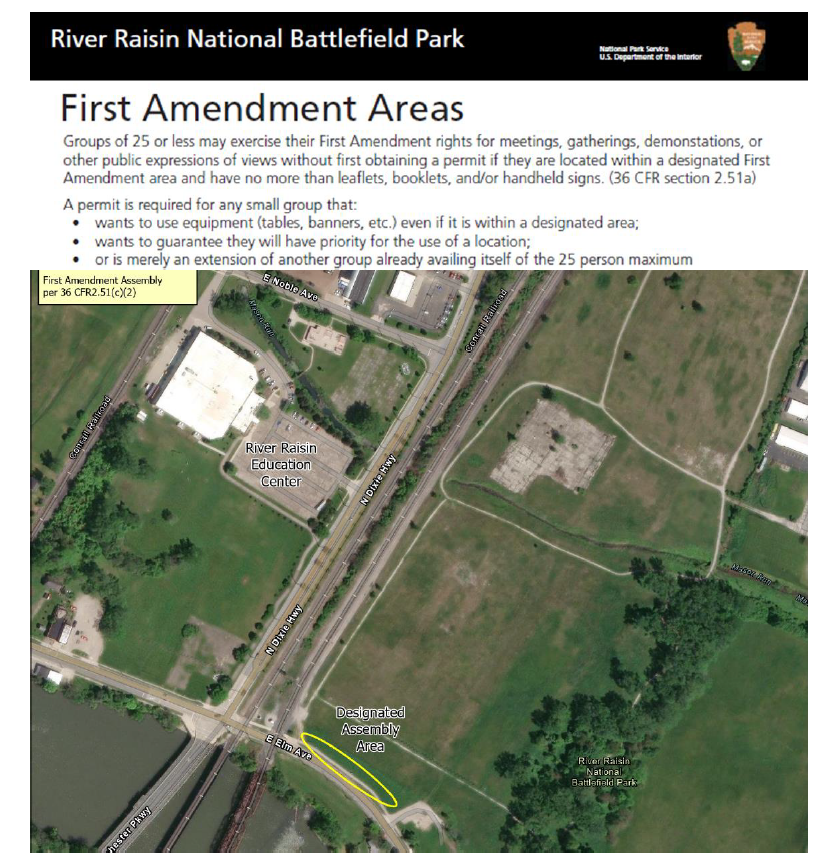
§2.51(b) Public assemblies, meetings, gatherings, demonstrations, parades, and other public expressions of views involving more than 25 people. Demonstrations involving 25 persons or less are allowed within the park areas designate as available in the attached map.
§2.52(c) Sale or distribution activities of printed matter that is not solely commercial advertising.
§2.60(b) Livestock use
§2.61(a) Residing on federal lands
§2.62 Memorialization
(a) Erection of monuments (Requires approval from the Director)
(b) Scattering ashes from human cremation
§4.11(a) Vehicles exceeding load, weight, and size limits (See, section III. §4.10)
§5.1 Advertisements including the display, posting or distribution
§5.3 Engaging in or soliciting any business (Requires a permit, contract or other written agreement with the United States or pursuant to special regulations)
§5.5 Some filming, still photography, and audio recording (depends upon the facts and circumstances; contact the park for more information) (See 36 CFR 1.5 (a)(2) and 54 U.S.C. 100905)
§5.6(c) Use of commercial vehicles on park area roads (The Superintendent shall issue a permit to access private lands within or adjacent to the park when access is otherwise not available)
§5.7 Construction of buildings, facilities, trails, roads, boat docks, path, structure, etc.
Determination: The listed activities may be appropriate in very limited situations or may be compatible with the purposes of the park for specific educational or commemorative events. Some situations may make the park the appropriate space for the exercise of Constitutionally protected rights. Therefore, the listed activities may be permitted with the approval of the Superintendent.
III. GENERAL REGULATIONS
36 CFR §2.1 – PRESERVATION OF NATURAL, CULTURAL, AND ARCHEOLOGICAL RESOURCES
(a)(5) The following conditions are in effect for walking, climbing, entering, ascending, or traversing the listed archeological or cultural resource, monuments, or statues:
Cannons
Flag Poles
The public is prohibited from digging, electronically prospecting, disturbing, moving, removing objects and artifacts.
The banks of Mason Run and other earthworks that are subject to erosion are closed to travel, but all other areas of the park are open to foot travel.
(c)(1), (c)(2) Due to the contaminations in the soil, it is recommended visitors do not ingest fruits, nuts, berries, or any vegetation within the Battlefield.
36 CFR §2.4 – WEAPONS, TRAPS OR NETS
(b)(1)(i) The possession of weapons (excluding legal firearms), traps, or nets are prohibited within River Raisin National Battlefield Park.
(d) A person may possess, carry, and transport concealed, loaded, and operable firearms within a national park area in accordance with the laws of the state in which the national park area, or that portion thereof, is located, except as otherwise prohibited by applicable Federal law.
This authority does not extend to Federal facilities within the park (18 U.S.C. 930(a)). These places are marked with signs at public entrances. The federal facilities firearms are prohibited at River Raisin National Battlefield Park are as follows:
Visitor Center located at 333 N. Dixie Highway, Monroe, MI
36 CFR §2.10 – CAMPING
Camping is prohibited unless authorized in accordance with a Special Use Permit issued by the Superintendent.
Determination: Camping detracts from the historic setting of the park, results in conflict among visitor use activities, and/or threatens natural or cultural resources.
36 CFR §2.11 – PICNICKING
Picnicking is permitted only in designated picnic areas. These areas are identified by the presence of picnic tables and/or trash cans.
Determination: All units of the park contain sensitive archeological features. Appropriate scientific and educational activities near or at these features would be adversely impacted by allowing picnicking throughout the grounds. The park provides picnic tables and other facilities at designated areas to limit impacts from erosion, burrowing animals, insects, and interference with educational activities.
36 CFR 2.13 – FIRES
(a)(1) The lighting or maintaining of fires is prohibited in the park except that the Superintendent may permit the use of fires for educational or interpretive purposes. If permitted, a fire may be ignited and maintained only by using fuel sources designed and commonly used for warmth or the preparation of food, such as charcoal briquettes or natural firewood. Lighting or maintaining a fire with other materials including, but not limited to, flammable liquids, garbage, fireworks, plastics, aerosol canisters, batteries, or other manufactured or synthetic materials, is prohibited.
Determination: Fire is a potential hazard to park resources and facilities and to neighboring properties. No fires shall be set for the purposes of camping activities or food preparation by visitors without a permit. This action is necessary for the maintenance of public health and safety, protection of environmental or scenic values, protection of natural or cultural resources, and the implementation of management responsibilities. Materials other than approved combustibles – especially fire accelerants and substances prone to wind transport or explosion – creates serious risks when used to light or maintain fires. These combustibles can ignite or spread wildfires that directly threaten people and valuable resources and assets. The burning of manufactured or synthetic materials can contribute to air pollution, contaminate soil and water, and be toxic to humans and the environment. Less restrictive measures, such as an education campaign informing visitors of the risks of using certain materials to light or maintain a fire, would not be commensurate with the substantial risks associated with those activities and could lead to adverse outcomes that might be prevented by establishing an enforceable condition.
36 CFR §2.15 – PETS
(a)(1) The following structures and/or areas are closed to the possession of pets:
Pets are not allowed in buildings or structures except service animals.
Determination: To prevent conflicts with other visitors and staff, animals are not allowed in park buildings with the exception of service animals.
(a)(3) Pets may be left unattended and tied to an object in the following areas, under the conditions noted:
In picnic areas, pets may be tied to picnic tables or tethered in the area while the owner/handler is present, however pets may not be left unattended.
(a)(5) Pet excrement must be disposed of in accordance with the following conditions:
Pet excrement is to be removed from trails, walkways, lawns, and other developed areas by the person responsible for the pet. Pet owners are responsible for their animals, including cleaning up after their animals.
Determination:The developed units of the park are commemorative spaces which should be treated with respect and decorum.
36 CFR §2.16 – HORSES AND PACK ANIMALS
(b) The use of horses or pack animals is allowed on the specified trails, routes, or areas:
The use of horses or pack animals is only allowed on the Mason Run Loop Trail that runs through the River Raisin Unit of the Battlefield. Horses and pack-animals are prohibited in all other areas.
Determination: The potential introduction of invasive plants is a concern.
36 CFR §2.18 – SNOWMOBILES
(c) The use of snowmobiles is prohibited in River Raisin National Battlefield Park.
36 CFR §2.20 – SKATING, SKATEBOARDS, AND SIMILAR DEVICES
The use of roller skates, skateboards, roller skis, coasting vehicles, or similar devices are allowed only in the following areas:
The River Raisin Heritage Trail that runs through River Raisin National Battlefield Park is the only trail that is open for the use of roller skates, skateboards, roller skis, coasting vehicles, or similar devices.
36 CFR §2.21 – SMOKING
(a) The following portions of the park, or all or portions of buildings, structures, or facilities are closed to smoking as noted:
Smoking is not allowed in park buildings, within 25 feet of building entrances and in picnic areas. Smoking on trails and other outside areas of the park may be prohibited during periods of high fire danger. All smoking debris must be removed from the park by the smoker.
36 CFR §2.35 – ALCOHOLIC BEVERAGES AND CONTROLLED SUBSTANCES
(a)(3)(i) The following public use areas, portions of public use areas, and/or public facilities within the park are closed to the use or possession of alcoholic beverages and controlled substances:
Alcoholic beverages are permitted only in designated picnic areas. Consumption of alcoholic beverages in other areas of the park is prohibited without a permit from the Superintendent.
Determination: Consumption of alcoholic beverages is inappropriate to the educational and interpretive activities that occur in areas outside picnic areas of the Battlefield.
36 CFR §4.21 – SPEED LIMITS
(b) The following speed limits are established for the routes/roads indicated:
The legal speed limit on all park roads and trails shall be 15 miles per hour.
36 CFR §4.30 – BICYCLES & ELECTRIC (E-BIKES) BICYCLES
(a) The use of a bicycle is prohibited except on park roads, trails and parking lots. No bicycles shall be operated off established pathways.
(b) In accordance with 36 CFR §4.30(i)(1) Class 1 and 2 E-Bikes are allowed in River Raisin National Battlefield Park where traditional bicycles are allowed. E-bikes are prohibited where traditional bicycles are prohibited. Except where use of motor vehicles by the public is allowed, using the electric motor to move an e-bike without pedaling is prohibited. Because of the public health and safety risks associated with the speed Class 3 E-Bikes travel and the limited line of sight along some sections of trails Class 3 E-Bikes are only allowed where motor vehicles by the public are allowed.
In accordance with 36 § 4.30(1)(5), A person operating an e-bike is subject to the following sections of 36 CFR part 4 that apply to the use of traditional bicycles: sections §4.12, 4.13, 4.20, 4.21, 4.22, 4.23, 4.30(h)(2)-(5).
In accordance with 36 § 4.30(1)(6), Except as specified in this Compendium, the use of an e-bike within River Raisin National Battlefield Park is governed by State law, which is adopted and made a part of this Compendium. Any violation of State law adopted by this paragraph is prohibited.
36 CFR §5.6 COMMERCIAL VEHICLES
(b) & (c) Using commercial vehicles on government roads within park areas when such use is in no way connected with the operation of the park is generally prohibited, and requires permission or a permit from the Superintendent.