



Last updated: July 9, 2026
Place
Pacific Springs
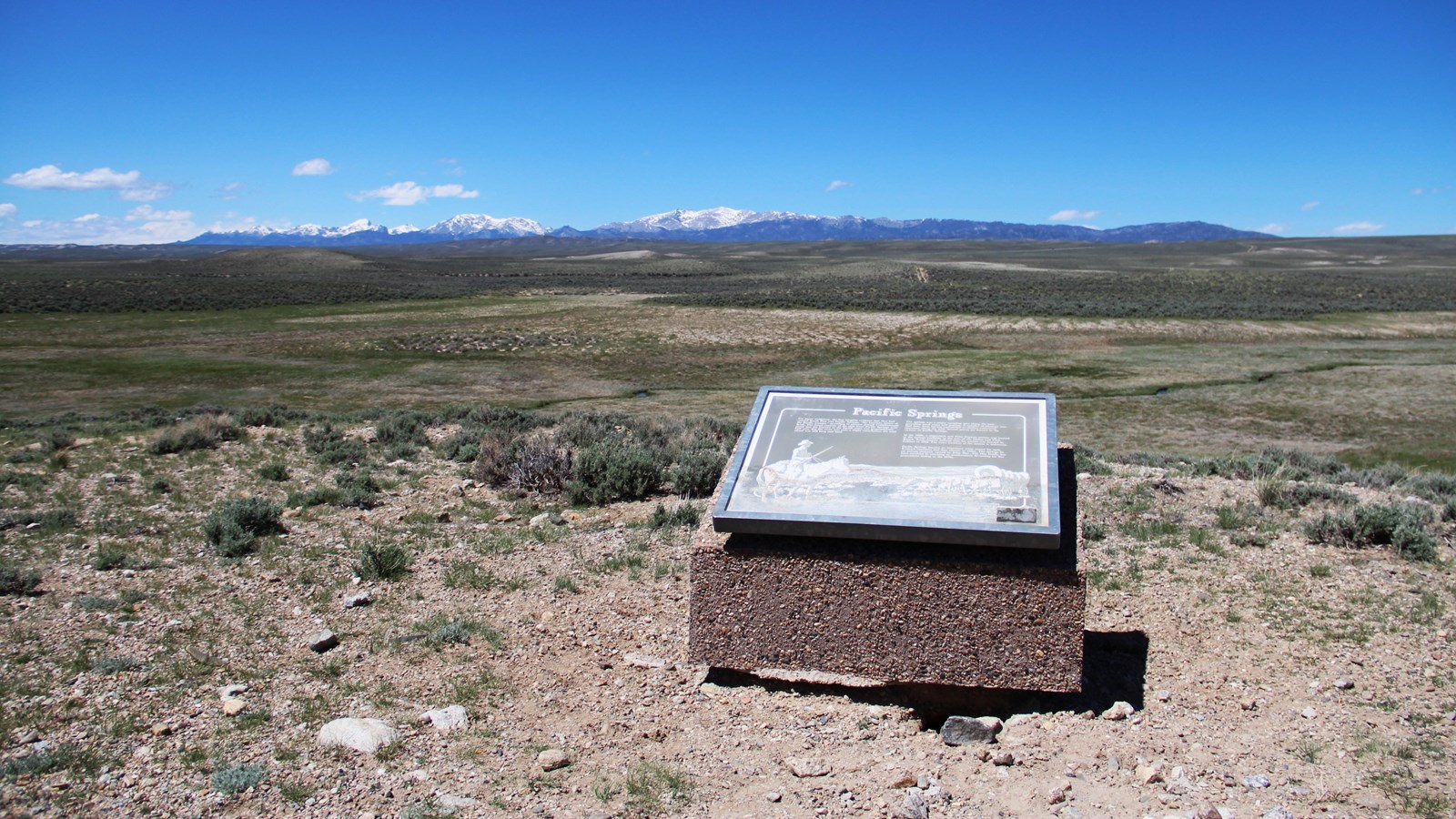
NPS Photo
Quick Facts
Location:
From the Bureau of Land Management’s South Pass Overlook interpretive site off WY-28, drive or walk the old stage road that goes down the hill. Cross Pacific Creek to reach the junction with the old emigrant trail, then turn left (northeast) on Emigrant Trail. Continue ¾ mile to the wayside exhibit on the left, near Pacific Creek. GPS for Pacific Springs wayside exhibit 42.332884 -108.945991
Significance:
Pacific Springs was the first good water source after emigrants crossed South Pass and entered the Pacific watershed. It became a popular emigrant camping area in the 1840s and later was the site of a Pony Express and stage station, various businesses, and a transcontinental telegraph relay station.
Designation:
Historic site on the California, Mormon Pioneer, Oregon, and Pony Express NHTs.
OPEN TO PUBLIC:
No
MANAGED BY:
Amenities
2 listed
Information, Scenic View/Photo Spot
Emigrants sometimes did not know they had crossed the Continental Divide until they reached Pacific Springs, about 2.7 miles west of South Pass, and saw water running to the west. J. Thaddeus Kenderdine, who stopped for a noon break on Oct. 1, 1858, described Pacific Springs as “a morass of twenty acres, vividly green and with a sluggish stream running through it.” Surrounding the springs was what appeared to be good pasture on solid ground, but it actually was a wiry mat of vegetation floating over mud and water. Sir Richard Burton, passing through in 1860, called it a “shaking bog”: a man could walk out on the mat and hop up and down, causing the surface to rock and quiver for yards around. As Kenderdine’s party quickly learned, though, a heavy ox could punch through and sink to its belly. “As soon as the oxen were loosened,” he recalled in his memoir, “they broke in a body for this deceitful meadow, in which many of them were soon floundering and unable to get out. We dragged them out by main force, attaching lassos to their horns.”
The decaying carcasses of animals that could not be rescued befouled the water and surrounding air. Emigrants often complained of the stench. That unpleasantness and fear that their own livestock might meet the same fate caused many parties to drive past the springs and camp farther downslope along Pacific Creek, which drains west from the springs. Hermann B. Scharmann estimated that he saw “five thousand oxen and numerous mules and wagons, besides their human owners” in the area when he crossed in 1849. An 1852 company, finding around 100 wagons in camp, “got the girls together” and danced to the music of fiddle and guitar. Rebecca Ketcham, who traveled that same season, was not in the mood to frolic. Pacific Springs was a “dreary, gloomy-looking” place, she grumbled to her journal. “On one side of the road nothing but sage and sand, and on the other the stream running from the spring, and wet marshy ground all around it. When there was a dry spot it had been camped on and was covered with manure and other filth.” But a place with water and potential customers would soon attract business.
At various times, emigrants could find a blacksmith shop, a trading post, a post office, a stage station, and a Pony Express station at Pacific Springs. By some accounts, Indians burned the stations in 1862. The ruins of an early ranch, known as Halter and Flick Station, lie on private land near the springs. A silver post near the buildings, some of which might date back to the 1860s, marks the location of the Pony Express station. View the spring at a distance from South Pass Overlook off WY-28 or visit the site by driving (high clearance advised) or walking 1.5 miles (one-way) from the overlook.
Site Information
Location (From the Bureau of Land Management’s South Pass Overlook interpretive site off WY-28, drive or walk the old stage road that goes down the hill. Cross Pacific Creek to reach the junction with the old emigrant trail, then turn left (northeast) on Emigrant Trail. Continue ¾ mile to the wayside exhibit on the left, near Pacific Creek. GPS for Pacific Springs wayside exhibit 42.332884 -108.945991)