



Last updated: June 16, 2026
Place
Hastings Cutoff
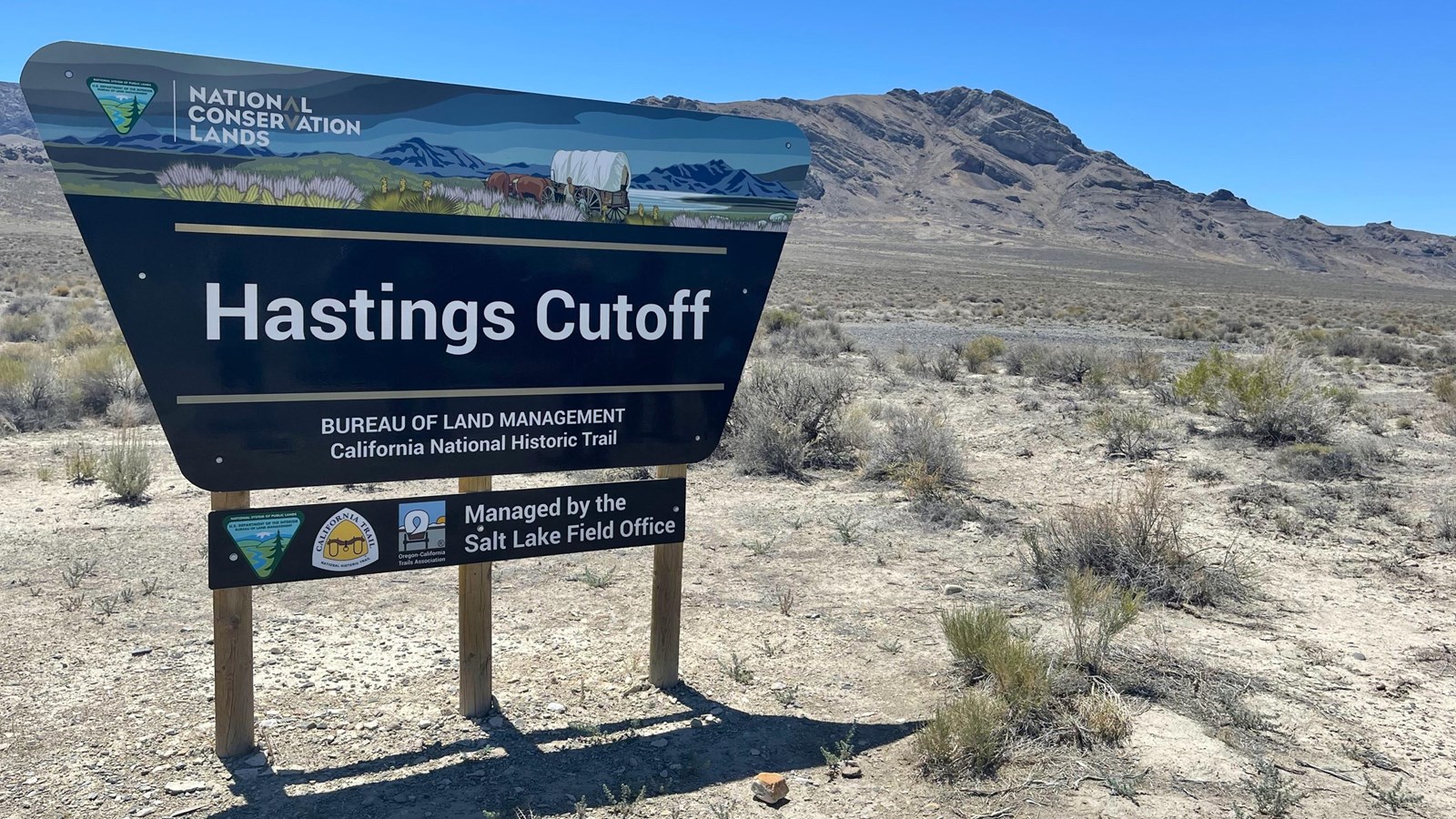
Photo/L. Kreutzer
Quick Facts
Location:
The Hastings Cutoff begins at Fort Bridger State Historic Site in southwest Wyoming (GPS 41.317828 -110.392667), goes through Salt Lake City, Utah, and ends at the Humboldt River about 8 miles southwest of Elko, Nevada (GPS 40.749315 -115.937684).
Significance:
The Hastings Cutoff is historically significant as a route used by early pioneers traveling to California and Utah. The Donner-Reed Party opened a section of the cutoff through the Wasatch Mountains in 1846, Mormon pioneers used the trail on their way to and from the Salt Lake Valley in 1847-1869, and the Pony Express used this route into the valley in 1860-1861.
Designation:
Historic site on the Mormon Pioneer, Pony Express, and California NHTs.
Amenities
8 listed
Benches/Seating, Cellular Signal, Historical/Interpretive Information/Exhibits, Information - Ranger/Staff Member Present, Parking - Auto, Picnic Table, Restroom, Wheelchair Accessible
In 1844, the sparsely populated province of Alta California belonged to Mexico. Lansford W. Hastings, a young American with political ambitions, set out to change that.
If enough Americans settled in California, he reasoned, their numbers and stubborn independence might leverage Mexico to give up its far-flung territory—not to expand the United States, but to establish an entirely new nation. Hastings himself, he imagined, would hold high office in the proud new Republic of California.
To attract settlers, 26-year-old Hastings published the Emigrants’ Guide to Oregon and California (1845), where he noted a possible shorter route to California. Instead of looping north on the established trail to Fort Hall (Idaho), emigrants might turn southwest from Fort Bridger, cross the desert west of the Great Salt Lake, and rejoin the trail at the Humboldt River in northeastern Nevada. This cutoff, he estimated, could save 300 to 400 miles of travel. He’d never been that way, but it made sense on maps.
In spring 1846, Hastings started east from California with a party of horsemen led by mountaineer James Clyman. Over Clyman’s objections, Hastings insisted they leave the trail to explore his “shortcut” across the salt flats west of the Great Salt Lake. The riders crossed the desert, which Clyman called “the most desolate country perhaps on the whole globe,” in about 30 thirsty hours. Ox-drawn wagons would take 3 days. Undiscouraged, Hastings made up his mind to divert the oncoming emigration onto his untried cutoff.
In mid-July, Hastings and partner James Hudspeth led a party of mule packers and 2 wagon trains out of Fort Bridger toward the Great Salt Lake. A third wagon train, the Donner-Reed Party, followed their track 11 days later, despite Clyman’s warning to stay on the established trail. The first 3 groups safely reached California. The Donner-Reed Party, delayed by troubles along the way, famously became snowbound in the Sierra Nevada.
The next year, Brigham Young’s vanguard of Latter-day Saints improved the wagon track into the Salt Lake Valley and established Salt Lake City. Some 70,000 Mormon pioneers followed the Hastings Cutoff to the valley in 1847-1869, as did the Pony Express in 1860-61. Gold-seekers thronged the cutoff in 1849-1850, but the “shortcut” turned out to be over 100 miles longer than the original California Trail. Reports of great suffering on the salt desert crossing caused emigrants to abandon the Hastings Cutoff in favor of other trails to California. Meanwhile, Lansford Hastings’s personal ambitions were thwarted when US military intervention brought California into the American union.
To learn more, go to Places to Go - California National Historic Trail (U.S. National Park Service). The Hastings Cutoff starts at the southwestern corner of Wyoming, crosses south of the Great Salt Lake, and rejoins the primary trail at the Humboldt River near Elko, Nevada. Click the buttons on the trail line for information about sites to visit.
Site Information
Location (The Hastings Cutoff begins at Fort Bridger State Historic Site in southwest Wyoming (GPS 41.317828 -110.392667), goes through Salt Lake City, Utah, and ends at the Humboldt River about 8 miles southwest of Elko, Nevada (GPS 40.749315 -115.937684).)