


Last updated: September 15, 2026
Place
100th Meridian - Nebraska
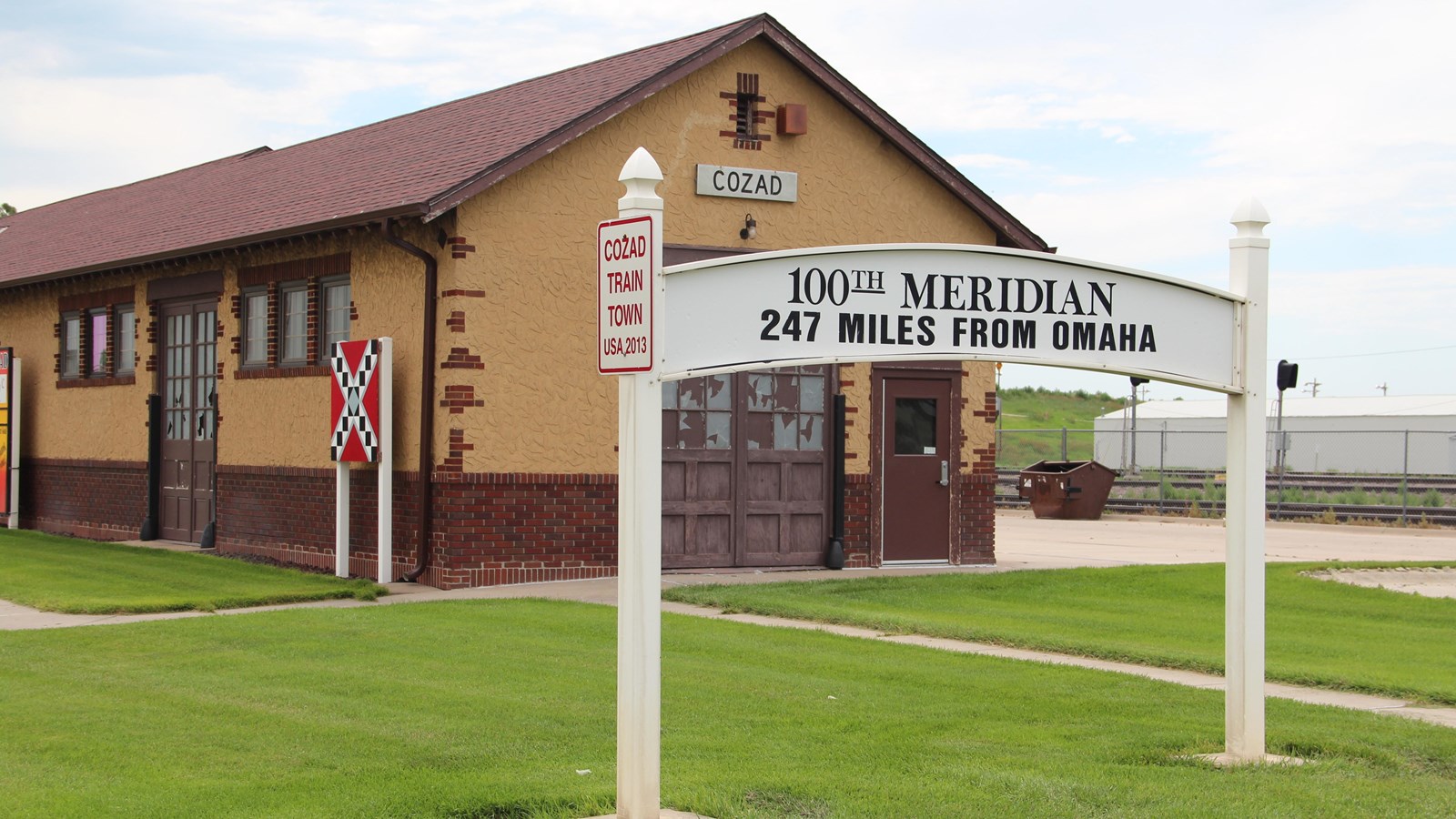
Photo/L. Kreutzer
Quick Facts
Location:
101-199 Lincoln Hwy (US 30), Cozad, Dawson County, Nebraska. GPS 40.856950 -99.98501
Significance:
The 100th Meridian marks the transition from the humid Eastern climate to the arid West. Here, trail travelers left the tallgrass prairie and entered the Great Plains.
Designation:
Historic site on the California, Mormon Pioneer, Oregon, and Pony Express NHTs.
MANAGED BY:
Private
Amenities
3 listed
Cellular Signal, Historical/Interpretive Information/Exhibits, Parking - Auto
Few emigrants realized they had crossed a significant line of longitude, the 100th Meridian, as they plodded up the Platte River through Central Nebraska. That unseen line, though, marked an important change in their journey: it heralded their entry into the arid West.
Part of a system of geographical coordinates established for navigation, lines of longitude, or meridians, run between the North and South poles. Together with east/west lines of latitude circling the globe, they create a theoretical grid system that can be used to describe the exact location of any place on earth. The 100th Meridian—the 100th longitudinal line west of Greenwich—passes through the United States from Texas through North Dakota, crossing the little trail town of Cozad, NE, along the way. That meridian at Cozad, by coincidence, also happens to be where humid East transitions into dry West.
West of the line, prairie tallgrass and cornfields give way to sagebrush steppe and ranchlands. Warm air loses its burden of moisture, turning dry. Emigrants no longer would need to shake morning dew from their canvas tents, and pioneer women would not have to start each day’s trek with their skirts soaked from wet grass. Travelers would begin seeing more bison—thousands, perhaps tens of thousands of the shaggy beasts in a single herd—as well as graceful, bounding pronghorn and vast “towns” of barking prairie dogs. Soon, too, overlanders would find themselves plagued by alkali dust kicked up by livestock and wagons, a torment that would accompany them until they reached the Sierra or Cascade Mountains.
The 100th Meridian also became a goal line, of sorts, as workers at Omaha began laying rail for the first transcontinental railroad in 1865. Reaching that invisible line was the Union Pacific’s first major objective, and the rails met that mark on Oct. 5, 1866. Three weeks later, the first passenger train west of the Missouri River hauled 250 dignitaries across the prairie to celebrate the engineering feat on-site. Today a Daughters of the American Revolution (DAR) monument and a Nebraska state historical sign mark that notable location at Cozad.
Site Information
Location (101-199 Lincoln Hwy (US 30), Cozad, Dawson County, Nebraska. GPS 40.856950 -99.98501)