



Last updated: May 19, 2026
Place
South Pass
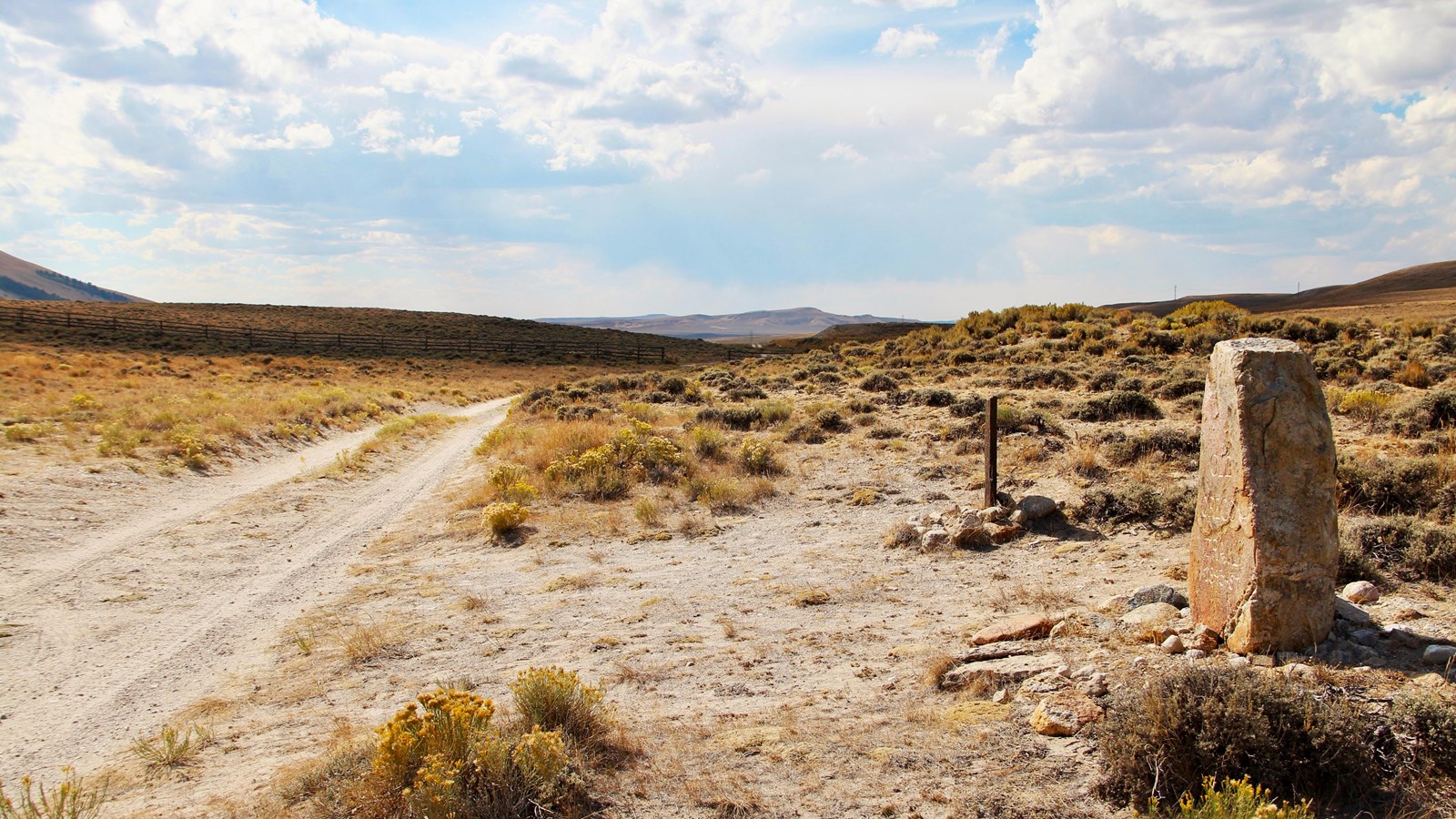
Photo/L. Kreutzer
Quick Facts
Location:
Approximately 35 mi southwest of Lander, Wyoming on Emigrant Trail (road), 1.3 mi west of Oregon Buttes Rd.
Significance:
Between 1840 and 1869, an estimated half-million overland emigrants crossed South Pass, “Gateway to the Continent,” to reach Oregon, California, Utah, and other destinations in the far West. By providing an easy crossing of the Continental Divide, South Pass made the overland emigration possible and enabled the United States to expand from coast to coast.
Designation:
National Historic Landmark; Historic site on the Oregon, California, Mormon Pioneer, and Pony Express NHTs.
MANAGED BY:
Amenities
2 listed
Historical/Interpretive Information/Exhibits, Scenic View/Photo Spot
South Pass is the most historically significant feature along the 2,000-mile length of the Oregon, California, Mormon Pioneer, and Pony Express trail corridor. This gently ascending, 20-mile-wide gap in the Rocky Mountains allowed wheeled vehicles—wagons, handcarts, and stagecoaches—easy passage over the granite spine of the Continental Divide. Between 1840 and 1869, as many as 500,000 emigrants funneled over the 7,440-foot-elevation pass to reach destinations in the far West. That emigration helped to make the United States a continental nation stretching from coast to coast.
Native Americans had known and used the pass, located south of the Wind River Range, for millennia before the arrival of European and American explorers. Having learned of it from tribesmen, white fur trappers found the pass in 1812, lost the information, and “rediscovered” it in 1824. They called it South Pass because it lay south of the route taken by Lewis and Clark through the rugged northern Rocky Mountains in 1805-1806.
Although countless Native women routinely traversed the Rocky Mountains, 19th Century American society considered white ladies too delicate to make such a rigorous trip. The successful passage of missionaries Narcissa Whitman and Eliza Spalding to the Oregon Country in 1836 proved otherwise. Land-hungry American men now realized that their wives and families could make the trip, too—and beginning in 1840, they did. Emigrants who expected to find wild, rugged scenery at the pass, like that they would encounter farther west in Oregon’s Blue Mountains or California’s Sierra Nevada, were underwhelmed by the windswept treeless plain. “We could hardly believe that we stood upon the dividing ridge between the Atlantic and Pacific oceans,” wrote forty-niner Charles Gould. “It seemed more like rolling prairie.” “[The] road through the pass is very disappointing and not at all romantic,” fretted George McCowen in 1857. “There is nothing in sight to merit the name Rocky Mountains – no rocks, no overhanging precipices, in fact nothing our geography led us to believe was there.”
In the 1860s, the Pony Express, mail and passenger coaches, and the transcontinental telegraph also crossed South Pass. Today’s travelers on WY-28 cross the Continental Divide at a slightly higher elevation about 2 miles north of the old wagon road. A Bureau of Land Management interpretive overlook on the south side of the highway provides a view toward the pass and other landmarks to the east. Look for the road sign to the overlook 5.4 miles southwest of the Sweetwater River rest area.
Site Information
Location (Approximately 35 mi southwest of Lander, Wyoming on Emigrant Trail (road), 1.3 mi west of Oregon Buttes Rd.)
Driving directions to the original historical crossing, where multiple wagon swales are still visible, are provided at the wyohistory.org website. Scroll to the section titled “South Pass and its Monuments.” High clearance vehicles are recommended.
More Site Information
Oregon National Historic Trail
California National Historic Trail
Mormon Pioneer National Historic Trail
Pony Express National Historic Trail
Sources: Bagley, South Pass; Unruh, The Plains Across; Meldahl, Hard Road West; Mcowen/Carpenter 1857 journal; Haines, Historic Sites Along the Oregon Trail; https://www.wyhistory.org/encyclopedia/south-pass; Wyoming State Historic Preservation Office, The Way West: A Historical Context; Charles Ross Parke, Dreams to Dust.