



Last updated: December 12, 2025
Person
Arthur Barlowe
National Park Service
Quick Facts
Significance:
Co-leader of 1584 English expedition to the Outer Banks
Place of Birth:
Unknown
Date of Birth:
Circa 1550
Place of Death:
Unknown
Date of Death:
1620
Place of Burial:
Unknown
One of the two commanders sent to the New World in 1584, Arthur Barlowe provided a detailed report of what happened, giving people past and present a view into this different world. His account provides a window into England’s first steps towards colonization in North America as well as European relations with Native Americans. The voyage led by Philip Amadas and Barlowe taught Europe a great deal about the New World but is the only legacy he left behind.
Arthur Barlowe was born in approximately 1550. No information about him appears until the early 1580s as a gentleman-soldier for Sir Walter Raleigh. Raleigh appointed Barlowe as well as Philip Amadas to lead a voyage to the New World. Their goal was to find land suitable for Raleigh’s planned privateering base. Amadas and Barlowe left England on April 27, 1584. They traveled with two ships and approximately 40 men, heading westward. They were in the Canary Islands by May 10 and by June 10, they had reached the West Indies (Caribbean). From there, the ships travel north and by early July they were off the coast of North Carolina. They made landfall at what is presumed to be Bodie Island (but may have been Ocracoke Island due to distance discrepancies in later editions).
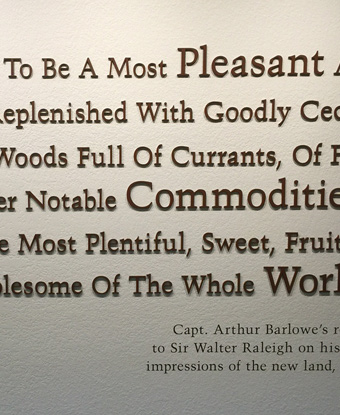
Throughout the voyage, Barlowe kept a record of the voyage and what had happened. This account also detailed the first English encounters with the Roanoc, which occurred three days after arriving in the Outer Banks. Three Roanoc men rowed out to the anchored boats in a canoe and were invited aboard the ships. Both the English and the Roanoc used this opportunity to trade and learn about the unfamiliar customs of the other. It is very likely that Arthur Barlowe participated in all of this because he wrote this information down for Sir Walter Raleigh. His report of the land was overwhelming positive, writing, “I thinke in all the world the like abundance is not to be found.” The positive reports led to the English selecting Roanoke Island as the site for their 1585 military base.
The men returned to England with two Native Americans: Manteo of the Croatoan and Wanchese of the Roanoc. The arrived in mid-September 1584. After this voyage, there are no known records of his subsequent life. In 1589, Richard Hakluyt published Barlowe’s report as part of a larger work. Arthur Barlowe died in 1620. His written account of the 1584 voyage is the only one, providing valuable resources for both his colleagues in the 1580s and historians studying the voyage today. The information provided by Barlowe led the English to select Roanoke Island for their 1585 base, setting motion the pieces that led to the Lost Colony mystery. Without him or his work, English colonization in North America may have looked very different. His writings also provide a look into the first English and Native American meeting and structure for the future relationship between them. While the man himself has remained relatively obscure, Barlowe’s work is an invaluable resource on early English colonization.