



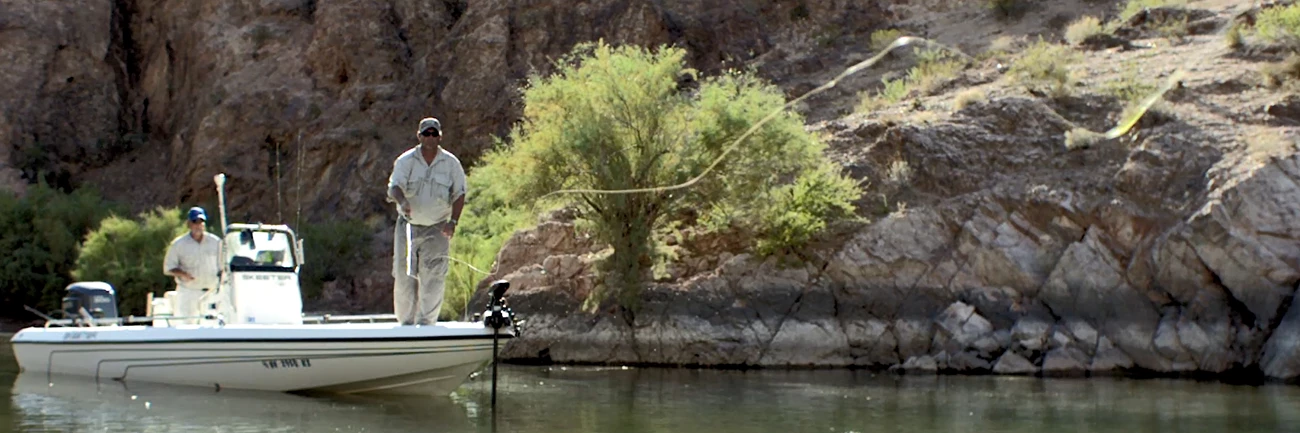
Hook, Line and SinkerFishing is a favorite pastime here at Lake Mead National Recreation Area. With more than 290 square miles of water surface, you can be sure to find a favorite spot to catch the big one. Lake Mead has become famous for its striped bass with an occasional catch weighing in at over 40 pounds. Popular fish include rainbow trout, catfish, sunfish, largemouth bass, striped bass, smallmouth bass and crappie. Rainbow Trout are routinely released near Willow Beach on Fridays. Keep in mind that our park lies within two states and each has their own specific fishing regulations. We have provided information below to help you have a fantastic fishing experience. Common Fishing & Suggested Bait
Fishing Information
Nevada Department of Wildlife - Weekly Fishing Report
Arizona Game & Fish Department - Weekly Fishing Report Fish cleaning stations are located at Hemenway Harbor, Callville Bay, Echo Bay, Temple Bar, Willow Beach, Cottonwood Cove and Katherine Landing. Please dispose of fish guts properly. Please do not place them on the ground or feed them to wild animals. Fishing is allowed 24 hours a day from watercraft, shores or on the park's two fishing piers located at Willow Beach and Katherine Landing on Lake Mohave. You must carry a valid Nevada or Arizona fishing license to fish Lake Mead or Lake Mohave. These can be purchased in nearby towns or at most park marinas. Marina stores also stock fishing supplies and bait. Arizona Game & Fish Dept. Several protected species of fish are found in the Colorado River System. Two of these, the razorback sucker and bonytail chub, may be found in the lakes. If these fish are caught, they should be returned to the water. Please report the catch to the National Park Service Resource Management office at (702) 293-8950. Fishing is not allowed within the posted boundaries of hatcheries, areas immediately above and below Hoover Dam or waters within the flat wake buoys around marinas and harbors. There is no fishing from marina piers. The term underwater spearfishing is defined as fishing by a person swimming or diving and using a mechanical device held in the hand which uses a remember band, spring or pneumatic power to propel a spear to take any type of fish. Bow fishing is defined as fishing or taking of any fish by the means of archery tackle from a boat or from the shore. In Nevada a Fishing License is required for persons 12 or older. The Nevada Department of Wildlife (NDOW) offers an Interstate Boundary Water License for reciprocal waters of the Colorado River, Lake Mead, Lake Mohave, Lake Tahoe, and Topaz Lake. Please see NDOW's website for how to buy a license. NevadaEach person may use only one combination of hook, line and rod at one time. Anglers may have no more than three baited hooks or fly hooks or two lures or plugs used at any one time or on a single line. The fishing line must be closely attended. ArizonaAnglers may have no more than two hooks, or one artificial lure with more than one hook attached, or two artificial flies or lured, attached to the same line or pole. The fishing line must be closely attended. 
|
Last updated: September 16, 2025