



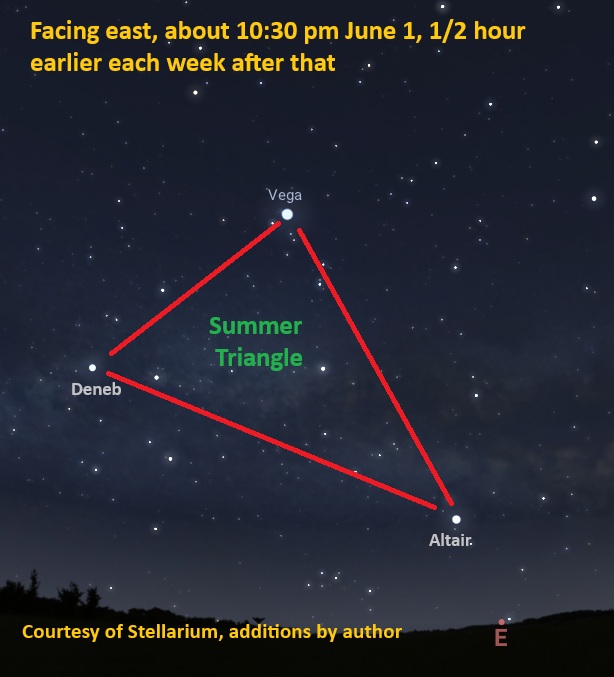
The stars of the Summer Triangle are visible in the late evening as June begins, rising earlier with each passing week. All of the charts on this month’s page are provided by Stellarium, with additions by the author.
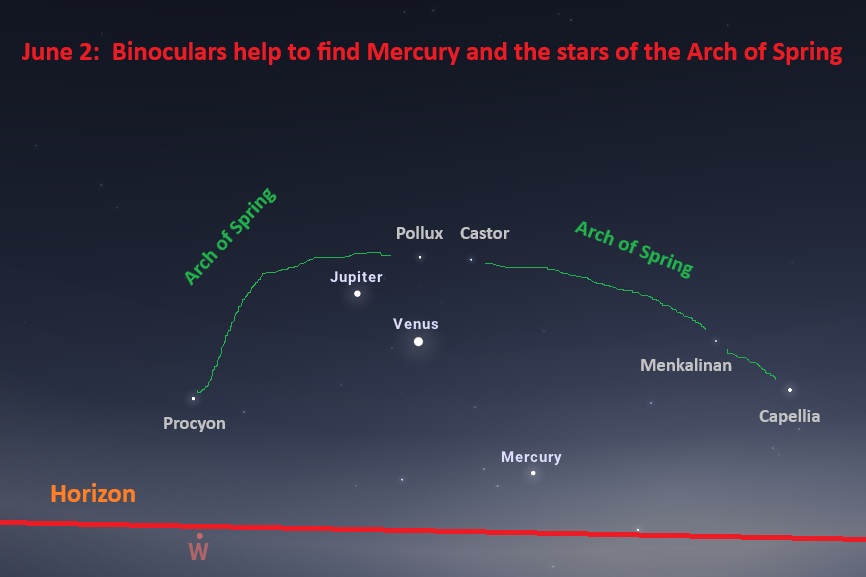
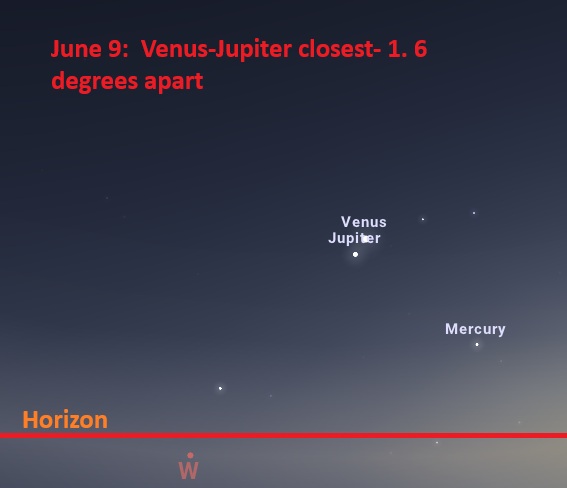
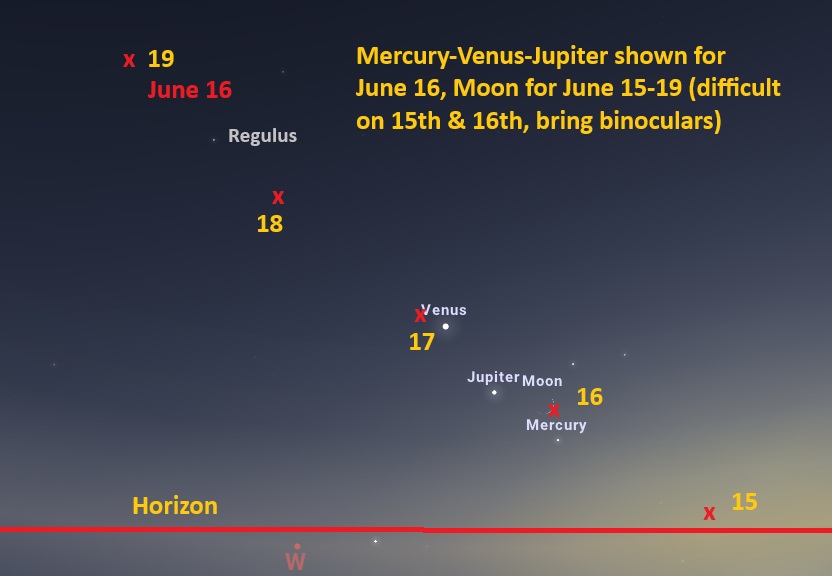
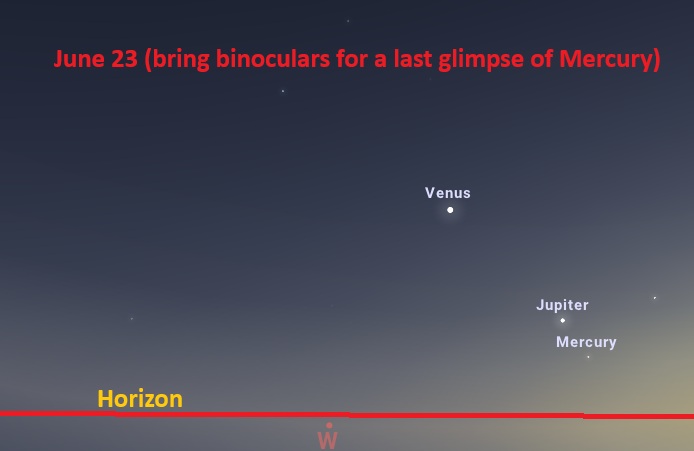
Much more eye catching and more convenient for my readers to look at will be the trio of planets, seen in the west about 45-60 minutes after sunset. Two will be unmistakable- super bright Venus and Jupiter, less so but still immediately obvious. At the beginning of June Jupiter appears to the upper left, but Venus’ faster motion causes it to close in noticeably each night, catching up to Jupiter on the nights of June 8 & 9. On those two nights they will appear just 1.6 degrees, or about three full moon widths apart. Don’t miss this infrequent gathering of our solar system’s two brightest planets! After their closest approach, the two planets will appear to have switched places, with Jupiter appearing ever farther to Venus’ lower right. At the beginning of June, the stars of the “Arch of Spring” are still seen in the vicinity of Venus and Jupiter - see the May 2021 issue of this blog for more information about our celestial namesake. Not as easy but still quite doable is Mercury. To find it you must have an open view down to the west northwestern horizon, and it is helpful to bring binoculars along as our innermost planet is seen against the twilight background. Looking about 45 minutes after sunset (around 9:15 St. Louis time), extend a line from Jupiter through Venus towards the horizon. Scan the area with binoculars - if the night is good and clear and Mercury’s easily seen you should also be able to see it with your unaided eye. Mercury will pass more and more between Earth and Sun as June goes on, turning its lit side away from us and gradually fade. After the moon passes through the area in mid June it will probably need binoculars to be found at all. What date will you last spot it?
If you have enjoyed finding these planets in OUR solar system, what about planets in OTHER solar systems? Come to the Education Classroom at 7 pm on June 20, 2026 to learn about “Planets Around Other Suns.”
Dr. Pamela Gay of the Planetary Institute will discuss what we know about these distant objects. Weather permitting, her free presentation will be followed by telescope viewing of the Moon and other objects on our Entrance Plaza.