



The skies of winter offer more bright stars than at any other season. Most of these stars form a huge asterism (star group) known as the Great Hexagon, which I have discussed before in the March 2021 and March 2023 editions of this blog. This month, I will focus on just one constellation that makes up part of the Hexagon - Auriga, the Charioteer.
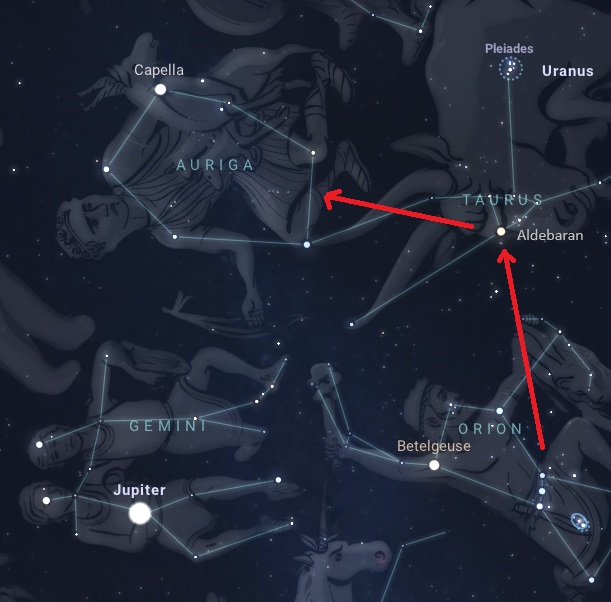
Face east during early January evenings. The stars of Orion’s belt point the way to Aldebaran and to Auriga, the celestial Charioteer. Courtesy of Stellarium, additions by the author.
As can be seen on my map, the best way to find Auriga at this time of year is to draw a line from the three stars of Orion’s belt to Aldebaran, eye of Taurus, the Bull, and then off to the left. The stars of Auriga form a distinct pentagonal pattern that is bright enough to be spotted from light polluted locations, particularly when high in the sky as it is now. Capella, sixth brightest star in the night sky, might have a slightly yellowish white tint to it if you look closely at it with your unaided eyes, more so if you peek at it in binoculars. This indicates that Capella might have a fairly similar temperature to that of our Sun, and it is relatively close to us at 43 light years away, but that is about all that there is in common. When analyzed with a spectroscope, Capella is found to be a quadruple star system made up of two close pairs gravitationally connected. The first pair is made up of two stars only about 70 million miles apart, or ¾ of the Earth’s distance to the Sun. Each member of this pair is about ten times larger than our Sun and about 75 times more luminous. The other pair is made up of cooler red dwarf stars some 10,000 times farther away from the brighter pair. All four combine into the one star that can be seen with the unaided eye or ordinary telescopes.
In Greek mythology, the stars of Auriga are associated with Ericthonius, inventor of the four-horse chariot, which he used in battle to make himself King of ancient Athens. There is also a connection with Myrtilus, who was plagued by suitors seeking his daughter Hippodamia’s hand. Myrtilus sponsored a race to win his daughter and decided to put his thumb on the scales by loaning his chariot to Pelops, his preferred candidate. The most ungrateful Pelops rewarded his new father-in-law by murdering him! As a parent of a popular teenage daughter, I can relate to this story.
Capella itself is associated with the mythological Amalthea, half goat, half human female, who suckled the infant god Zeus. According to this story, the star to the right of Capella on the map and the pair to the lower right make up three young goats, called the Kids, with Capella marking the mother goat. The name Amalthea has also been given to Jupiter’s closest large moon, only visible in very good telescopes. The giant planet itself is easily seen as the brilliant object below Capella in the eastern sky. Next month, I will discuss how you might be able to find as many as six planets in this winter’s sky.
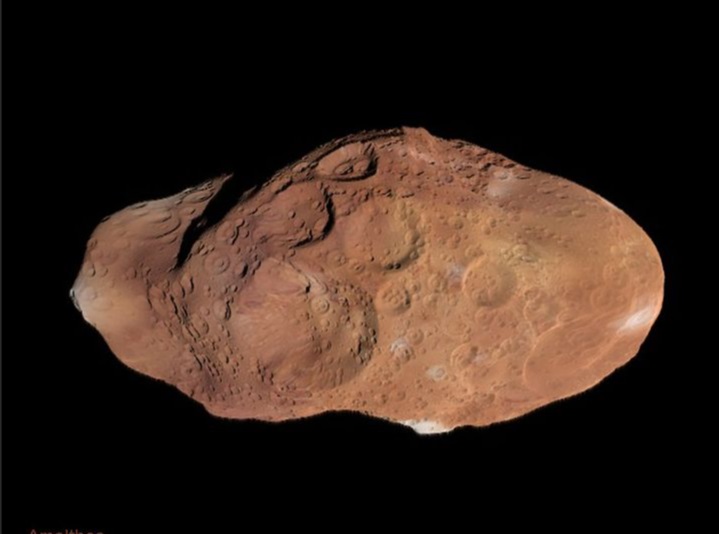 Amalthea, Jupiter’s closest large moon (courtesy of NASA)
The Gateway to the Stars program will be resuming this spring. It will feature monthly educational talks on stargazing or Gateway Arch National Park, followed by telescope viewing on our Entrance Plaza. Tentative dates for 2026 are May 23, June 20, July 18, August 22, September 26, and October 24.