



After a rather quiet fall and early winter, late winter and early spring have featured a number of cool sky events. This month features the two brightest planets, Venus and Jupiter, well up in the west soon after sunset. Venus’ faster motion causes it close in on Jupiter throughout May, on the way to a tight pairing June 7-9. Venus is the lower and brighter of the two this month, as shown on the map below.
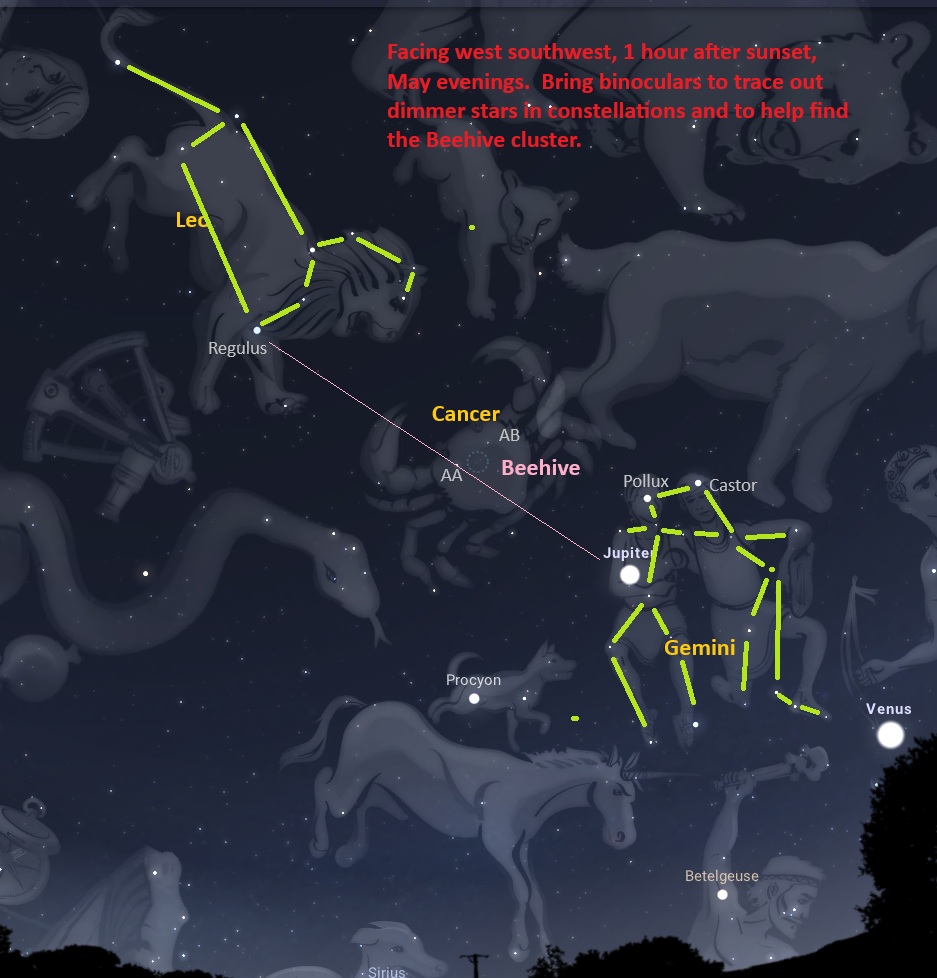
On a clear dark night, it is possible to make out much of the constellation Gemini- two matchstick twins. If you have a lot of city lights, binoculars can help you fill out the pattern. Two bright stars, Pollux and Castor, mark the heads of the famous Twins, although of course they are far outshone by Venus and Jupiter. The next prominent grouping to the upper left of the Twins is Leo - which actually looks slightly like a lion crouching in tall grass. The bright star Regulus is at the end of a distinctive curve of stars that marks the lion’s head, although to me the group looks more like a sickle. A triangle of stars further to the upper left marks the hindquarters and tail of the mighty beast. I focused on the constellation Leo in the June 2025 edition of this blog.
Both Gemini and Leo are famous constellations that are in the zodiac, the path of the Sun in the sky. In between them is the dimmest of the twelve members of the zodiac, Cancer, the Crab. According to Greek mythology, while Hercules was battling the multi-headed Hydra as part of his twelve labors, the goddess Hera sent a crab to further distract him. The crab bit Hercules in the foot, enraging the hero, who stomped on it and killed it. Hera retaliated by placing the crab in the sky, where it could always watch over Hercules, who was placed in the sky himself by King Zeus later on. The main celestial landmark in Cancer is the Praesepe, also known as the Beehive star cluster. It is currently located on a line from Jupiter to Regulus, about 2/5 of the way. Once Jupiter moves off line in the next few weeks, you can use the line from Pollux to Regulus instead. The Beehive is fairly obvious to the naked eye as a dim fuzzy patch from reasonably dark sites but will need binoculars to see from near the city. In mythology, the Beehive was the manger from which two donkeys, the stars marked “AB” (Assellus Borealis, the northern donkey) and “AA” (Assellus Australis, the southern donkey) were feeding. These two stars are quite dim and will need binoculars unless you are viewing from a dark sky site. The Beehive consists of about 1,000 stars of varying ages, of which several dozen can be seen in binoculars or a small telescope, making it one of the better objects to find. Light from the Beehive takes about 590 years to get to your eyes.
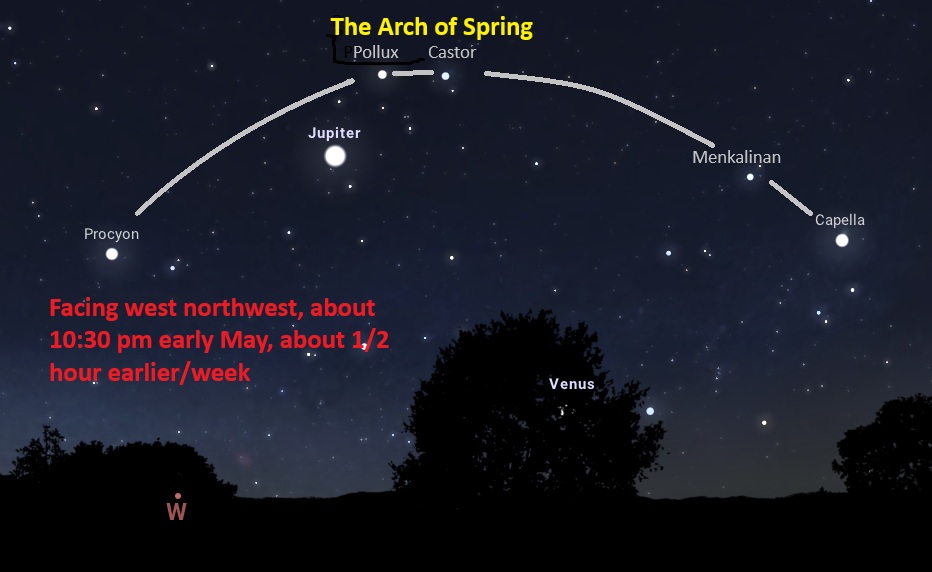
The stars of the Arch of Spring are easily found low in the western skies of May and early June
One final sky landmark that I just can’t pass over is the Arch of Spring. The stars in this large grouping are really holdovers from the winter and stand out in the western skies of May and early June. You might need an open view to the west to pick up the entire Arch. Start with Pollux and Castor above Jupiter, which form the keystone of the low-slung Arch. Jog to the lower right to see Menkalinan and Capella, which form the north leg, and to the lower left for Procyon, to mark the south leg. I have written about the Arch of Spring several times, most completely in May 2021 and May 2025. For some reason we are partial to arches here at Gateway Arch National Park!