To me, the skies of April have a sisterly theme. It starts with Venus, the brilliant starlike object fairly low in the western sky in the early evening. Venus is often termed Earth’s sister planet because it is nearly the same size as Earth and is most often the closest planet to us, although that title is sometimes held by Mercury or Mars. Although farther from Earth than usual during April, at a distance of about 140 million miles, Venus still easily shines as the brightest planet due to receiving a lot of light from the Sun, reflecting it back to Earth very well with its cloudy atmosphere, and being relatively close. With a telescope, Venus shows an almost full, slightly gibbous phase this month. In late summer, Venus will make a dramatic exit from our evening skies as it passes more and more between Earth and Sun, presenting an ever-thinner crescent to us as its lit side increasingly faces the Sun and its dark side faces Earth.
During much of April, look above Venus for what at first glance looks like a tiny silvery cloud. On close inspection, most people can make out five or six individual stars, although those with eagle eyes can glimpse seven. This causes the Pleiades Cluster to often be called the Seven Sisters. This famous cluster is shaped a bit like a tiny dipper but is not THE Little Dipper. The bright star Aldebaran is at one end of the “V” shaped Hyades cluster, nearby.
During April, Earth’s motion around the Sun causes the Pleiades to drop ever lower towards the western horizon during the early evening as they appear on the far side of the Sun. Venus moves faster than the Earth and is able to stay even or even get higher in the sky. Bit by bit, Venus will close in on the Pleiades, appearing most nearly side by side on the night of the 25th. The light from the stars of the Pleiades takes about 445 years to get to your eyes, having left just a little before telescopes were invented. On the other hand, light from Venus currently takes about 12 minutes to make its way towards you.
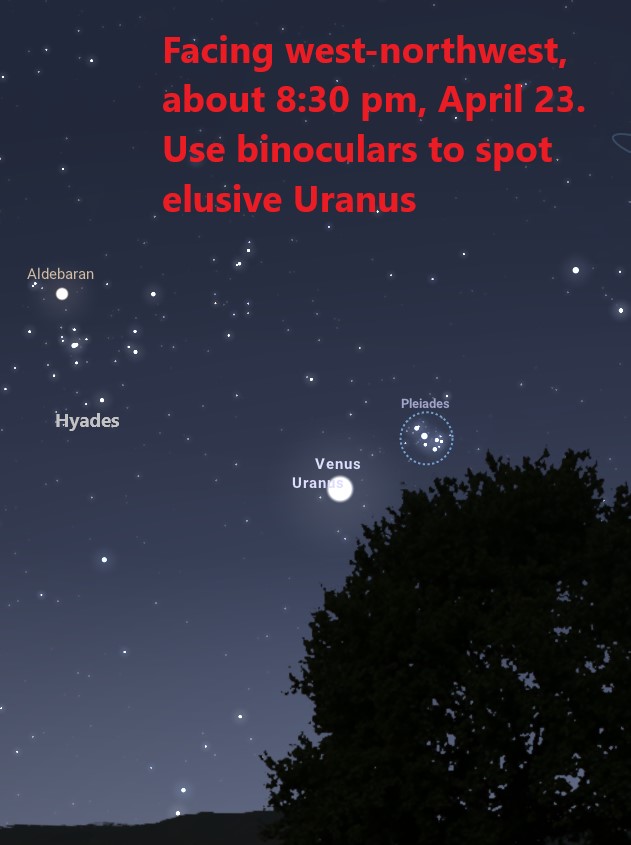
Our Sister planet and the Seven Sisters shine together in April’s western evening skies. Uranus might be spotted in binoculars to the left of brilliant Venus.
Bring out a pair of binoculars to see many more stars in the Pleiades and discern the bluish white color of most of them. As an added bonus, around the 23rd, you may be able to spot distant Uranus as a dim star at about 8 o’clock from Venus in the binoculars. If you have eagle eyes and are viewing from a very dark location, can you possibly spot Uranus without optical aid? I have never done it and think my eyes are too old for it now.
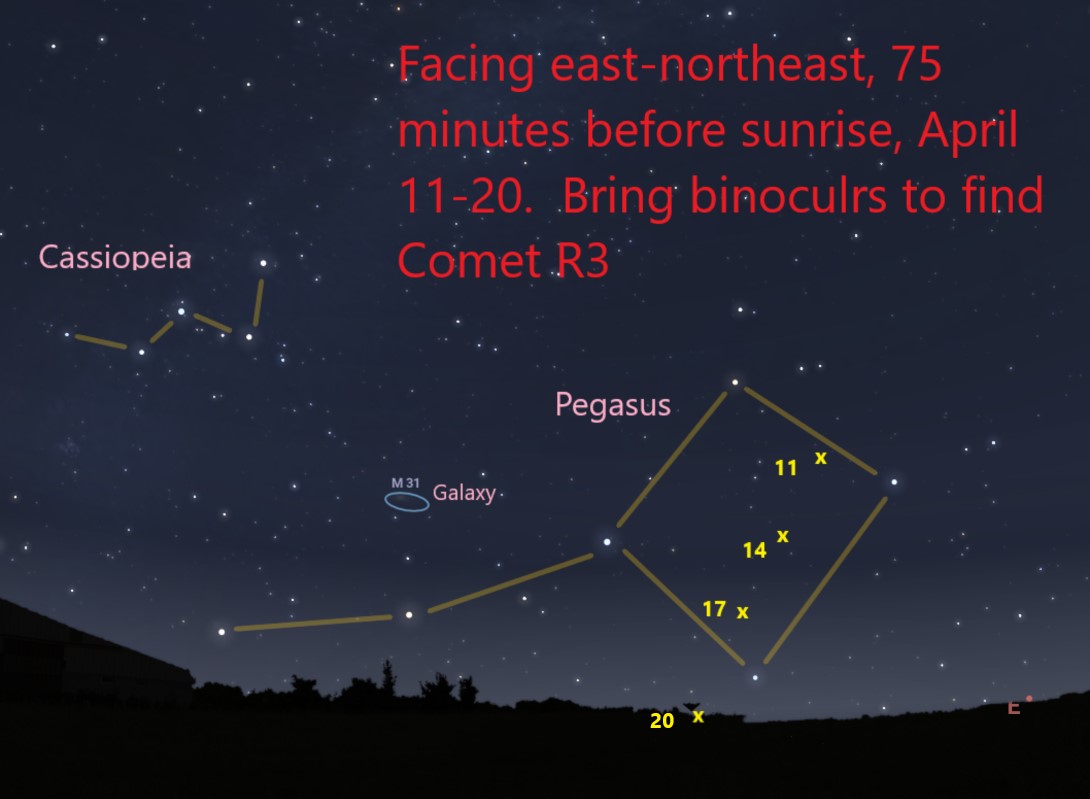
Up until a few days ago, it looked like there was a possibility of seeing sister comets in April’s night skies, but unfortunately Comet MAPS approached too closely to the Sun, and was destroyed by our star’s intense heat and gravity. However, Comet PanSTARRS (designated C/2026 R3) may be visible for those who rise early, use binoculars, have an open view to the eastern horizon, and preferably at least fairly dark skies. Look about 75-90 minutes before sunrise and spot W-shaped Cassiopeia in the northeast and then jog over to the stars of the Great Square of Pegasus. The comet will probably look like a small hazy spot in binoculars- try using your cellphone camera on a night shot setting and perhaps you can record PanSTARRS’ tail. If you have a good enough sky, see if you can find the Andromeda Galaxy nearby. Which one is brighter, the mote of rock, dust and ice about 50 million miles away or the huge galaxy seen clear across 2.5 million light years of space?