Mount Baldy Beach at Indiana Dunes National Park

Mount Baldy closure image showing the comfort station with a sand dune behind it.
Mt Baldy closure sign from late March to mid-June. Image of a parking lot and comfort station bordered by an encroaching sand dune that rises behind the building.

NPS / Jeff Manuszak

Mount Baldy is Closed from Late March to Mid-June

Mount Baldy Access Site Temporary Closure for Sand Management ProjectThe Mount Baldy Access Site will be closed beginning in late March 2026 for several months while the National Park Service carries out an important sand management project at Indiana Dunes National Park. This work will move sand that, in recent years, has buried parts of the Mount Baldy parking area and sanitary infrastructure, and will help protect facilities and maintain long-term visitor access to this iconic site.

What’s happening:

  • Crews will move about 40,000 cubic yards of sand that has accumulated on and around the existing (now buried) parking lot.
  • The sand will be relocated to Crescent Beach in coordination with the U.S. Army Corps of Engineers’ ongoing shoreline stabilization (beach nourishment) efforts.
  • Work is confined to previously disturbed areas and is designed to avoid impacts to undisturbed dune habitat and archaeological resources.
  • The project has undergone appropriate environmental and cultural resource compliance review.

Visitor impacts: Temporary, localized closures will be in place around Mount Baldy during active construction. For safety, the Mount Baldy Access Site will remain closed to the public throughout the project. Crescent Beach may also experience periodic truck traffic and access limitations during sand placement.

We appreciate your patience as we work to protect park infrastructure and maintain visitor access at this much-loved location. Updates will be shared here throughout the project.

Visitor FAQ

Why is the Mount Baldy Access Site closing? The Access Site is temporarily closing so crews can move sand that has buried parts of the parking lot and sanitary infrastructure. Sand accumulation has reached a point where action is necessary to protect park facilities and maintain visitor access.

What exactly is being done?
About 40,000 cubic yards of sand will be moved from and near the buried parking area and relocated to Crescent Beach to support shoreline/beach nourishment efforts.

Will natural dunes or habitat be disturbed?
No impacts to undisturbed dune habitat or archaeological resources are anticipated.

How long will the Mount Baldy Access Site be closed?
Field work begins in late March, with the project expected to wrap up by mid-June, 2026. The Mount Baldy access will remain closed throughout active construction.

Will other areas of the park be affected?
Crescent Beach may have periodic truck traffic and temporary access limitations during sand placement from early April through early June. Traffic control measures will be in place. All other visitor impacts are expected to be localized.

Why is sand being moved to Crescent Beach?
The placed sand supports ongoing shoreline stabilization efforts, also known as beach nourishment, by the U.S. Army Corps of Engineers and helps restore beaches affected by erosion.

Is this in response to recent events?
No. Sand has been steadily deposited onto the parking area over the past decade influenced by past development. This project addresses that accumulated buildup.

How can I stay updated?
Follow Indiana Dunes National Park on social media for updates, photos, and project progress as work continues.

 
Mount Baldy

NPS Collection


Loading weather forecast...


Parking and Hours

Parking Lot

Mt. Baldy

  • 92 total spaces
  • 3 oversized spaces
  • 41.706852, -86.929907

Live Status

The parking lot is paved, and restroom and potable water facilities are located on site. The beach is located 0.33 miles from the parking lot via a rustic sandy trail. An entrance pass, annual pass, or lifetime is needed to park in this lot. Visit https://www.nps.gov/indu/planyourvisit/fees.htm for more information.


Getting There
Mount Baldy Parking Lot
101 Rice Street (U.S. Highway 12), Michigan City, IN 46360

Need to Know

  • Facilities – Year-round restrooms and potable water.
  • Prohibited – Glass and fires on the beach, littering.
  • Prohibited – Removing plants, rocks, shells, and fossils.
  • Parking lot is paved.
  • There is a picnic shelter and two additional picnic tables at the parking lot. First come, first served. No advance reservations.

Safety

  • Please stay on the trail and respect closed area signs. Going off trail damages fragile habitat.
  • Ticks are present year-round. Take precautionary measures to prevent bites.
  • Poison ivy can be present on the edges of the parking lot and on the trails to the beach.
  • In case of an emergency or to report a crime, call 1-800-PARK-TIP.

Accessibility

  • The beach and picnic shelter are not wheelchair accessible. The picnic tables and restrooms are wheelchair accessible.


Visitor Activities
  • Swimming. No lifeguards. Swim at your own risk; rip currents and waves can make swimming hazardous.
  • Hiking. Mount Baldy Summit Trail. Restricted Access. Access to the Mount Baldy Summit Trail requires accompaniment by authorized staff. There are ranger-led daytime and sunset hikes on weekends in the summer. Hike dates and times are listed in the park's newspaper The Singing Sands, on the park's website calendar, and the park's Facebook page.

Nearby Beaches


Interesting Facts

  • Mount Baldy is 126 above the water level of Lake Michigan.
  • Mount Baldy is moving 5-10 feet a year. Beach sand moves when the prevailing northwest wind exceeds 7 mph.
  • Mount Baldy is 'starving'. Beach erosion is taking away more sand than the waves are bringing in due to the breakwall that was built for the Michigan City Harbor. To try and correct the effect of the breakwall the U.S. Army Corps of Engineers began feeding the beach in 1974. Thus far they have given it four meals:
    • 1974 fine sand trucked in.
    • 1983 coarse sand trucked in.
    • 1996 early summer 35,000 cubic yards slurried in by pipe from the harbor.
    • 1996 late summer 50,000 cubic yards trucked in.
 
 
Rip Tides Poster

Rip Currents:

Be on the lookout this summer for rip currents on Lake Michigan.

Before your next visit to the beach, learn how to spot a rip current and what to do if you get caught in one. Always check the local beach forecast for any warnings, and exercise caution.

IF CAUGHT IN A RIP CURRENT

♦ Don't fight the current
♦ Swim out of the current, then to shore
♦ If you can't escape, float or tread water
♦ If you need help, call or wave for assistance

SAFETY

♦ Know how to swim
♦ Never swim alone
♦ If in doubt, don't go out
More information about rip currents can be found at the following websites: www.ripcurrents.noaa.gov and www.usla.org

 
Infographic explaining to flip, float, and follow when drowning.

Drowning? Flip, Float, and Follow

“Flip, Float, and Follow,” is a campaign and drowning survival technique by Great Lakes Surf Rescue Project to help people remember how to successfully escape a variety of drowning accidents in the Great Lakes such as rip currents, long-shore currents, and structural currents.

1️⃣FLIP: Flip over onto your back and float.

2️⃣FLOAT: Float to: keep head above water; calm yourself down, and conserve energy.

3️⃣FOLLOW: Follow the safest course to safety: do not fight current; follow current to assess which way it's flowing. Swim perpendicular to the flow. If too tired to swim, continue floating and try to signal for help.

 
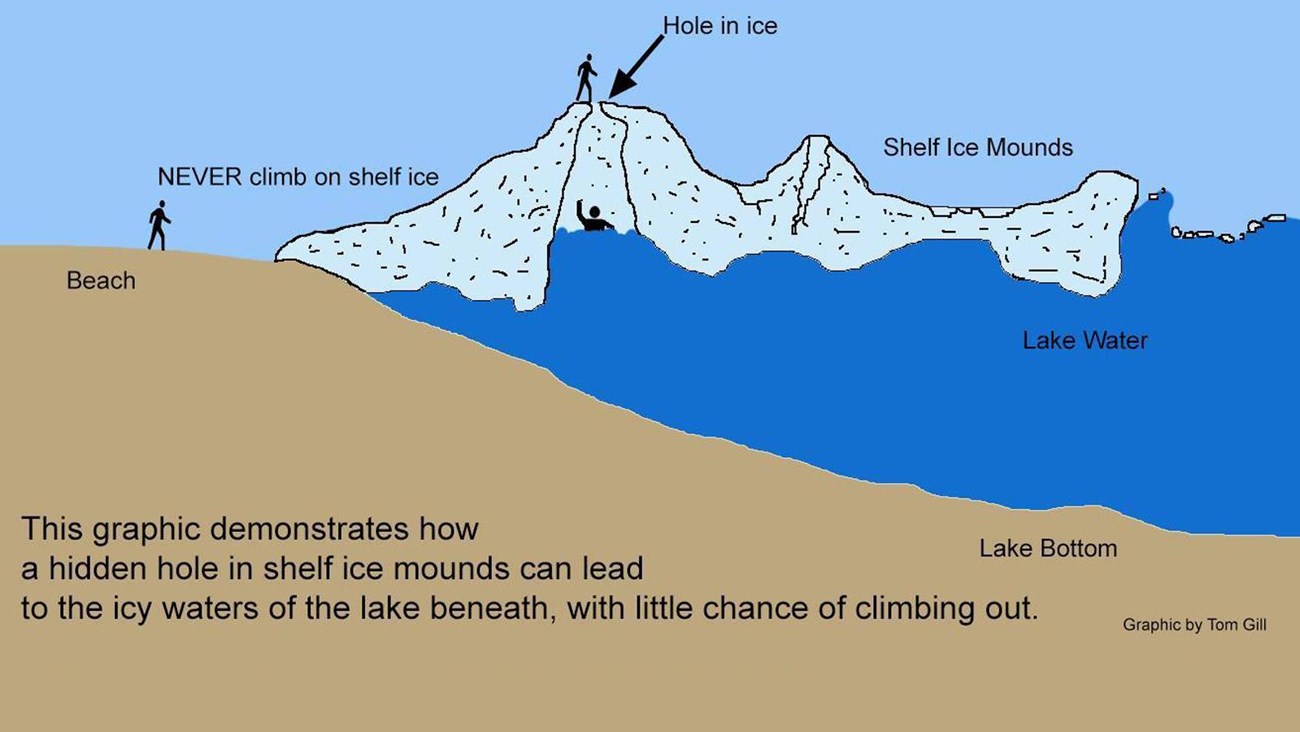
The Dangers of Shelf Ice

Stay off the shelf ice! Despite its unusual beauty, don't risk your life. Enjoy the view of the shelf ice—from a distance!

Park footer

Contact Info

Mailing Address:

1100 North Mineral Springs Road
Porter, IN 46304

Phone:

219 395-1882
Indiana Dunes Visitor Center phone number.

Contact Us