



Family tradition states that the Adamses used this tool to cast musket balls during the American Revolution.
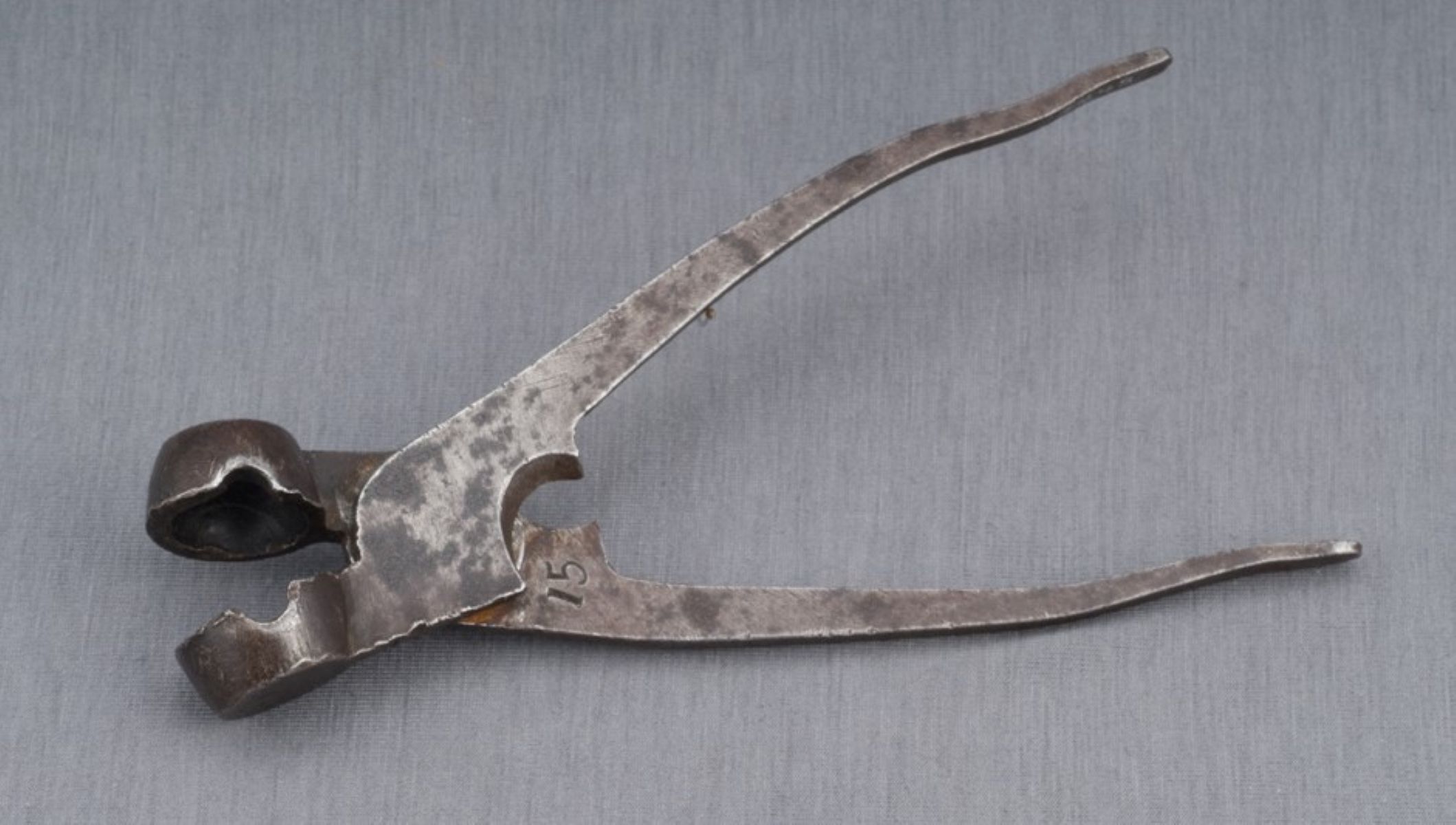
This bullet mold is made of iron and is shaped like a pair of pliers. The mold has two handles that connect at a center hinge. The hinge opens and closes a hollow spherical tip. The number “15” is debossed into one of the handles but its meaning is unclear. The interior of the mold is about 20mm in diameter.1 A cutter is just below the hinge point to snip excess metal off the ball after casting. The edges of the mold are jagged and damaged near the tip, showing signs of use – likely from tapping on a hard surface to get the musket ball to release from the mold.
During the American Revolution, soldiers and colonists created their own bullets using molds like this one.2 This painstaking process called hand casting produced only one bullet at a time.3 The process began by melting metal objects in a cauldron hung over a roaring fire. With few options for raw materials, families like the Adamses used old pewter dishes, cups, or tableware.4 When the pewter was fully liquified, the plier-shaped mold was warmed so the metal alloy did not immediately crack inside. Then, the molten pewter was carefully spooned into the mold. Once it cooled and set, the ball released from the spherical tip by tapping the edge on a hard surface. Any remaining metal fragments, called sprues, would be trimmed off using the cutter.5 Hand casting did not produce perfect spheres but it provided simple and accessible ammunition for soldiers and citizens alike.6 Most of what we know about this bullet mold comes from the writings of John Quincy Adams.7 In 1813, a 45-year-old John Quincy wrote a letter to his brother Thomas Bolyston. In the letter, John Quincy remembered “the melting of pewter spoons in our house into bullets.” According to John Quincy, this happened soon after the battles of Lexington and Concord in 1775.8
Fourteen years later, an elderly man named Cary visited President John Quincy Adams and brought back childhood memories:
Cary asked me if I remembered a Company of Militia, who about the time of the Battle of Lexington in 1775 came down from Bridgwater, and passed the Night at my father’s house and barn at the foot of Penn’s Hill; and in the midst of whom, my father placed me, then a boy between seven and eight years, and I went through the manual exercise of the musket, by word of command from one of them— I told him I remembered it as distinctly as if it had been last week— He said he was one of that company. - Diary of John Quincy Adams, August 20, 1827.9
Although John Quincy’s diary entry remarks on practicing shooting with the militia, he does not mention making bullets like in his 1813 letter to his brother. As a result, we cannot know for sure the history of this object. How did the Adamses use this bullet mold? When was it purchased and by whom? What was the Adams Farm like in the weeks following Lexington and Concord?10 Regardless of the questions that remain, we do know that the Adams family cherished this item for generations. It continues to be a symbol of their family’s patriotism and industriousness during the American Revolution.
Dimensions: The bullet mold is 16 cm long and 3.8 cm across at the handles’ widest point. The closed tip is 2.5 cm wide.
1. National Park Service, “Historic Furnishings report: The Birthplaces of Presidents John Adams and John Quincy Adams.” Vol I. Adams National Historical Park. April 2001, 175.
According to James L. Kochan: The musket balls produced by this mold would have been too small for the common smoothbore muskets used by soldiers at the time. It is unlikely that the Adamses used this mold to hand cast bullets for soldiers but rather produce ammunition for their own firearm.
2. Carey P. McCord, “Wares Manufactured in the American Colonies (1600-1775).” Journal of Occupational Medicine 15, no. 12 (1973): 981.
Weapons and ammunition were hard to come by during the American Revolution. McCord writes that the issue was not supply but the infrastructure needed to gather and transport existing weaponry.
3. N.A. Roberts, J. W. Brown, B. Hammett, and P. D. F. Kingston. “A Detailed Study of the Effectiveness and Capabilities of 18th Century Musketry on the Battlefield.” Journal of Conflict Archaeology 4, no. 1/2 (2008): 6.
4. John Quincy Adams to Thomas Bolyston Adams, 3 April 1813, in Worthington Chauncey Ford, Writings of John Quincy Adams, New York, 1913–1917; 7 vol., 4: 460–463.
5. Vermont State Historic Sites, “Mount Independence Revolutionary War Artifacts: Musket Balls.” February 27, 2024.
6. Roberts, Brown, Hammett, & Kingston, 6.
7. Abigail Adams to Edward Dilly, May 22, 1775. Massachusetts Historical Society, Adams Papers Digital Edition.
Abigail Adams never directly mentioned the bullet mold but did remark on the soldiers marching down Old Coast Road. A little over a month after the battles of Lexington and Concord, Abigail wrote: “Now this very day, and whilst I set writing the Soldiers provincial are passing my windows upon an allarm [sic] from the British troops... Each party are now in actual engagement."
8. Worthington Chauncey Ford, Writings of John Quincy Adams, 460-63.
9. John Quincy Adams, 20 August 1827, entry, The John Quincy Adams Digital Diary, published in the Primary Source Cooperative at the Massachusetts Historical Society.
10. National Park Service, “NPS Discovers Nearly 250-Year-Old Musket Balls from ‘Shot Heard Round the World.’” Minute Man National Historical Park. July 9, 2024.
Although we don’t know much about the musket balls produced by this mold, we do know a bit about musket balls used during the battle of Concord in 1775. Five musket balls were found two years ago during an archeological dig at Minute Man National Historical Park. These musket balls were believed to have been fired from both British and American soldiers.