



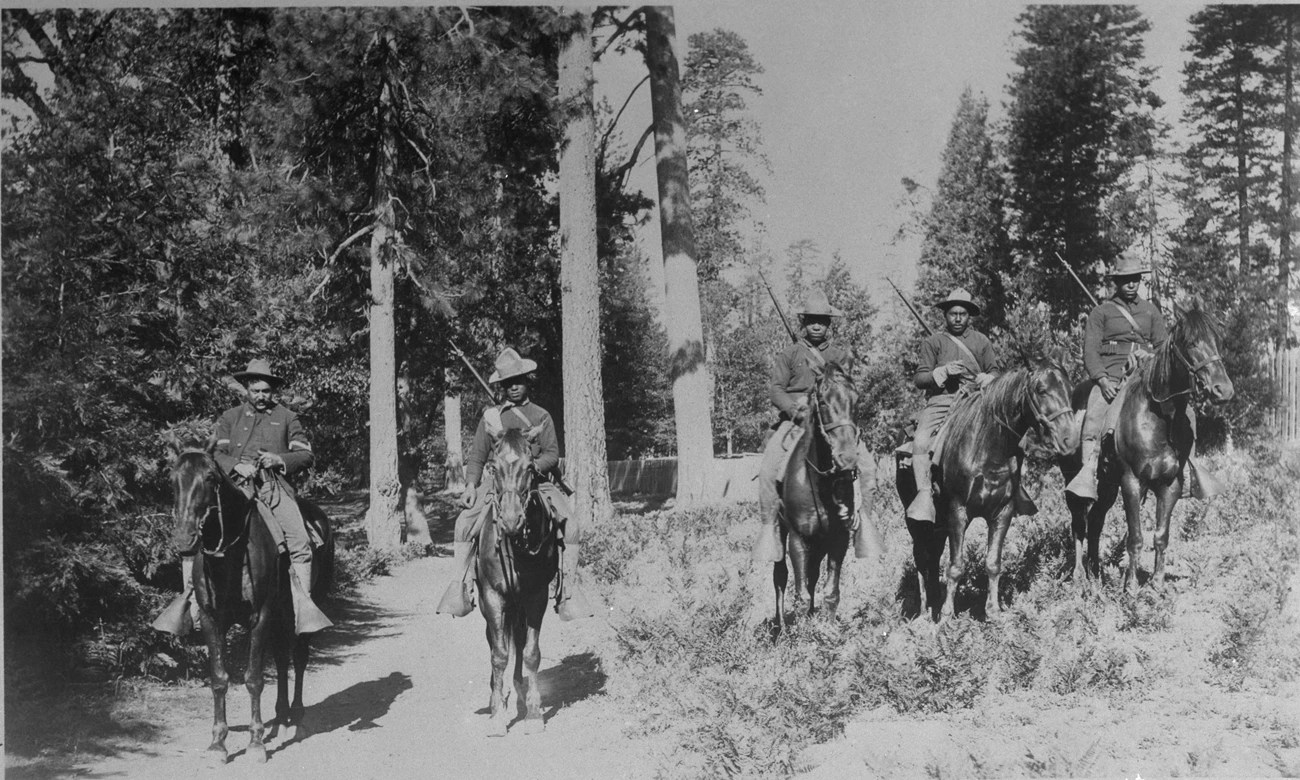

Buffalo Soldiers, like their white counterparts in U.S. Army regiments, were among the first park rangers, in general, and backcountry rangers, in particular, patrolling parts of the West. African-American army regiments, formed just after the Civil War, had been dispatched westward where these black soldiers fought in the Indian Wars and were eventually given the name Buffalo Soldiers by the Cheyenne and other Plains Indians who saw a resemblance between their dark, curly hair and the matted cushion between the horns of the buffalo. Congress, in 1866, created six segregated regiments which were soon consolidated into four black regiments: the 9th and 10th Cavalry and the 24th and 25th Infantry. Historians have recorded the service of these Buffalo Soldiers on the Western frontier, but their service in some national parks has been nearly forgotten. Approximately 500 Buffalo Soldiers served in Yosemite National Park and nearby Sequoia National Park with duties from evicting poachers and timber thieves to extinguishing forest fires. Their noteworthy accomplishments were made despite the added burden of racism. As background, the U.S. Army served as the official administrator of Yosemite and Sequoia national parks between 1891 and 1913, and, in that capacity, it helped create a model for park management as we know it today. These army troops were garrisoned at the Presidio of San Francisco during the winter months and served in the Sierra only during the summer months. 
© Simon Griffiths This arrangement was an unusual duty for troops and greatly prized by army men with one army officer referring to the Sierra Nevada as the "Cavalryman's Paradise." Commanding officers became acting military superintendents for these national parks with two troops of cavalry, normally, assigned to each park. Each troop would be made up of approximately 60 men. The troops essentially comprised a roving economy-infusing money into park and local businesses-and thus their presence was generally welcomed. The presence of these soldiers as official stewards of park lands brought a sense of law and order to the mountain wilderness. The hidden chapter of this U.S. Army history revolves around the participation of African-American troops of the 24th Infantry and 9th Cavalry, who protected both Yosemite and Sequoia national parks in 1899, 1903, and 1904. (The parks are located approximately 150 miles apart.) Most of these men were veterans of the Spanish-American War and the Philippine-American War in which they were called "Smoked Yankees." Many of them enlisted in the South where opportunities for African-Americans were limited to sharecropping, and other labor intensive work. Even though the Buffalo Soldiers wore the uniform of the U.S. Army, their ethnicity combined with the racial prejudice of the time made the performance of their duties quite challenging. In the early 1900s, African-Americans were routinely abused, or even killed, for the slightest perceived offense. They occupied one of the lowest rungs of the social ladder; a fact which served to undercut the authority of any black man who served in any position of power. Yosemite and Sequoia's Buffalo Soldiers had to be simultaneously strong and diplomatic to fulfill the duties of their job but to avoid giving offense. Although officers were mostly Euro-American, an exception to this was Charles Young, the third African-American graduate of the U.S. military academy at West Point. He served as the acting military superintendent of Sequoia National Park in 1903. Although his tenure was brief, it was groundbreaking. Young is considered by some to be the first African-American superintendent of a national park. Most of the men under Young's command in Sequoia, as well as the 9th Cavalry soldiers serving in Yosemite, were Philippine war veterans, but service in the Sierra brought about an astonishing change in geography and function for these battle-weary men. Their duties included confiscating firearms as well as curbing poaching of the park's wildlife, suppressing wildfires, ending illegal grazing of livestock on federal lands, and stopping thefts of timber and other natural objects. They oversaw the construction of roads, trails, and other infrastructure. Their accomplishments included, but by no means were limited to, the completion of the first usable road into Giant Forest and the first trail to the top of Mt. Whitney (the tallest peak in the contiguous United States) in Sequoia National Park in 1903; and the building of an arboretum in Yosemite National Park near the south fork of the Merced River in 1904. One scholar considered the latter area to contain the first marked nature trail in the national park system. Thus, an integral part of that history played by the 500 Buffalo Soldiers, comprising eight troops of cavalry and one company of infantry, will no longer be forgotten. Videos
More Information
List of Associated National Park Service UnitsStewardship RoleOther Historical TiesMore National Park Service Buffalo Soldier Information |

Last updated: September 23, 2025