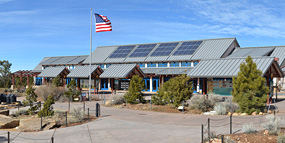
Join the rangers at the Grand Canyon Visitor Center to learn more about people who lived here long ago. Family friendly hands-on activities take place from 10:00 a.m. to 4:00 p.m. (Outdoor activities weather permitting.)
Make clay pinch pots
Make split-twig figurines
"Sift for artifacts"
Create rock art on scratch art paper
Plant a seed
Throw an atlatl
Regularly Scheduled Ranger Programs - Saturday March 23
(With a focus on Archaeology)
10:00 a.m.Rim Nature Walk, at Yavapai Geology Museum - Ty Karlovetz, Park Guide
11:00 a.m.Mather Point Talk, Mather Point Amphitheater - Park Ranger Jennifer Onufer
2:00 p.m. History Talk, Verkamp's Visitor Center - Park Guide Marty Martell
7:30 p.m. Evening Program, Shrine of Ages Auditorium - Park ArchaeologistEllen Brennan,
"My Eyes Were Opened, Historical Memory and the Canyon's Traditionally Associated Tribes."
Listen to the 2013 Archaeology Day Audiocast (2 minutes)
On Saturday, March 23, 2013 Grand Canyon will be hosting its sixth annual Archaeology Day, in honor of Arizona's Archeology and Heritage Awareness Month. Join the rangers to learn more about people who lived here long ago.
10:00 a.m.. Friday, March 22 Museum Collection Tour
View split-twig figurines, pottery types and historic mining cache items. Limit of 12 people. Sign up required at Park Headquarters, 928-638-7888
12:00 p.m. Saturday, March 23: Grand Canyon Visitor Center Theater
Hopi Culture: Traditions of the Past and Present by Ramson Lomatewama, Hopi Tribal Member
Various Times: Saturday, March 23: Grand Canyon Visitor Center
Cultural demonstrations: Navajo Hoop Dance, Navajo weaving, Hopi basket making, Hopi kachina carving, and flint knapping.
Evening Program Saturday, March 23, 2012
Park Archaeologist and Cultural Resources Manager, Ellen Brennan Presents a free evening program takes place in the Shrine of the Ages auditorium at 7:30 p.m.
"My Eyes Were Opened, Historical Memory and the Canyon's Traditionally Associated Tribes."
Shrine of the Ages is located at Parking Lot A near Park Headquarters.
Map shows the location of Grand Canyon Visitor Center (right) where most of the Archaeology Day activities will take place --- The yellow areas with a red letter or numeral show the location of parking lots. It is possible to park in one of the Visitor center lots and ride the free Village Loop Shuttle to the Shrine of Ages, where Archaeology Day evening programs will be held.
Additional Special Evening Programs During March (Arizona Archaeology Month) Shrine of Ages Auditorium: 7:30 p.m.
Sat., March 2 - "Grand Archaeology: Exploration and Discovery Along the Colorado River"
by Allyson Mathis
Sat., March 9 - "A River of Dramatic Change: Lessons from a May 2009 Archaeology River Trip"
by Jennifer Onufer
Sat., March 16 - "Bridging the Gap: Finding the Intersection Between Park Management and Tribal Values"
by Janet Cohen and Jan Balsom
Fri., March 22 - " We're Not Just Surviving, We're Thriving: Native American Ethnobotany"
by AJ Lapre
Sat., March 23 - My Eyes Were Opened: Historical Memory and the Canyon's Traditionally Associated Tribes"
by Ellen Brennan
Why do we celebrate Archaeology Day at Grand Canyon National Park ?
Native people have lived in the Grand Canyon area for thousands of years and have left behind clues about their lives. The oldest artifacts are from the Paleo-Indian period and are nearly 12,000 years old.
Did you know that Grand Canyon has over 4300 archaeological resources with nearly 5% of the park surveyed? This gives us just a glimpse into the vast human history of the area.
What hands-on activities will be happening at Grand Canyon National Park during Archaeology Day?
Hands-on activities for all ages will take place at Grand Canyon Visitor Center from 10 a.m. to 4 p.m. on Saturday, March 23rd.
Join a ranger to make a split-twig figurine, similar to artifacts that have been found in remote caves of the Grand Canyon. These split twig figurines may resemble a deer, or perhaps a bighorn sheep, and are thought to be a hunting talisman.
You could also make a pinch pot out of clay and compare your work to thousand year old pots which were used for cooking, serving or storing food. Obtaining and preparing food used to take a lot more time for people of the past than it does for us today.
If you want to pretend to be a modern archaeologist, you can participate in the artifact sifting activity. When you find bits of evidence, perhaps you can discover what they are and what they were used for.
Discover ancient places within Grand Canyon where people lived long ago. What did the archaeologists find during theses major excavations along the Colorado River ?
Credit / Author:
Tom Bartels
Date created:
2010-12-14
Take a virtual tour
Grand Canyon Archaeology Virtual Tour
Discover ancient places within the canyon where people lived long ago.
What did the archaeologists find during the first major excavation to occur along the Colorado River corridor in nearly 40 years? Interactive 360° photos show archeologists at work.
The River Monitoring Program
generates data regarding the effects of Dam operations on historic properties, identifies ongoing impacts to historic properties within the APE [Area of Potential Effect], and develops and implements remedial measures for treating historic properties subject to damage.
Archeological Excavations at 9 Sites along the Colorado River Corridor
Between 2007 and 2009, the National Park Service, in cooperation with the Museum of Northern Arizona, undertook the first major archeological excavations along the river in Grand Canyon National Park in 40 years.
Archeologists Make Exciting Discoveries Along the Colorado River
In October, 2007, archeologists excavated a habitation site along the Colorado River. The fascinating artifacts they found provide insight into the lives of people who once made the Grand Canyon their home.
Canyon Sketches Vol 03 - May 2008 Archeologists Excavate Kiva by the Colorado River
Archeologists excavated nine archeological sites along the Colorado River because they are being impacted by severe erosion. In April and May 2008, crews discovered a complete kiva during the excavation of one of these sites.
Canyon Sketches Vol 09 - March 2009 Archeologists Excavate Two Sites Along the Colorado River.
In fall 2008, archeologists excavated two archeological sites during a three-year project along the Colorado River corridor in Grand Canyon. One of the excavated sites has evidence of as many as six different human occupations over a time span of 3,500 years.
The Vanishing Treasures Program
Grand Canyon National Park is one of 45 National Park Service areas that participate in the Vanishing Treasures Program. The goal of the Vanishing Treasures program is the conservation of architectural remains through research, documentation, and preservation treatment.
Canyon Sketches Vol 04 – June 2008 Vanishing Treasures Archeologists Stabilize Transept Ruin (North Rim)
In late June 2008, archeologists from Grand Canyon National Park’s Division of Science and Resource Management cleaned and stabilized Transept Ruin, a two-room ancestral Puebloan (Anasazi) ruin on the North Rim.
Did You Know?
President Theodore Roosevelt said of Grand Canyon, "Leave it as it is. The ages have been at work on it, and man can only mar it. What you can do is to keep it for your children, your children's children, and for all who come after you, as one of the great sights which every American should see."