National Park Service LogoU.S. Department of the InteriorNational Park ServiceNational Park Service
National Park Service:  U.S. Department of the InteriorNational Park Service Arrowhead
Cane River National Heritage AreaCane River Lake, Photo by Sonny Carter
view map
text size:largestlargernormal
printer friendly
Cane River National Heritage Area
Nature & Science
 
Children in forest, Photo by John Lees
School children in forest, Photo by John Lees
Natural History

Louisiana is within the Gulf Coastal Plain and is at the end of the extensive Mississippi River system, which drains more than 40% of the continental United States. Natchitoches Parish, in northwestern Louisiana, is part of the greater Red River Valley.
 
Antique Hay Baler operator demonstrates how to make a bale of hay for visitors at the Tractor Event at Oakland Plantation, Photo by NPS
Photo by NPS
Good Soil, Good Farmland

The soils that predominate in the Cane River corridor—Roxana, Gallion, Moreland, Latanier, and Armistead—are considered prime farmland. Based on the Department of Agriculture definition, these soils are best suited to producing food, feed, forage, fiber, and oilseed crops. The red coloring of the soils in the region gave the mighty Red River both its name and its rusty hue.
The agricultural fertility of the soils long played a major role in the region’s development. Soon after the French arrived and constructed Fort St. Jean Baptiste, settlers began clearing the fertile floodplains along the Red River. They laid out their plantations using the French arpent land tenure system—long narrow lots that fronted on and ran perpendicular from the river to the back bayous. Plantation owners acquired many of these arpents to create their large landholdings. They located their plantation homes along the river, set back enough to provide views of the fields, orchards, agricultural buildings, and of course the river.
 
Small flock of Cow Birds dot the landscape within the Heritage Area.
Photo by NPS
Vegetation and Wildlife

Like all of Louisiana, the Cane River region is rich in flora and fauna. The following lists demonstrate some of the ecological variety found in this area. The lists are not meant to be comprehensive—they are designed to give a general overview of the plants and animals found in the region.
 
YCC workers clearing brush at Oakland Plantation, Photo by NPS
Photo by NPS
Agricultural Vegetation

Large and small farming operations have sustained this region for nearly three centuries. A variety of vegetation can be found on farms, although cotton was “king” for much of the region’s history.

Pecan orchards
Cattle pastures
Bermuda Grass
Pensacola bahiagrass
Tall fescue
White clover
Cultivated Crops
Cotton
Corn
Soybeans
Grain sorghum
 
Magnolia Tree and Fence, Photo by NPS
Photo by NPS
Residential Trees

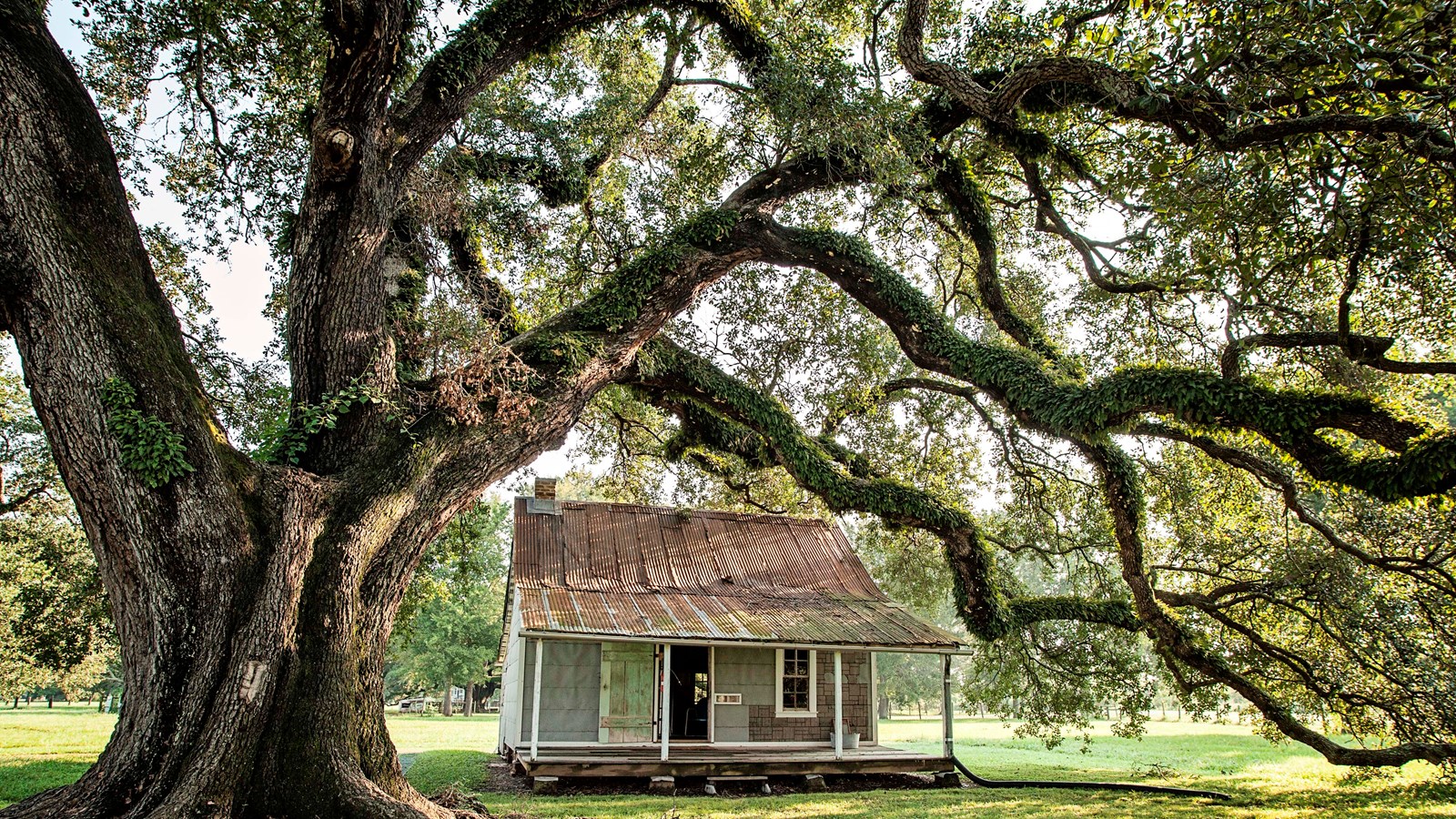
Historically and in the present, plantation homes along Cane River are characterized by majestic oak alleès and fragrant, flowering magnolias. The trees listed below are common near houses large and small in the region.

Live oaks
Osage orange
Southern magnolia
Catalpa
Japanese magnolia
Crepe myrtle
Chinaberry
Plum
Jujube
 
Large catus plant
Photo by NPS
Bottomland Hardwoods

The native bottomland hardwoods and wooded backswamps represent only a small fraction of what once grew within the river valley. Today, less than 10,000 wooded acres remain in the lowlands along the river. The recent establishment of the Red River National Wildlife Refuge will contribute to future conservation of wooded bottomlands.

Water oak
Willow oak
Swamp privet
Water locust
Honey locust
Bitter pecan
Archaeology students shift through dirt from slave-tenant cabin at Magnolia Site, Photo by NPS
Archaeology Students
Archaeology students camped out during their six weeks on-site training.
more...
Oak Allee at Oakland Plantation, Photo by John Lees
Oak Allee
Although the oak allee was originally designed to function as a wind tunnel, its beauty is apparent
more...
Natchitoches National Fish Hatchery raises sport and endangered species, Photo by John Lees
National Fish Hatchery, Photo by John Lees
The facility sits on the site of a historic Caddo village and the aquarium features native species.
more...
Grand Ecore Visitor Center overlooks Red River, Photo by John Lees
Grand Ecore Visitor Center, Photo by John Lees
The facility features exhibits on the natural, cultural history, & remnants of Civil War earthworks.
more...
Wooden Wagon, Photo by NPS  

Did You Know?
National heritage areas such as Cane River National Heritage Area may be developed around a common theme or industry that influenced the culture and history of a region.

Last Updated: January 04, 2007 at 12:21 EST