



Last updated: April 3, 2026
Place
Fort Jesup State Historic Site
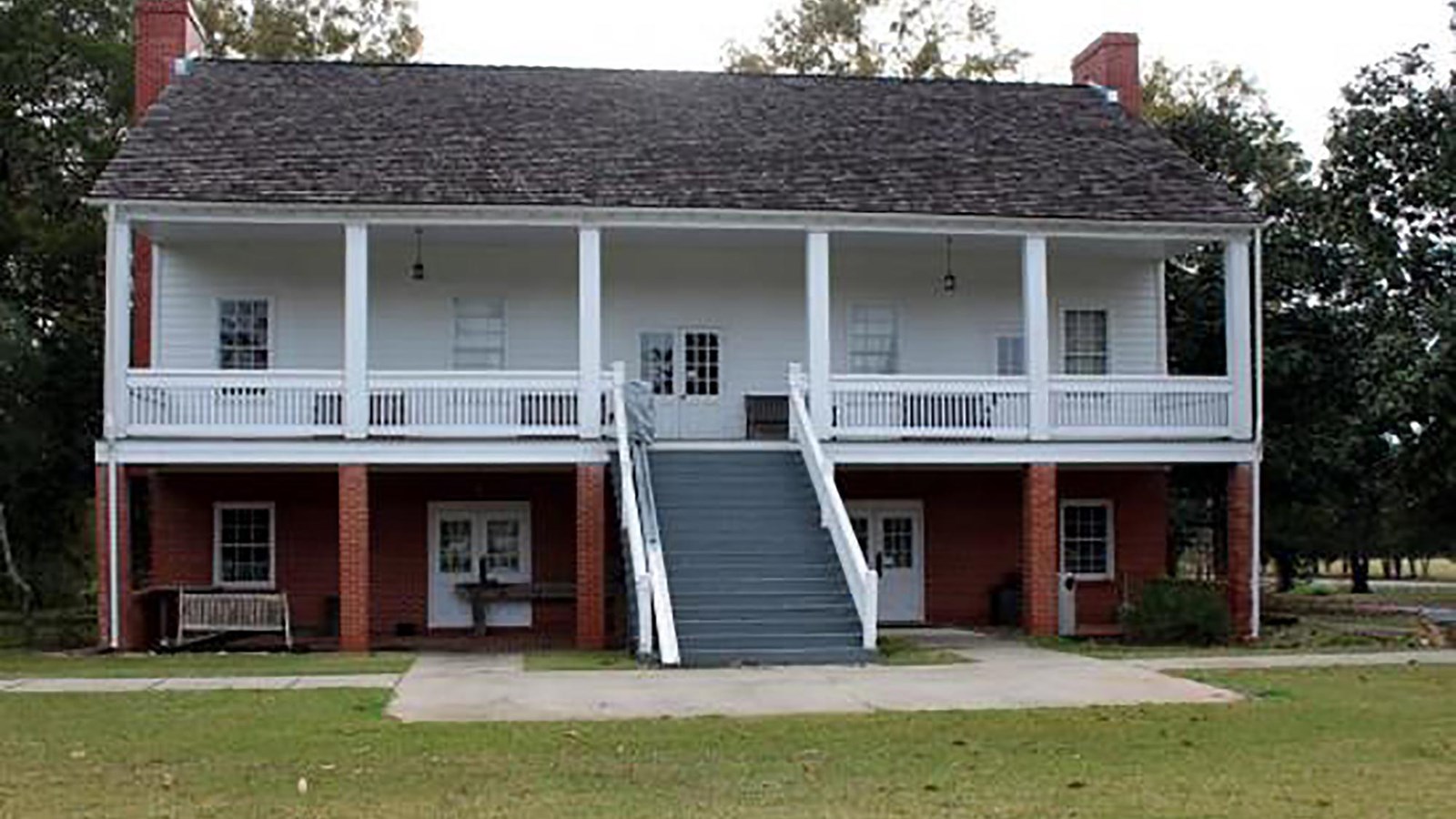
Photo/Louisiana State Parks
Quick Facts
Location:
32 Geoghagan Road (six miles northeast of Many, just south of State Highway 6)
Significance:
Added to the National Register of Historic Places in 1966, Fort Jesup provides a glimpse of life on the US-Spain (and later, Us-Mexico) border
Designation:
certified site, State Historic Site, National Register of Historic Places
MANAGED BY:
Amenities
1 listed
Historical/Interpretive Information/Exhibits
Fort Jesup stands as a testament to the young United States’ efforts to control the eastern end of El Camino Real de los Tejas. The fort, located southeast of Natchitoches, Louisiana, was one of several fortifications constructed over the centuries by various powers vying to control the surrounding area. By the time of the fort’s construction in 1822, the land it stood on had been claimed at various times by the French Empire, Spanish Empire, and the neighboring Caddo Indians.
When United States officials purchased the Louisiana Territory from France in 1803, they also acquired an uncertain boundary with the Spanish Empire’s North American territories. Years of border disputes ensued, until the 1819 Adams–Onís Treaty established the boundary between Spanish Texas and the state of Louisiana at the Sabine River. To help control this territory, the US constructed Fort Jesup. The fort was one of many constructed between Minnesota and Louisiana in the first half of the 1800s to protect settlements from attacks by Native Americans, contain the Spanish Empire, and facilitate the fur trade.[1] The fort’s first commander was Lieutenant Colonel Zachary Taylor, who later became the 12th president of the United States.
The garrison at Fort Jesup protected travel and trade along El Camino Real de los Tejas. Acting as a protective force, the army helped ensure ease of travel along the US sections of the route. The fort also served as a support and safe haven for settlers heading west to Texas.
The officers and enlisted soldiers at this frontier outpost performed a diverse array of duties.[2] In addition to guarding the border, the troops at Fort Jesup also facilitated control of the enslaved population in Louisiana. Soldiers from the fort helped crush several uprisings.[3] Soldiers stationed at the fort also monitored the movement and activity of Caddo bands in the United States and Mexico.[4]
The Texas Revolution and continued warfare between Mexico and the Republic of Texas increased Fort Jesup’s strategic importance. As the annexation of Texas became more likely, the US government sent an observation corps to the fort in 1844. This unit monitored the military situation between Texas and Mexico with orders to intervene if US interests were threatened.[5] To command this force, the US government sent Zachary Taylor—by then a general—back to Fort Jesup.
In May 1845, General Taylor received new orders to prepare to march southwest as “Texas will shortly accede to the terms of annexation.”[6] In June, Taylor and his troops left Fort Jesup and headed to the disputed borderland between Texas and Mexico.[7] On April 25, 1846, troops under Taylor’s command clashed with Mexican forces, marking the beginning of the Mexican–American War.[8] During the war, Fort Jesup served as a supply depot and stopover point for soldiers heading to the frontlines.
With the annexation of Texas and the conclusion of the Mexican-American War, Fort Jesup was no longer a border outpost. In 1846, less than a year after Taylor and his troops departed for Texas, the United States abandoned the fort.
Throughout its history, enslaved workers also lived at or near Fort Jesup. In the late 1830s, Dred and Harriett Scott may have lived at the fort. The two were enslaved by Dr. John Emerson, a military surgeon stationed at Fort Jesup.[9] The Scotts later sued for their freedom in the court case Dred Scott v. Sandford. While the Scotts lost the case, the Supreme Court’s ruling--which held that Black Americans had no citizenship rights and that the government could not ban slavery in the territories--helped inflame tensions in the lead up to the Civil War.
Today the site of Fort Jesup is preserved as Fort Jesup State Park. With the exception of the kitchen, most of the original fort no longer stands. Visitors can explore the site and view exhibits in the reconstructed officers’ quarters.[10] Guided tours of the area’s human history and natural features are available.
Site Information
Location (32 Geoghagan Road (six miles northeast of Many, just south of State Highway 6))
More site information
El Camino Real de los Tejas National Historic Trail
[1] R. Eli Paul, “Frontier Forts,” Encyclopedia of the Great Plains, accessed September 20, 2024, http://plainshumanities.unl.edu/encyclopedia/doc/egp.war.017
[2] “Fort Jesup State Historic Site,” Louisiana State Parks, accessed 3 May 2024, https://www.lastateparks.com/historic-sites/fort-jesup-state-historic-site
[3] Ibid.
[4] Texas Beyond History, “Sha'chahdínnih, Treaty and Abandonment,” accessed September 20, 2024, https://www.texasbeyondhistory.net/timberhill/treaty.html; Seldon B. Graham, “This Unsung Texas Hero’s savvy dealings with the Caddo Nation helped the State win its freedom,” HistoryNet, accessed on November 8, 2024, https://www.historynet.com/soldier-savvy-dealings-won-texas-freedom/
[5] K. Jack Bauer, Zachary Taylor: Soldier, Planter, Statesman of the Old Southwest (Baton Rouge: LSU Press, 1993): 111-112.
[6] William L. Marcy to Zachary Taylor, “Orders and Instructions to General Taylor, from May 28, 1845, to March 2, 1846,” accessed September 20, 2024, https://libraries.uta.edu/usmexicowar/node/6527
[7] Kent Barnett Germany, “Patriotism and Protest: Louisiana and General Edmund Pendleton Gaines’s Army of Mexican-American War Volunteers, 1845-1847,” Louisiana History: The Journal of the Louisiana Historical Association 37, no. 3 (1996): 326, accessed September 20, 2024, http://www.jstor.org/stable/4233314 .
[8] Ibid, 328.
[9] Melvin I. Urofsky, “Dred Scott,” Encyclopedia Britannica, accessed August 6, 2024, https://www.britannica.com/biography/Dred-Scott
[10] “Fort Jesup State Historic Site,” Explore Louisiana, accessed May 3, 2024,https://www.explorelouisiana.com/articles/fort-jesup-state-historic-site; “Louisiana State Commemorative Areas,” Louisiana History: The Journal of the Louisiana Historical Association 18, no. 2 (1977): 202, accessed September 20, 2024, http://www.jstor.org/stable/4231676.