



News Release
You are viewing ARCHIVED content
This content was published online before January 20, 2025. Please note that this content is NOT UPDATED, and links may not work. For current information, visit https://www.nps.gov/aboutus/news/index.htm.
NPS / RPaterson
News Release Date: June 1, 2021
Contact:
Mike Theune, Fire Information Officer, 559-565-3703
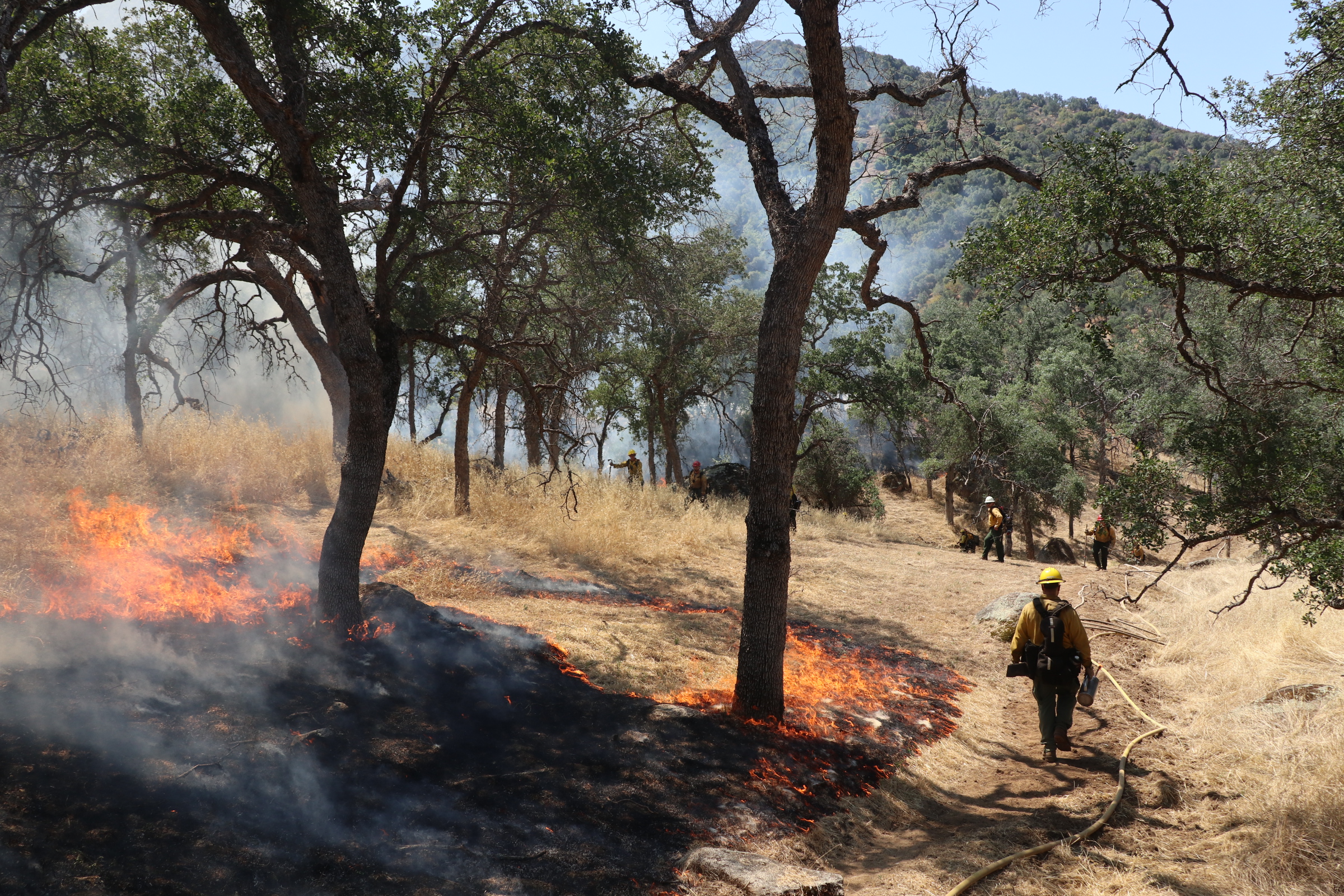
Prescribed burning in the parks’ foothills ecosystem reduces concentrations of fine fuels such as exotic grasses that aid in the rapid spread of wildfire; a critical factor that later in the year could limit access for first responders and hamper evacuations.
“The benefits of this prescribed burn are that our parks’ historic buildings and critical infrastructure will be better protected in the event of an unwanted wildfire,” said John Ziegler, parks’ fire management officer. “Please drive with caution when you see us as we complete this critical work.”
The 2021 Ash Mountain Prescribed Burn consists of 12 segments, for a total of approximately 40 acres between the Sequoia National Park entrance station and the Foothills Visitor Center, one mile inside the park. Nearly seven of those acres in the foothills are being treated manually through the grazing of the parks’ stock animals.
Information about this prescribed burn will be post to the parks’ website, social media pages, and Inciweb at https://inciweb.nwcg.gov/incident/7505
Visitors may see smoke, active fire, and firefighters during the burn, and are asked to drive slowly and follow all firefighter instructions. Smoke impacts are expected to be minimal and short-lived, as the vegetation in the unit is chiefly fine fuels that will be consumed quickly. Visitors can learn more about air quality and smoke by visiting www.airnow.gov or www.valleyair.org.
-NPS-
About Sequoia and Kings Canyon National Parks’ Fire Management Program
For over fifty years, our mission has been to use the full range of options and strategies available to manage fire in the parks. This includes protecting park resources, employees, and the public from unwanted fire; building and maintaining fire resilient ecosystems; reducing the threat to local communities from wildfires emanating from the parks or adjacent lands; and recruiting, training, and retaining a professional fire management workforce
.-###-
Last updated: June 1, 2021