



Last updated: July 9, 2026
Place
Three Crossings
NPS Photo
Quick Facts
Location:
On private land approximately 4 miles northeast of Jeffrey City, Wyoming.
Significance:
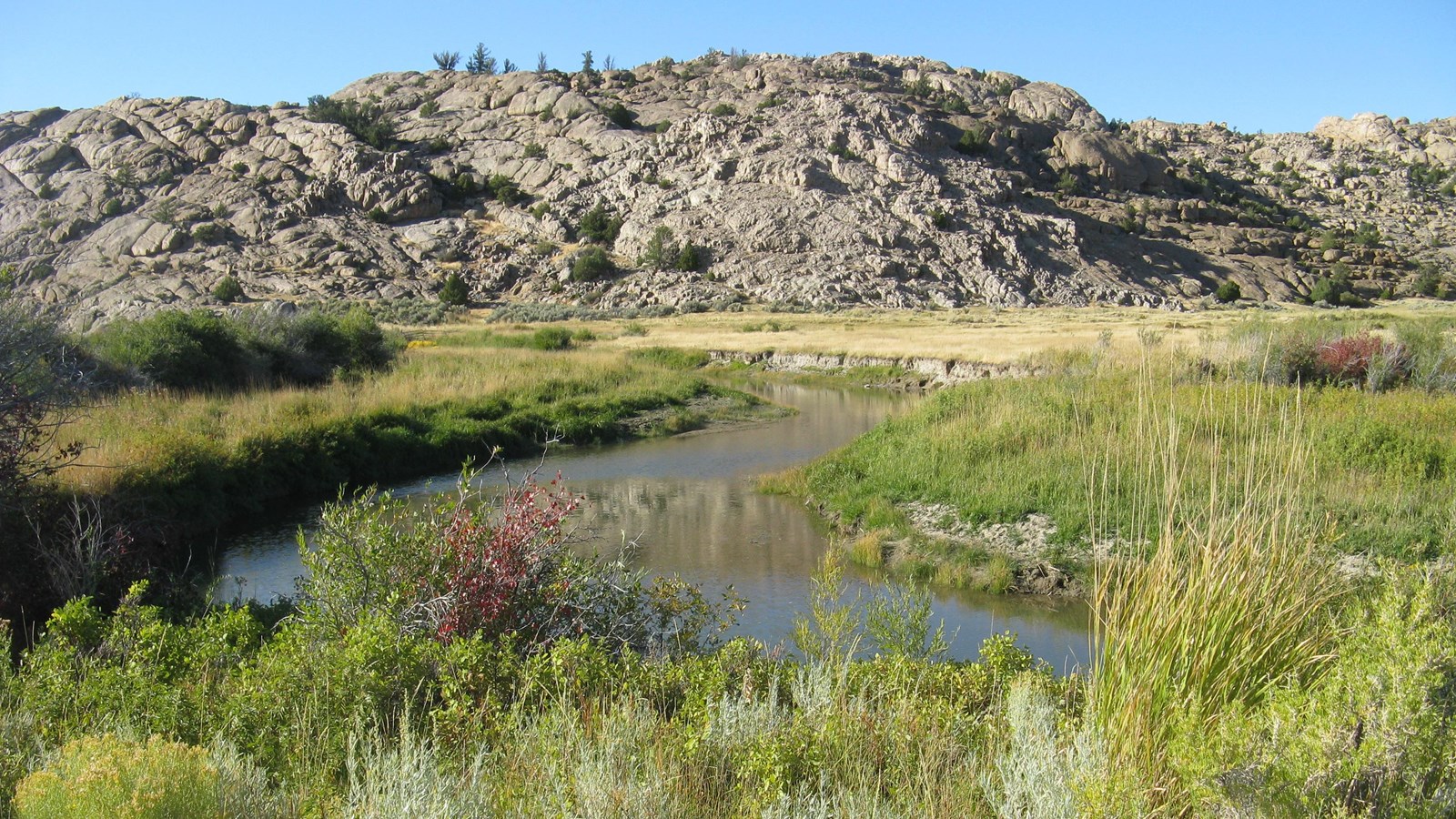
Three Crossings was a narrow passage between granite walls that forced wagons to cross the Sweetwater River 3 times in 2 miles. A Pony Express station/stage station and a small, fortified army post with a telegraph station and a cemetery were located here in the 1860s.
Designation:
Historic site on the California, Oregon, and Pony Express NHTs.
OPEN TO PUBLIC:
No
MANAGED BY:
Amenities
1 listed
Historical/Interpretive Information/Exhibits
The trail forks about 30 miles west of Devil’s Gate. One branch stays south of the Sweetwater River and crosses several miles of deep sand that clutched at hooves and wagon wheels. The Deep Sand Route exhausted the draft animals, but emigrants often chose that way to avoid the difficulties of the alternate branch, Three Crossings. This alternate crosses to the north bank of the Sweetwater and enters a “narrows” between high ridges of the Rattlesnake Hills. Constrained by granite walls, the trail crosses the winding river twice more within ¼ mile, earning the route its name.
The vanguard party of Latter-day Saints followed the Deep Sand Route on the way to the Great Salt Lake Valley in 1847, but some members tried Three Crossings when returning east later that summer. Having experienced both, William Clayton recommended the Three Crossings variant in his popular Latter-day Saints’ Emigrants’ Guide. “By fording here,” he advised, “the road is shorter, and you avoid much very heavy, sandy road.” During dry months, the fords typically were shallow. Travelers crossing in spring, though, needed to raise their wagon boxes on blocks to keep them above water, and the river’s depth forced draft animals to swim the wagons through the current.
In places, chokepoints allowed passage of only one wagon at a time, causing traffic backups. James Evans, California-bound in June 1850, complained to his journal, “There were a train of wagons nearly a mile long. . . here for two hours we moved along inch by inch, while the scent of dead cattle was unremitting and utterly obnoxious.” During delays, travelers scrawled their names with axle grease on the nearby cliff walls. Few of those remain today. The Willie Handcart Company of Latter-day Saints waded the 3 fords on Oct. 17, 1856, and camped among willows along the river that night, awaking the next morning to 8 inches of snow.
The Martin Handcart Company and the Hunt and Hodgetts wagon companies met 4 rescue wagons in this area on Nov. 12. By 1859, a tidy, well-run stage and mail station served passengers at Three Crossings, and the Pony Express operated a relay station there the following year. Completion of the transcontinental telegraph, which crossed through this area, put the Pony out of business in October 1861. Shoshone, Lakota, and Cheyenne warriors began attacking mail wagons, stations, and telegraph lines along the Sweetwater in spring 1862, burning the Three Crossings Station to the ground. The US Army soon built a small, fortified post and telegraph relay station at the site to protect traffic and communications. Some soldiers and warriors died during fighting in the area in 1862-1865. The army withdrew from the station in winter 1865, although attacks along the trail continued for another 3 years.
The buildings are gone today, but the grave of Pvt. Bennett Tribbett, who died from natural causes, is fenced and marked. Access requires landowner permission and directions; 4-wheel drive is advised.
Site Information
Location (On private land approximately 4 miles northeast of Jeffrey City, Wyoming.)