



Last updated: June 16, 2026
Place
Little Mountain Summit
NPS Photo
Quick Facts
Location:
Little Mountain Summit on Emigration Canyon Rd, about 8 highway miles from east Salt Lake City GPS 40.774974 -111.718270
Significance:
Little Mountain, steep and challenging, was the last mountain pass on the California, Mormon Pioneer, and Pony Express trail corridor into the Salt Lake Valley.
Designation:
Historic site on the Mormon Pioneer, Pony Express, and California NHTs.
Amenities
3 listed
Historical/Interpretive Information/Exhibits, Parking - Auto, Toilet - Flush
The California-bound wagons of the Donner-Reed Party were first to cross Little Mountain, the final pass before entering the Great Salt Lake Valley in present Utah. For 3 days these emigrants camped near today’s Little Dell Dam while grubbing trail over the summit, finally crossing on July 21, 1846.
Exactly a year later, most of Brigham Young’s vanguard party of Latter-day Saints reached the foot of Little Mountain. Company scouts soon located the faint track, already overgrown, left by the Donner-Reed group. “It is evident that the emigrants who passed this way last year must have spent a great deal of time cutting a road through the thickly set timber and heavy brush wood,” observed camp scribe William Clayton.
The 1847 vanguard scouts chose a slightly different route up the side of Little Mountain, but both steep, twisting trails climbed 640 feet to the summit (6,230’ elevation) in less than a mile. From there they could see the Salt Lake Valley, about 6 miles ahead. Scouts Erastus Snow and Orson Pratt simultaneously “uttered a shout of joy at finding it to be the very place of our Destination.” The main party of Latter-day Saints, arriving later that day, urged their exhausted oxen to Little Mountain Summit. After pausing to catch their breath and take in the view, the emigrants began the steep, half-mile skid down the mountain’s west slope to Emigration Canyon. There they encamped after a 13-hour, 14-mile trek through the Wasatch Range, just hours from their trail’s end.
Between 1847 and 1869, tens of thousands of Latter-day Saints, forty-niners, freighters, soldiers, Pony Express riders, and stagecoach passengers climbed and descended Little Mountain. John Clark, traveling in 1852, called the western descent “the steepest, roughest and unchristian like road to be seen in any country.” Reaching Emigrant Canyon, his company camped and watched other emigrants come down the mountainside. “We had a good and full view of the tide of emigration as it came tumbling down the steep sides of the mountain,” Clark wrote. “Sometimes the wagons would get before the teams which it would drag after until brought up by some hoary headed rock, when wagon, oxen, women and children would all tumble together in one confused mass of matter amid the wreck of which would soon be heard the screams of women, the yells of children and the swearing of men.” Wagon ruts are still clear on the ground and online satellite imagery.
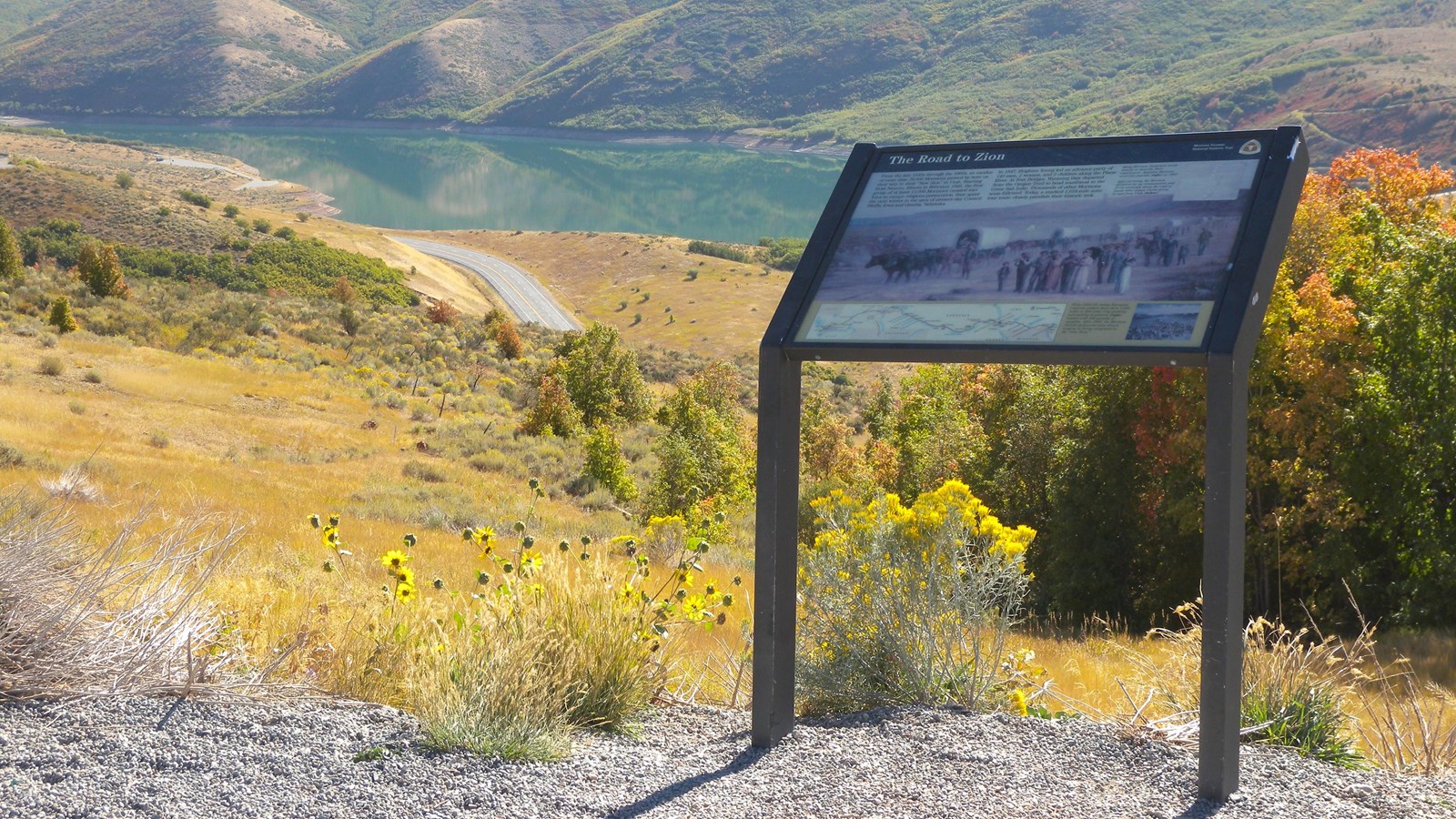
To visit, follow Emigration Canyon Road 8 miles east from Salt Lake City to the summit turnout. Look down the eastern slope to see multiple trail scars climbing to the pass. Cross to the west side of the highway to see the descent trail, marked with white posts; then follow the highway westbound as it switchbacks down the mountain, and at 0.8 mile from the summit, look for a line of boulders near the road on the right (intended to keep vehicles from entering the trail trace), and look back up the swale toward the summit.
Site Information
Location (Little Mountain Summit on Emigration Canyon Rd, about 8 highway miles from east Salt Lake City GPS 40.774974 -111.718270)