



Last updated: September 23, 2026
Place
Kansas River Crossing & Pappin’s Ferry
NPS Photo
Quick Facts
Location:
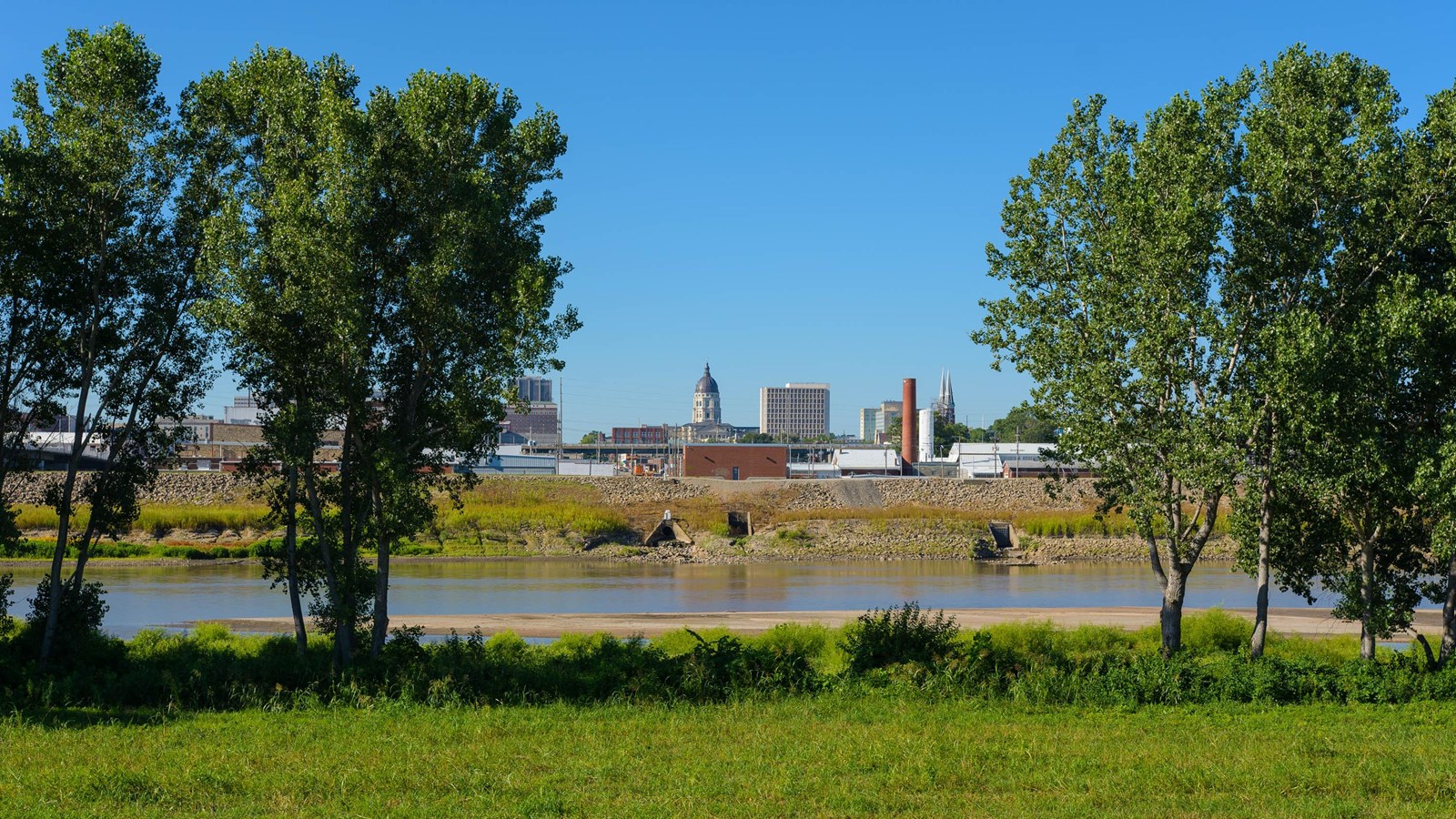
Visitors can view the ferry location in the North Topeka Neighborhood, between NW Topeka Blvd and NW Harrison St Street, and south of NW Curtis St along the Kaw Reserve Trail along the Kansas River levee. Approximate GPS: 39.064609 -95.671297 A ferry monument stands near the south bank at Ward-Meade Historical Park, 124 NW Filmore St, Topeka (park in the lot off NW Clay St). GPS 39.06385, -95.6831166667
Significance:
Pappin’s (also spelled Pappan’s and Papin’s) Ferry was a major crossing of the Kansas (Kaw) River for 19th century travelers starting from Independence, Missouri, along the Santa Fe, Oregon, and California trails. Located at present-day North Topeka, it operated ca. 1843 – 1863.
Designation:
Historic site on the California, Oregon, and Santa Fe NHTs.
MANAGED BY:
Various: City of Topeka, Shawnee County, and Railroad Heritage Inc. properties.
Amenities
3 listed
Cellular Signal, Parking - Auto, Scenic View/Photo Spot
Pappin’s (also spelled Pappan’s and Papin’s) Ferry was a major crossing of the Kansas (Kaw) River for 19th century travelers starting west from Independence, Missouri, along the Santa Fe, Oregon, and California trails.
In 1842, before a ferry existed, John C. Fremont—crossing in an inflatable rubber boat—described the Kaw as a “swollen, angry, yellow turbid current.” The river, typically some 200 yards wide, could be forded only during dry seasons when water levels were low, but it ran fast and high in spring, just when most emigrants needed to cross. Many attempts to ford the channel ended in wagon accidents and drownings.
Four French-Creole brothers named Pappin married women of the Kanza Tribe whose treaty allotments lay along the north bank of the river. By 1843, as the emigration to Oregon and California surged, the Pappin families had established one of the first ferries along the Kaw. Their first ferryboats were log platforms set across 2 or 3 dugout canoes, large enough for one wagon at a time. A rope stretched from bank to bank kept the craft on course and prevented it from drifting downstream. To move the ferry across the current, the ferryman pushed against the riverbed with a long pole. The fare cost $1 per wagon—about $44 in 2026 dollars.
A wide range of travelers gathered at Pappin’s Ferry: emigrants, gold seekers, freighters, Latter-day Saints, military units, and enslaved people—some reportedly led by John Brown—fleeing north along the Underground Railroad. People of many cultures, including white Americans, European immigrants, Native Americans, and Black people, interacted and traded at this crossing. However, as more emigrants began “jumping off” from St. Joseph, Council Bluffs, and other northern river ports, ferry traffic from Independence dwindled. New bridges and railroads put the ferry out of business by the mid-1860s.
Although the river channel has changed little since the 19th century, no trace of the ferry landings or nearby buildings survives. About 700 feet northeast of the levy, at 701 N Kansas Ave, stands the Great Overland Station, a grand, 1927 train depot with a plaza and flag pavilion. Exhibits inside highlight the development of the rail industry and its impact on American society. South of the river, at Ward-Meade Historical Site, a Daughters of the American Revolution monument commemorates the Pappin Ferry operation.
Site Information
Location (Visitors can view the ferry location in the North Topeka Neighborhood, between NW Topeka Blvd and NW Harrison St Street, and south of NW Curtis St along the Kaw Reserve Trail along the Kansas River levee. Approximate GPS: 39.064609 -95.671297
A ferry monument stands near the south bank at Ward-Meade Historical Park, 124 NW Filmore St, Topeka (park in the lot off NW Clay St). GPS 39.06385, -95.6831166667)