



Last updated: March 4, 2026
Place
Gauley Bridge Depot
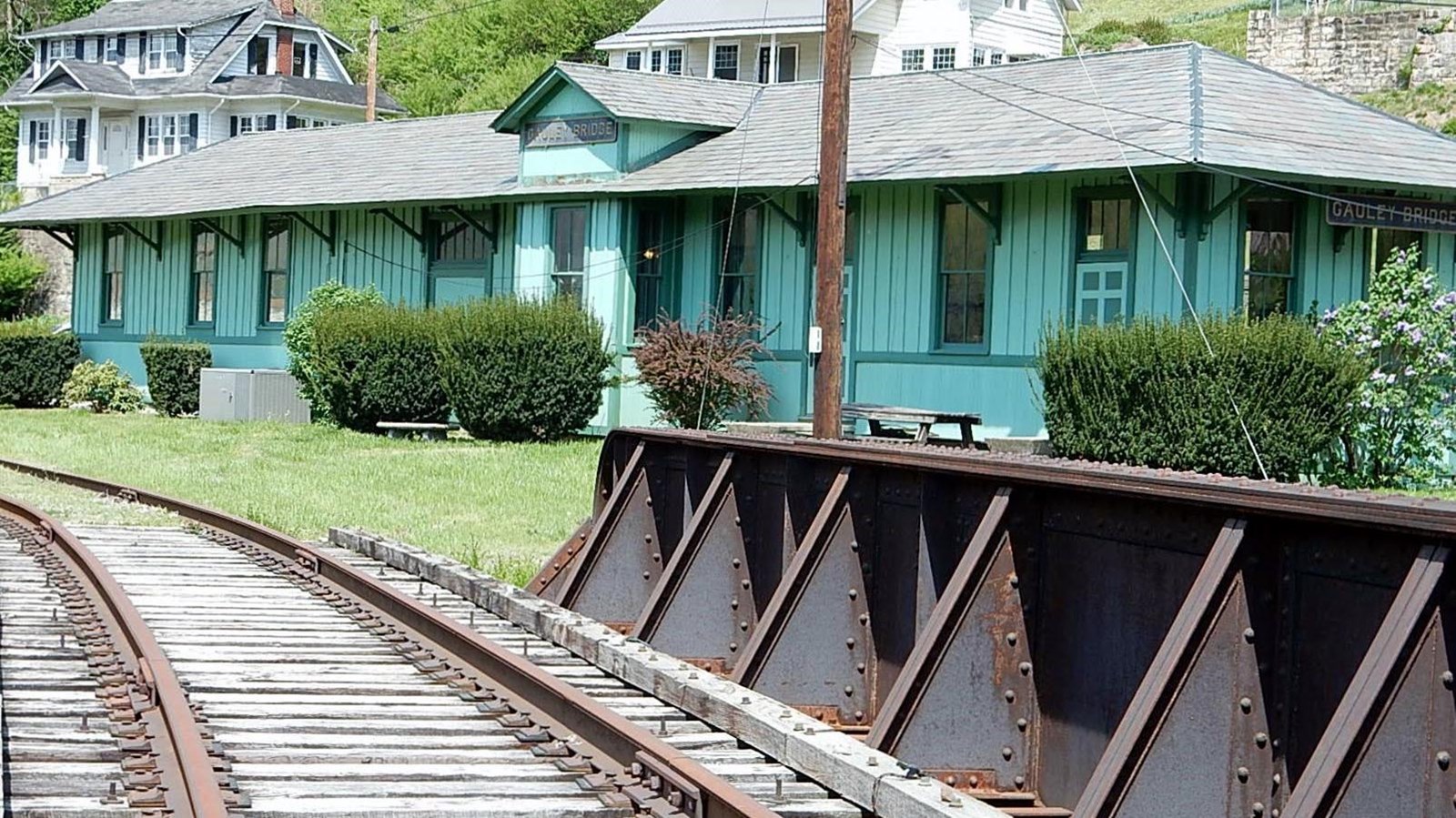
Mark Bollinger
Quick Facts
Location:
Gauley Brige Depot
Significance:
After construction of the C&O Rail Line was completed, the depot and rail yard at Gauley Bridge, as at other towns along the rails, continued to provide many African American workers with steady jobs.
OPEN TO PUBLIC:
No
Amenities
1 listed
Parking - Auto
African American Heritage Driving Tour Stop 7: African Americans and the Railroad
If using the NPS app, to listen to the audio narrative, press the green button below or read the audio narrative text below.
This tour stop is not advised for trailers, RVs, or motorhomes due to a low railroad bridge and difficulty turning around.
Audio Narrative
Written by: Richard Altare and Mark Bollinger
Narrated by: Adrienne Jenkins
The Gauley Bridge Railroad Station was constructed in 1893. It is one of the pre-designed “company trademark” stations built in small communities throughout West Virginia during this time. It has a rectangular wood frame structure and a hipped slate roof. Its gabled bay window, centered in the north façade facing the tracks, was the focal point of all station activity.
Construction of railroads and stations brought thousands of people to the coal-rich region of Appalachia. Three railroads opened the vast coalfields of Southern West Virginia to mining: the Chesapeake & Ohio Railway along the New and Kanawha rivers, the Norfolk & Western Railway through the Pocahontas coalfield, and the Virginian Railway into the Winding Gulf fields. This meant jobs building and maintaining the railroads as well as jobs in the coal mines. Jobs in these industries provided the opportunity for African American families to escape the “Jim Crow” segregated society of the Deep South. African American men were able to build new lives as vital, more respected, and better-paid workers.
African Americans made up the majority of workers whose sweat, muscle, and blood carved the C&O Railway, its branch lines, and other railroads through the mountainous landscapes. Constructed between 1869 and 1873, it employed thousands of Black laborers. Journalist Jedidiah Hotchkiss wrote about black railroad workers in 1873:
They have proved in fact to be fine laborers, both as track-makers, and for mining, blasting, and all the other work of railroad building. They lived in shanties along the road, wherever their work lay … It [the road] was built almost entirely by the labor of negroes, who here proved themselves admirable and trustworthy workmen; sober, equal to the severest toil, and winning the good opinion of everyone. These blacks, of whom five thousand were employed on the road, [were] all formerly slaves in Eastern Virginia …”1
After construction was completed, the depot and rail yard here at Gauley Bridge, as at other towns along the rails, continued to provide Blacks with steady jobs. Maintaining the tracks was called “lining track.” It was a daily, hard-labor – a never-ending task primarily accomplished by Black work crews. Often known as “gandy dancers” these men used songs and rhythm as a choreographed team. They aligned the track with precision, placing heavy wooden ties and steel rails, and driving in spikes.
Each C&O rail yard, engine house, roundhouse, and depot required other workers to operate and maintain the massive coal- and water-powered steam locomotives as well as the coal, freight, and passenger cars. African Americans were employed as train porters, freight handlers, switch tenders, and engine shop workers.
Following the Civil War, George Pullman established the Pullman Sleeping Car Company. Pullman sleeper cars were contracted out to all the passenger railways in the United States and the porters hired to staff the sleepers were exclusively Black. The Pullman Company grew to be the largest single employer of African Americans in the nation. In 1925, Pullman porters formed the first all-Black union, the Brotherhood of Sleeping Car Porters.
Although the railroad provided employment opportunities for Blacks, these jobs often required the hardest work while providing the lowest pay. Even with these challenges and the limitations of a segregated society, African American railroad men worked hard to provide for their families, and built strong Black communities through church, school, and civic organizations.
1 Christopher Wilkinson, Big Band Jazz in Black West Virginia, 1930-1942, University Press of Mississippi, Jackson, 12-13.
Additional Information
Construction of railroads and stations brought thousands of people to the coal-rich region of Appalachia. Three railroads opened the vast coalfields of Southern West Virginia to mining: the Chesapeake & Ohio Railway along the New and Kanawha rivers, the Norfolk & Western Railway through the Pocahontas coalfield, and the Virginian Railway into the Winding Gulf fields. This meant jobs building and maintaining the railroads as well as jobs in the coal mines.
African Americans made up the majority of workers whose sweat, muscle, and blood carved the C&O Railway, its branch lines, and other railroads through the mountainous landscapes. Constructed between 1869 and 1873, it employed thousands of black laborers. Jobs in these industries provided the opportunity for African American families to escape the “Jim Crow” segregated society of the Deep South. African American men were able to build new lives as vital, more respected, and better-paid workers.
For the full story go to: African Americans and the Railroad: Gauley Brige Depot; Gauley Bridge, WV
Other nearby places of interest:
Cathedral Falls
Kanawha Falls
Gauley Bridge
Driving Directions:
Gauley Bridge DepotPhysical Address: 278 Railroad Street, Gauley Bridge, WV 25085
GPS Coordinates: N38.164618 W81.196832
From Beckley and Fayetteville, WV: Take Highway 19 north to Highway 60. Follow the exit up the ramp and turn right onto Highway 60 west. Travel approximately 18 miles to the town of Gauley Bridge, WV. Cross the bridge over the Gauley River and turn right on Highway 16N/39E at the Welcome to Gauley Bridge sign. Drive under the old railroad bridge and immediately turn left and drive up the hill to the parking lot behind the Depot. Tour Stop #7 and parking is behind the Railroad Depot.
Directions to the next Tour Stop
Bright Hope Lodge
From the Railroad Depot, return to Hwy 60 and turn right. Take Highway 60 west for approximately 10.5 miles to the Town of Smithers, WV. Turn right onto the exit for Highway 61 to Montgomery. Cross the river and continue straight across the overpass and turn right on Hwy 61 south. Travel .2 tenths of a mile and turn left on the first road (Gaines Street). Tour Stop #8 and parking is in front of the lodge.
The requested video is no longer available.