



Last updated: June 2, 2026
Place
Garden Grove - Trailside Historical Park
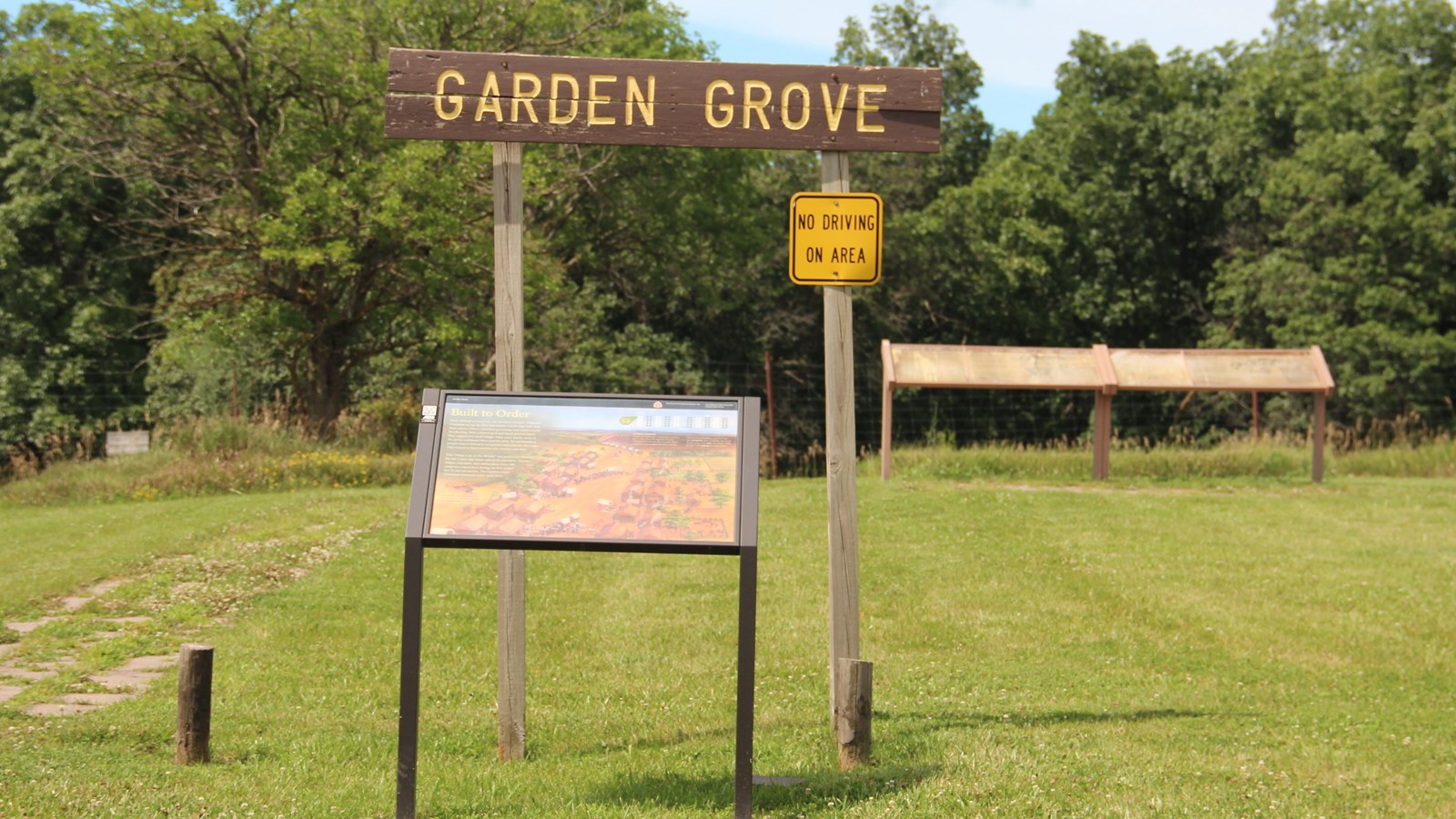
Photo/L. Kruetzer
Quick Facts
Location:
30308 Mormon Trail Road, Garden Grove, Iowa 50103.
Significance:
Here, emigrants from Brigham Young’s 1846 vanguard company established a trailside settlement, Garden Grove, to feed and shelter themselves and the oncoming wagon trains from Nauvoo. Many died here from disease, hunger, and exposure during that first winter.
Designation:
Historic site on the Mormon Pioneer NHT.
Amenities
6 listed
Benches/Seating, Cellular Signal, Historical/Interpretive Information/Exhibits, Parking - Auto, Picnic Shelter/Pavilion, Scenic View/Photo Spot
After nearly 2 months of slogging through snow, rain, and mud, many families among the 1846 vanguard company of Latter-day Saints had exhausted their food and supplies. Some were ill, and their draft animals were starving. The situation seemed to grow ever more dire.
On April 24, the lead wagons reached the Weldon Fork of the Grand River, 144 miles west of Nauvoo and 120 miles east of the Missouri River. Leaders decided to establish here a temporary farm settlement, which became known as Garden Grove because of its tall oak timber and vast field of wild onions. Some of the weaker emigrants would stay here for a season, building cabins and growing crops to help the continuing emigration from Nauvoo. Hosea Stout described this place, which he called the “Magic City of the Woods,” as “a pleasantly situated place from the first appearance [with] a beautiful thick wood of tall shell bark hickory the soil uncommonly rich & so loose now that our teams could but draw their loads through.”
Over the next 19 days, crews set to work with axe and plow in pouring rain to build cabins and plant gardens. On May 13, Brigham Young and the main camp pulled out and continued across Iowa, but the work at Garden Grove continued. In his journal entry of May 19, Orson Pratt wrote, “Many houses have been built, wells dug, extensive farms fenced, and the whole place assumes the appearance of having been occupied for years, and clearly shows what can be accomplished by union, industry, and perseverance.” However, the situation was far less idyllic than those happy journal entries imply.
This “garden” seethed with rattlesnakes in numbers that, according to Thomas Bullock, “evoked memories of Pharoah’s plagues.” The snakes bit many of the emigrants’ oxen and horses, and some of the valuable draft animals died from the venomous strikes. More critically, the emigrants who remained behind to tend the crops were pitifully weak, and some already were dying from malnutrition, disease, fatigue, and exposure. The toddler son of Hosea and Louisa Stout, whose family was starving, died in his father’s arms from “the whooping cough and black canker [scurvy]” while encamped there.
Additional needy emigrants, arriving with the spring and autumn emigrations from Nauvoo, placed more demand on food supplies. Garden Grove, the midpoint of the Mormon Pioneer National Historic Trail between the Mississippi and Missouri rivers, sheltered 500 to 600 Latter-day Saints over the winter of 1846-1847, and as many as 70 of them did not live to see spring. Emigrants would continue to occupy Garden Grove and support passing wagon trains until 1852, when most Latter-day Saints departed for Zion (Salt Lake City) in response to a call from church leaders.
Today, the pioneer cemetery is open to the public as part of a small county park, and the site itself is on nearby private farmland. The present town of Garden Grove, Iowa, grew up near the old Latter-day Saints camp.
Site Information
Location (30308 Mormon Trail Road, Garden Grove, Iowa 50103.)
Safety Considerations