



Last updated: August 15, 2026
Place
Henry Wadsworth Longfellow Memorial
NPS / Kelsey Graczyk
Quick Facts
Location:
Washington, DC
Amenities
1 listed
Historical/Interpretive Information/Exhibits
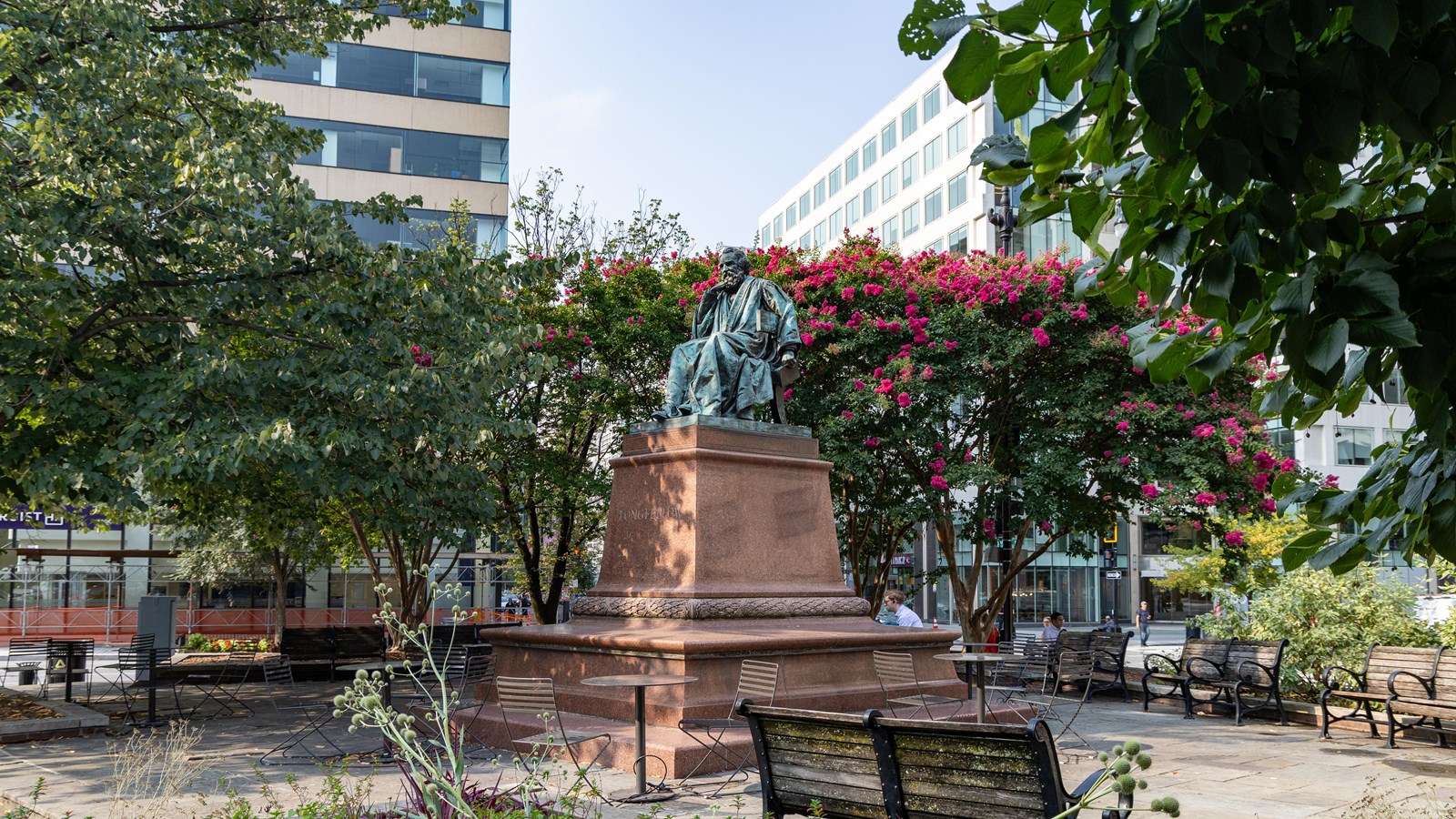
The Henry Wadsworth Longfellow Memorial in Washington, D.C., stands as one of the nation’s earliest tributes to American literary achievement and a testament to the wide esteem in which the 19th-century poet was held. Located at the triangle formed by M Street and Connecticut Avenue NW, the memorial greets pedestrians and commuters in downtown Washington with a serene bronze figure of Longfellow, inviting reflection on a life devoted to words that helped define the American spirit.
Henry Wadsworth Longfellow was born on February 27, 1807, in Portland, Maine, into a family steeped in intellectual and civic life. Over the course of his long career, he became one of the most influential American poets of the Victorian era, bridging scholarly erudition with broad popular appeal. Longfellow’s verse, ranging from lyrical meditations on life and faith in “A Psalm of Life” (1839) to narrative epics like Evangeline (1847) and The Song of Hiawatha (1855), and popular patriotic pieces such as “Paul Revere’s Ride” (1861), helped shape a distinctly American literature at a time when the young nation was seeking its own cultural voice. Unlike many poets whose audiences were narrow, Longfellow’s work was read in parlors and classrooms across the country, making him perhaps the first American writer to achieve truly national and international renown.
When Longfellow died in 1882, the outpouring of public admiration was immense, and plans for memorialization followed quickly. His legacy was honored in diverse ways: a bust was placed in Poets’ Corner at Westminster Abbey in London in 1884, and a memorial statue was erected in his hometown of Portland, Maine, in 1888. But in Washington, D.C., friends, admirers, and civic leaders envisioned a national tribute to literary accomplishment. In 1902, the Longfellow National Memorial Association formed in the capital to raise funds and lobby Congress for a permanent monument. Members of the association included prominent figures of the day, including Andrew Carnegie, Henry Cabot Lodge, Charles William Eliot, Edward Everett Hale, Julia Ward Howe, Curtis Guild, and Theodore Roosevelt, who served as honorary regent. Congress contributed the site at Connecticut Avenue and M Street and provided $4,000 toward the pedestal, while $21,000 more came from public subscriptions raised by the association.
Sculptor William Couper, a New York artist trained in the classical tradition, was chosen to create the memorial. Couper’s design presents Longfellow seated in contemplative repose atop a reddish-brown marble pedestal quarried in Scotland. The bronze figure depicts him in academic robes with his right hand under his chin and an open book in his left arm, while additional volumes rest beneath the bench—symbols of his enduring commitment to letters. This naturalistic portrayal captures both the dignity and quiet introspection of the poet, suggesting a mind engaged in contemplation rather than heroic action.
The memorial was dedicated on May 7, 1909, at a public ceremony attended by dignitaries including Chief Justice Melville Fuller, who presided, members of the Cabinet and the Supreme Court, and Longfellow’s own descendants. Longfellow’s granddaughter, Erica Thorp, performed the unveiling, and the United States Marine Band provided music for the occasion, linking the celebration of artistic achievement with ceremonial civic tradition.
Though modest in scale compared to monumental works honoring presidents or generals, the Longfellow Memorial was significant for its time: it was one of the first national memorials in Washington dedicated to a figure from the arts, emphasizing the importance of cultural, not just political, contributions to the American story. The site and figure continue to complement the city’s larger commemorative landscape, offering a quieter space where passersby can pause and consider the power of language and imagination.