An official website of the United States government
Here's how you know
Official websites use .gov A
.gov website belongs to an official government
organization in the United States.
Secure .gov websites use HTTPS A
lock (
) or https:// means you've safely connected to
the .gov website. Share sensitive information only on official,
secure websites.
*Note: Standards depend on activities chosen to complete
Common Core Standards for English & Language Arts
SL.4.1 - Engage effectively in a range of collaborative discussions (one-on-one, in groups, and teacher-led) with diverse partners on grade 4 topics and texts, building on others' ideas and expressing their own clearly. SL 4.4 - Describe people, places, things, and events with relevant details, expressing ideas and feelings clearly.
Michigan K-12 Social Studies Standards
4 – H3.0.2 - Use primary and secondary sources to explain how migration and immigration affected and continue to affect the growth of Michigan. 4 – H3.0.4 - Describe how the relationship between the location of natural resources and the location of industries (after 1837) affected and continue to affect the location and growth of Michigan cities.
Michigan K-12 Geography Standards
4 – G4.0.3 - Describe some of the movements of resources, goods, people, and information to, from, or within the United States, and explain the reasons for the movements.
Visual Art Standards
ART.VA.I.4.3 - Analyze and reflect on the elements of art and design to communicate ideas. ART.VA.I.4.4 - Prepare, present, and collaboratively evaluate personal artwork.
Assessment
Students will orally explain to partners to demonstrate understanding of why values and preservation are important.
Carnegie Museum of the Keweenaw in Houghton, MI
NPS Photo
Background
Not familiar with Houghton, Michigan and the Keweenaw Peninsula? Start here:
This is the Carnegie Museum lesson plan in the Copper TRACES online program for fourth graders and equivalents. In this lesson, students will learn about the city of Houghton’s historic buildings and how the city was a center of transportation, commerce, and supported the people working in the mines. The main takeaway from the activities and materials in this lesson is to teach about the importance of preservation and the role of values.
Preservation is the act of restoring, upkeeping, and maintaining a historical artifact for future generations to understand and learn about the past. It is a way of passing on history and traditions as a way of expressing or projecting community values.
Values are ideas or objects that are deemed important. Individuals and communities can each have their own values and ideals. Through time capsules, we can see what previous generations valued by the objects they contained (i.e., heirlooms, etc.)
Some things cannot be preserved within a time capsule, such as buildings. Many buildings in downtown Houghton hold the city’s historical significance in commerce, transportation, and mining. Houghton’s historic buildings were sites of business, government, fraternity, and hospitality. The buildings also highlight the changes to the city over the last century, with many of these buildings now being used for other purposes different from their original intent.
Finally, the idea of telescoping values comes into play in this lesson. Telescoping values is the idea that valuing one thing can lead to the formation of valuing another thing. Something can be valued and that can in turn lead to another similar thing being valued. One example is books lead to the value of knowledge, knowledge leads to the value of education, education leads to the value of a library. These telescoping values are important because it relates how individual persons values can add up and contribute to a community’s values.
Activity Objective: To show students the physical changes of historical buildings over time. To also show students why certain buildings are preserved due to the value they hold in their communities.
Introduce the website and the picture exploration activity. Explain how you can use the sliders on the picture to switch between the old and new pictures at the same time.
In small groups allow students to explore the pictures on their own. Have them compare and contrast the buildings and how they have changed from then and now.
Telescoping Values Discussion:Use the library building as an example of this idea of telescoping values, where a value of something leads to the formation of other buildings, organizations, and other values, etc. to reinforce its importance. (For example: Books lead to the value of knowledge, knowledge leads to the value of education, education leads to the value of a library.)
Extension Activities
Time Capsule Activity
Activity Objective: To highlight to students their individual and communal values they wish to preserve by creating a time capsule to show the future.
Have students create or choose objects from a selection by the teacher that they would like to show to people in the future.
Students can create a range of things; drawings, letters, and other arts and crafts such as artwork, origami, necklaces, etc. The possibilities are nearly endless for what they want to show the future.
After all students have something to contribute, initiate a discussion about how long these objects will be preserved, who will open them, what the communal value of these objects are, and how those values might change over a period.
Before each student contributed their item, they should participate in a “Turn and Talk” where they talk with a partner and explain why they chose the object.
Combine all the items in a container and create a time capsule.
Store away the time capsule and open at the end of the school year.
Printable House Template
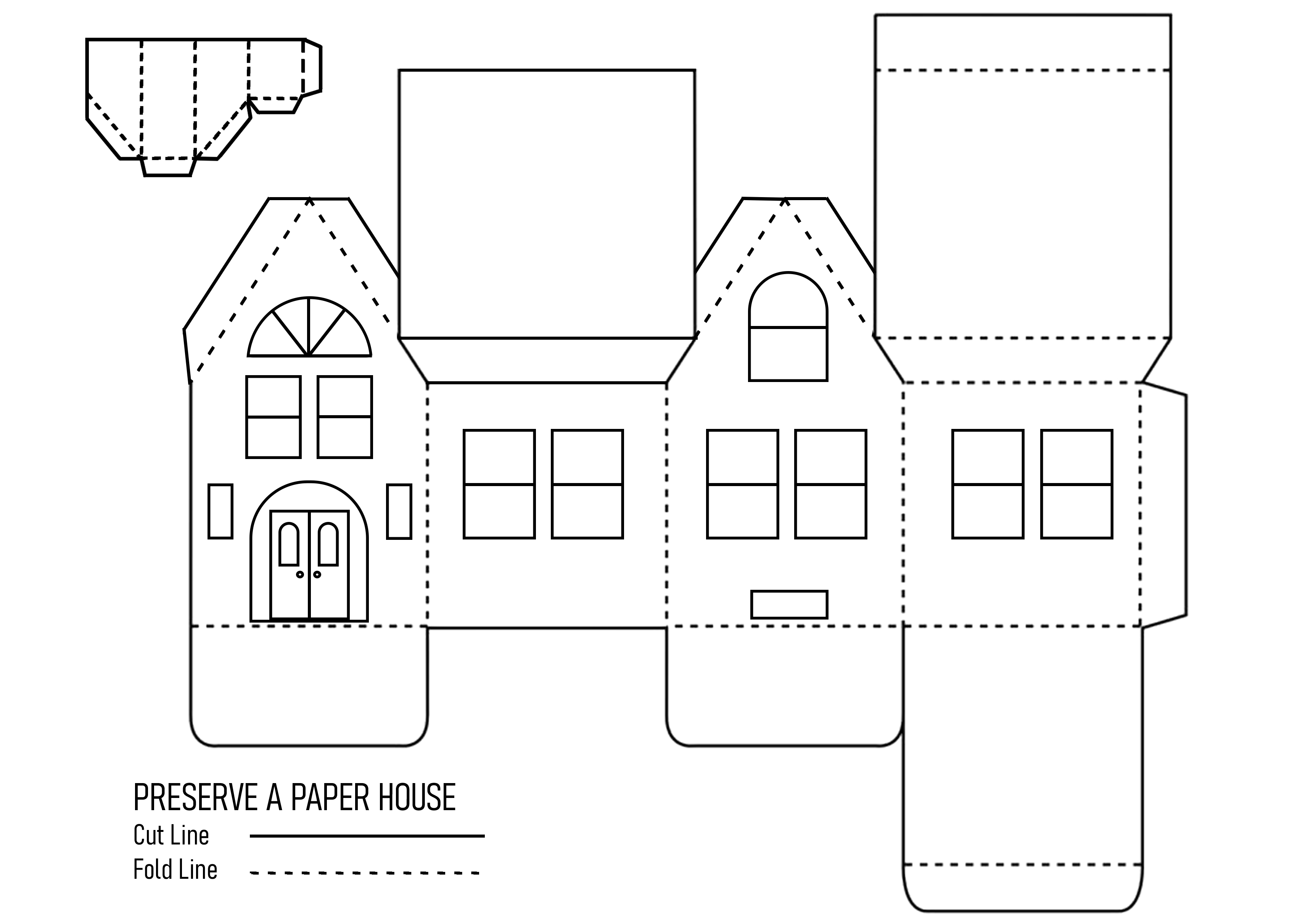
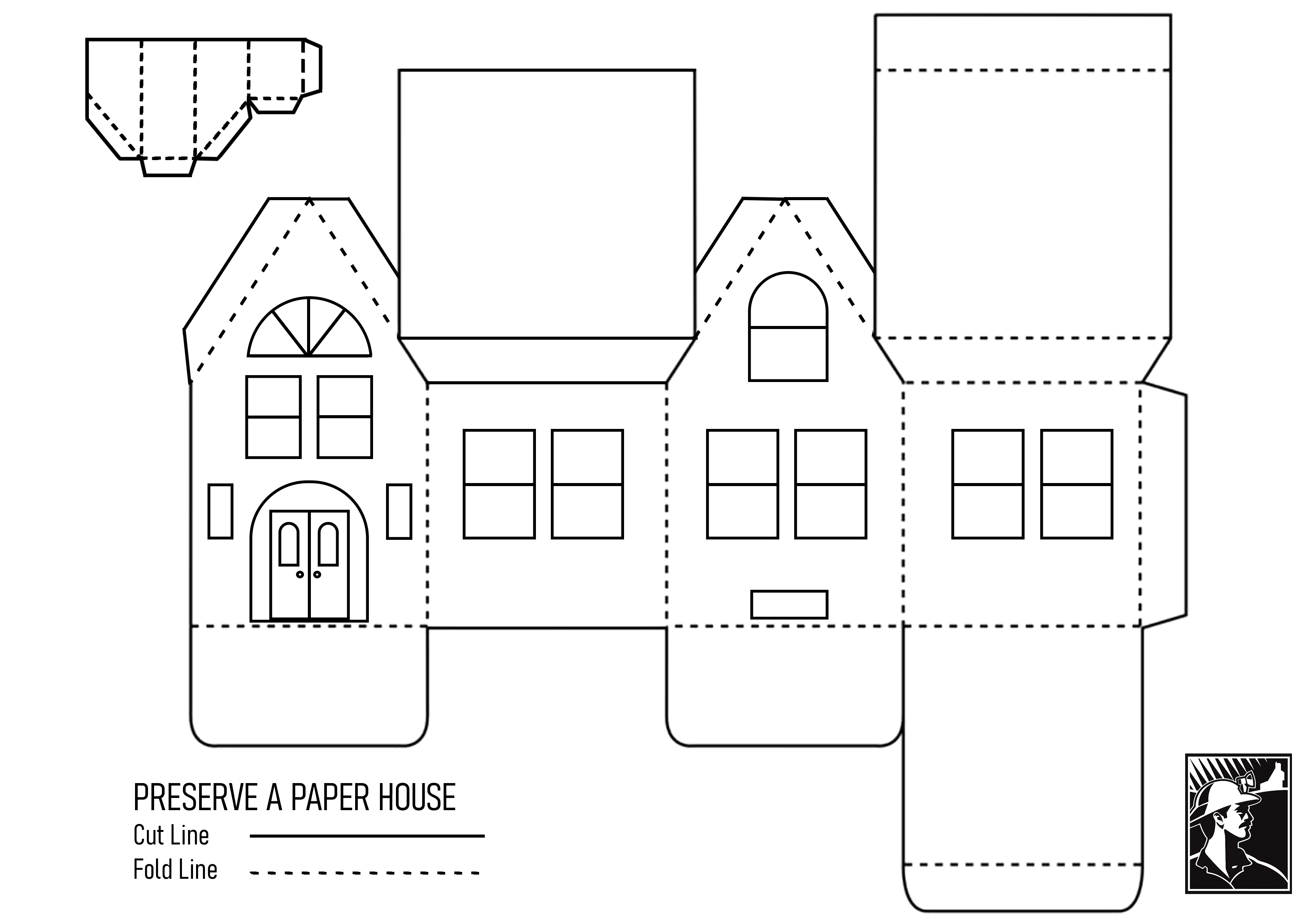
Make and Preserve a Paper House
Activity Objective: To emphasize the changes that can be done to a building and highlight the compromises and difficulties of preserving such community buildings.
*This activity can be done with each individual person designing their own house or with groups collaborating to design a house
In this exercise, the students will design a building and have their building altered in some way, to try and restore or preserve the house back to its original state then later.
Students will form small groups and will be given a template of a house in which they can decorate or draw on in any way they see fit. The idea is making the houses uniquely designed. Let them know during this step that the buildings they create will be edited by other people to avoid discouragement and conflict.
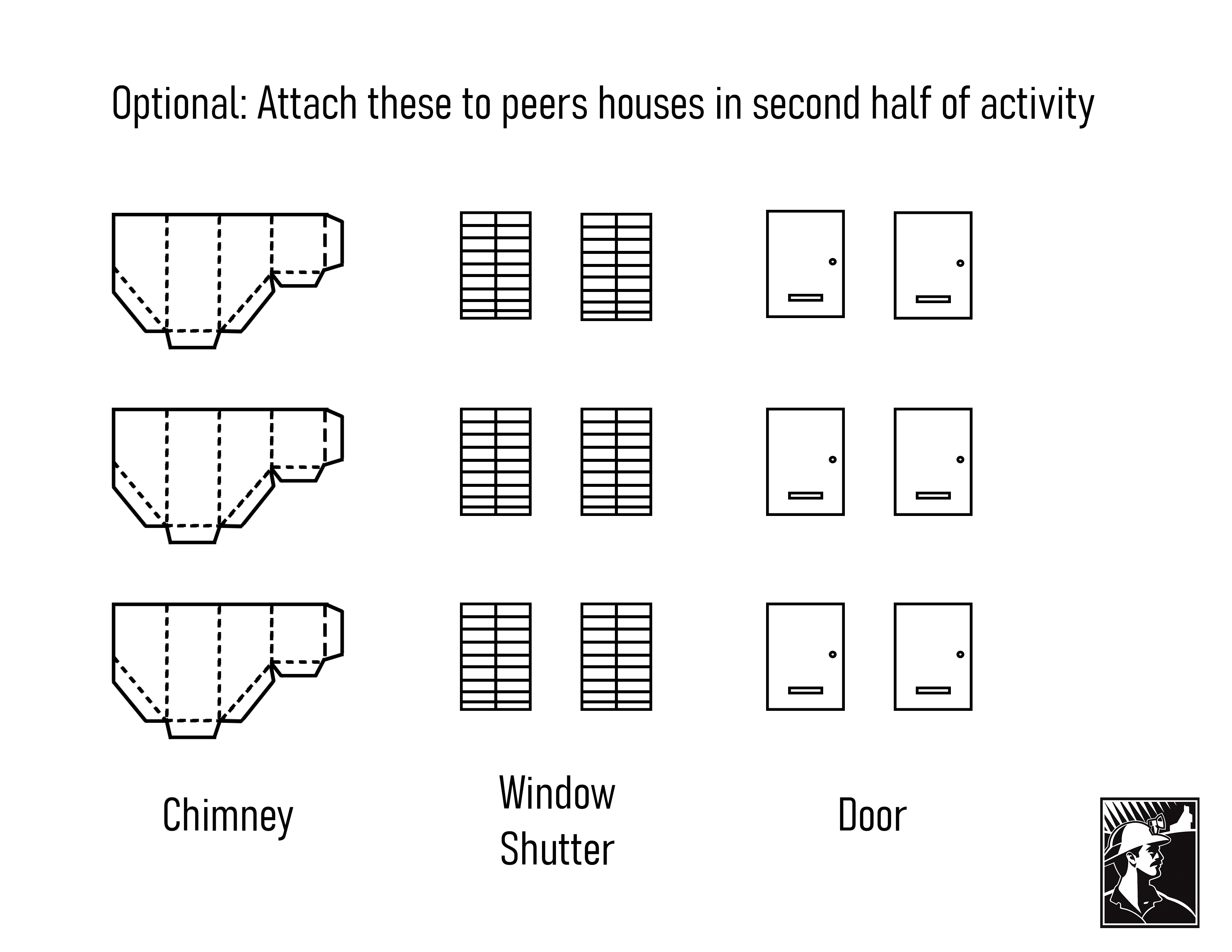
After each group has a completed building, they will pass their buildings around to one or many other groups who will then change or alter the house in some way. They can alter the houses by coloring on them or pasting the provided extra windows, doors, or chimneys.
After the house has been rotated around by each student, the building will return to the original student and see the changes done to the building over time when in the hands of other people. If time allows it, the students could be given the opportunity to restore or preserve their houses back to their original state as best as possible.
Activity Objective: The objective of this activity to have students focus on the objectives and purposes of a museum and the objects they exhibit in them.
*This activity can be done on many levels. It can be done with just one class participating or even done with another class coming in to act like “museum visitors.”
Each student is assigned or brings in an item from home and sets up a mock museum exhibit at their desk.
The goal of the exhibit is to help communicate the value of the object they are presenting about.
Exhibits can range from creating small posterboards to simply showcasing the object and talking to other students about it.
Students should write a sentence or two on an index card to explain why their object is important.
When all students have their exhibits completed, some students can move around the room while some stay at their desk and be the tour guide (showcase and explain the value behind their assigned object).
Paper Chain of Values
Activity Objective: To highlight each students individual values and how they relate and intertwine with the values held by the entire classroom.
*Make sure that students know that valuable doesn’t necessarily mean monetary value.
Each student is given a rectangular strip of paper and write something they find valuable to them.
Once all papers with values have been turned in, their slips of paper will combine to form a paper chain of communal values.
With the class, the students will see the values everyone wrote down and try and recognize the overall communal values of the classroom (i.e., if students wrote down “parent”, “grandparent”, and “siblings” then the communal value is family)
Discuss at the end how individual values impact and change communal values.
Additional Student Learning Opportunities
Field Trip – Visit the Carnegie Museum of the Keweenaw
Learn more at: Carnegie Museum of the Keweenaw *Warning* This website contains content that may not be suitable for 4th grade students.