




Photo courtesy of Sharon Fujimoto-Johnson Shigeki Fujimoto (藤本茂樹)Family and Incarceration HistoryBorn to Isaku Fujimoto, founder of Fujimoto Trading Company in Hilo, and picture bride Umeyo Fujimoto, Shigeki was a U.S. citizen by birth who was raised in part in Japan. In 1939, Shigeki married Kikue Kishii, also a U.S. citizen by birth who had been raised in Japan, in an arranged marriage. The newlyweds returned to Hawai’i, the land of their birth to start their life together. After the Japanese military attack on Pearl Harbor, the FBI sought to arrest Isaku Fujimoto because of his prominent status in the Japanese American community in Hawai’i and his business ties to Japan. However, Isaku was in Japan on business and could not return to Hawai’i as civilian transportation was shut down. In his place, the FBI arrested his son, Shigeki Fujimoto. At the time of his arrest in November 1942, Shigeki Fujimoto was 29 years old and a young husband and father. Shigeki and Kikue had two young sons. Kikue gave birth to their third son shortly after Shigeki’s arrest. Shigeki was incarcerated at Sand Island from December 1942 to March 1943, after which he was transferred to Honouliuli Internment Camp. In November 1943, Shigeki was transferred to Tripler Army Hospital in failing health. Two months later, he was paroled, and in February 1945, he was released from parole. Shigeki never fully recovered his health, and he died at 49 years old. The shells he collected in the incarceration camps carried his story across generations to his descendants. In a Granddaughter's VoiceSharon Fujimoto-Johnson, granddaughter of Shigeki Fujimoto, offers her personal thoughts regarding her grandfather's incarceration, the lasting impacts on his family, and her journey to reconcile her dark family history into a positive message for the future in this essay she wrote for Honouliuli National Historic Site.

Photo courtesy of Sharon Fujimoto Johnson My grandfather, Shigeki Fujimoto (1913-1963), was a Japanese American civilian incarcerated at Sand Island and Honouliuli during World War II. In these incarceration camps, he collected shells that became our family’s heirlooms. I never had the chance to meet my grandfather, as he died when he was only 49 years old, long before I was even born. But his shells carried his story across generations to his descendants. In my children’s book, Shell Song, I imagine the shells he collected behind barbed wire representing lost time and loneliness and also the family he had been torn away from.
Upon hearing that my grandfather’s health, both physical and mental, was deteriorating in incarceration, my grandmother decided to take the three young children all under the age of three to visit their father at Honouliuli. My father, the baby, met his father for the first time at Honouliuli Internment Camp.

Photo courtesy of Sharon Fujimoto-Johnson I have often wondered: Had my grandfather also lived a long life, would he have spoken about those years lost to the incarceration camps? Would he have been willing to voice what he endured at Sand Island and Honouliuli? Would I have had the courage to ask him to share these stories with me? Would I have had the fortitude to carry these stories alongside him? But my grandfather did not live long, and so I could not ask to hear his story in his own voice. Instead, I have returned time and again to the framework of his story, as documented by others. Time, fragments of story, and more time waft through the bare bones of his story. Standing amidst the labyrinthine, multifaceted shell of these stories, I listen for my grandfather’s voice. My grandfather and those incarcerated with him are long gone from Honouliuli, released from the isolation and injustice of this place. Their stories and their memory are ours to hold and carry forward now. But this place remembers them still. Where tents and wooden structures once stood as primitive shelters against the sweltering heat, trees grow now, covering the valley in leafy arms that extend to the open sky. When I visited Honouliuli for the first time, just after Shell Song was released, a gentle breeze moved through the vegetation like a winged memory. Honouliuli stream trickles through the valley, stagnant and muddy in places, but nevertheless, watering the vegetation that grows over our ancestors’ memory. And birds called to each other overhead, like generational bearers of story and time. And I have realized that though just an echo now, my grandfather’s voice persists because of those who continue the work of storytelling: those who tell the stories and those who listen to the stories. By preserving, hearing, and retelling the stories of those who came before us, we breathe life into stories that will continue on long after us. Our voices become part of an intricate long interwoven series of stories that connect all of us, stories in which something as small as a tiny shell can tell a story. 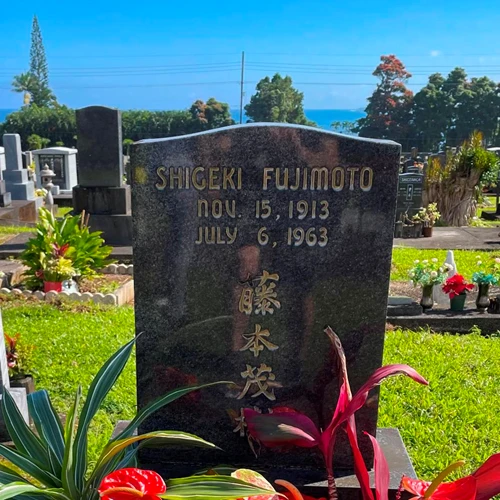
Image credit: Sharon Fujimoto-Johnson
All information on this page was provided by Sharon Fujimoto-Johnson
|
Last updated: August 5, 2026