



You are viewing ARCHIVED contentThis content was published online before January 20, 2025. Please note that this content is NOT UPDATED, and links may not work. For current information, visit https://www.nps.gov/aboutus/news/index.htm. 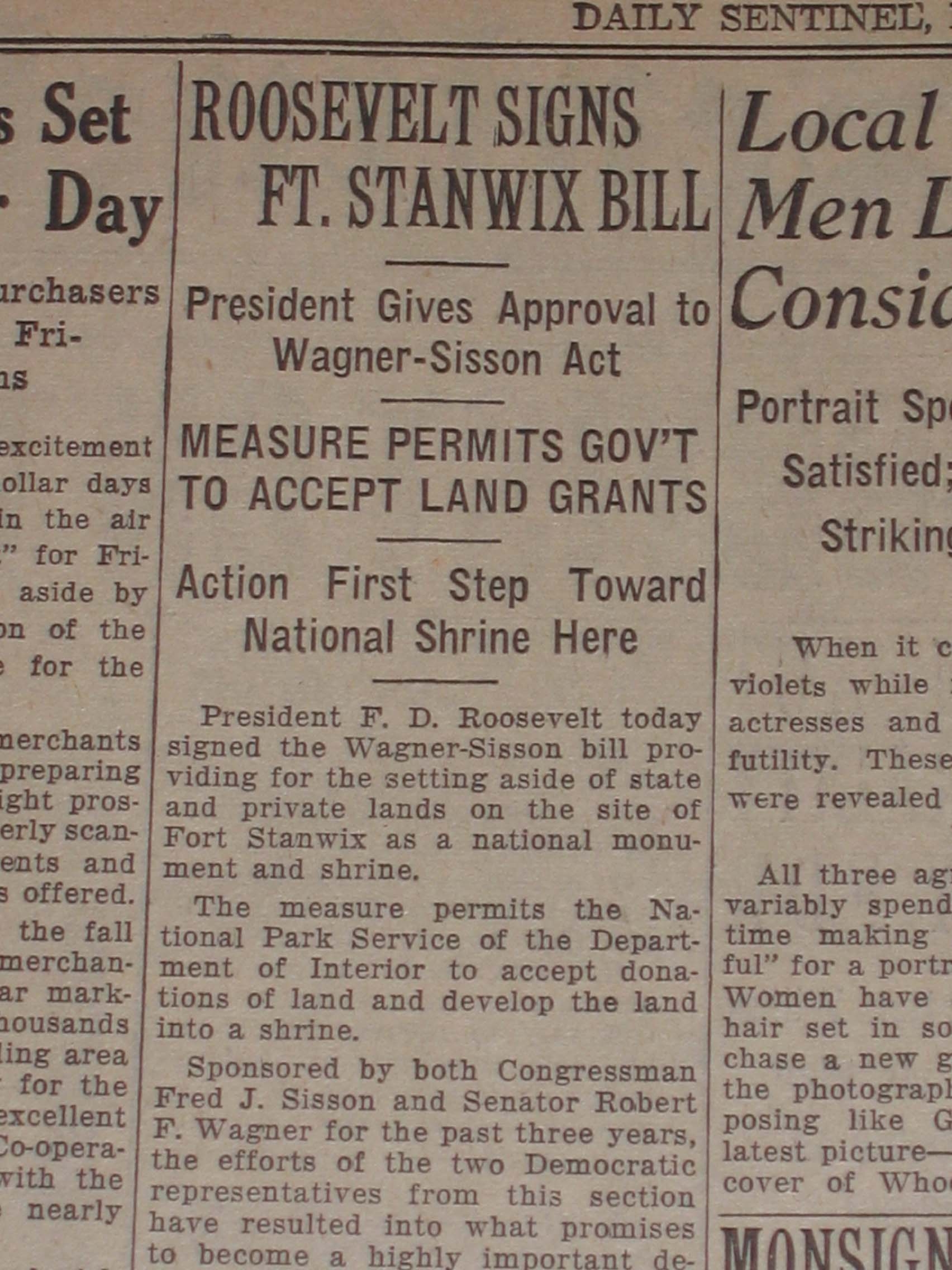
Rome Historical Society
News Release Date: August 7, 2010 Rome, NY: After years of work by citizens of the City of Rome, New York, President Franklin D. Roosevelt signed the Wagner-Sisson Bill on August 21, 1935, to establish Fort Stanwix National Monument "for the benefit and inspiration of the people." Saturday, August 21, 2010 Living History Encampment Behind the Scenes Tours Family Programs Linda Russell Concert Sunday, August 22, 2010 Living History Encampment Behind the Scenes Tours Family Programs Linda Russell Concert 1935 at the Movies at the Capitol Theater [1935 prices, 35 cents adults, 15 cents children] You may be asking yourself: "But, the fort was not opened until 1976?" This is true. The reason why the fort was not built and opened until 41 years later is that the bill, like many bills establishing National Park Service sites, had an interesting and commonly used clause: "The Secretary of the Interior is authorized to accept donations of land, interests in land and/or buildings, structures, and other property within the boundaries of said national monument as determined and fixed hereunder, and donations of funds for the purchase and/or maintenance thereof, the title and evidence of title to lands acquired to be satisfactory to the Secretary of the Interior." In other words, the property and/or the money to purchase the property had to be donated. The property was donated to the Secretary of the Interior in the 1970s. The mission of Fort Stanwix National Monument is to preserve the location and objects associated with the military, political, and cultural events that occurred at the site and provide opportunities for visitor understanding and appreciation of these events. Fort Stanwix National Monument is significant because it commemorates the broader contest of nations for economic and political control of the rich resources within the Mohawk Valley region of New York State during the 18th century: in particular, the Siege of 1777, the stories of the combatants involved, and European-American Indian and United States-American Indian relations. - NPS - |
Last updated: March 31, 2012