




Last updated: August 20, 2026
Article
Native Peoples at Mission Espada: Preserving Cultural Heritage
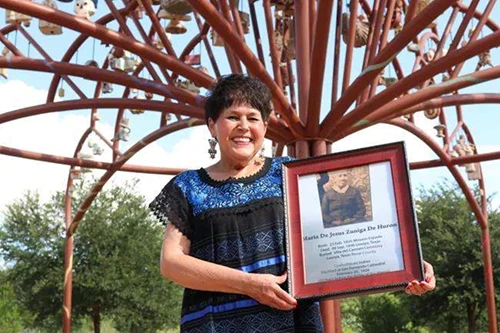
As I enter into any of the missions, I feel a connection to my ancestors who walked and lived their lives on these same grounds and more than 200 years ago. This is amazing. And to think that my Coahuiltecan Indian ancestors built the missions, one stone at a time, and created the magnificent structures that we see today. They’re still standing after 300 years. It’s a testimony to their determination.
Image credit: NPS Photo
For Native Americans at Mission Espada and their descendants, the natural landscape is inseparable from their cultural heritage, and its continuity is the priority for preservation.
For thousands of years, Native American groups prospered in the South Texas landscape. The Yanaguana River and its surroundings was their sacred site and home. Long before the introduction of Spanish missionaries, they established thriving communities in the lands where Mission Espada would later be built. The arrival of colonial forces and inter-tribal conflict pushed new bands of Native people into the South Texas area. Reasons for entering the mission system varied; however, these stresses were likely factors that led to many Native Americans to building and maintaining the mission systems.2
Mission Espada was founded as a religious complex, designed to Christianize the Native peoples. Along with manual labor, inhabitants were expected to attend church and sometimes reject their traditional culture.3 Many Native practices, beliefs, and languages were rapidly replaced by Spanish ideology and customs. In the confined space of the mission complex, intermarriage between the Spanish and Natives was common. This new lifestyle formed a new identity known today as Tejano culture. This unique social aspect was a significant reason for the establishment of an UNESCO world heritage site.4

American Indians in Texas at the Spanish Colonial Missions [7]
For generations, Native inhabitants lived, worked, and were buried on the grounds. Several descendant families continued to live on mission land after secularization. Many people today can trace their ancestry to mission inhabitants. Contemporary descendant groups work to preserve their heritage, ancestors’ home, and burial sites at Mission Espada. These groups, the National Park Service, and the Native American Graves Protection and Repatriation Act (NAGPRA),5 advocate for burials to remain untouched, or that individuals be returned and re-buried on the land.6
Mission descendants actively preserve the mission’s Native American intangible heritage, which includes traditions, oral histories, dances, stories, and religion. These elements are passed down through generations and continue to shape the lives of descendants.7 Native American heritage is evident in every aspect of Mission Espada’s identity, from the structures, grounds, and practices of its inhabitants.
Transcript
Well, Native culture of course has been completely engulfed by other cultures and by the passage of time. But I don’t think there’s anything you could do that would divorce the land from the Native Americans. They were here for, you know, 15,000, 20,000 or whatever years. And it’s their land. I think the Spanish came [and] hit Mexico in 1519, that’s 500 years or something like that. So, the Native Americans have been here, and their genetics are still here. It’s hard to tell sometimes. So, there’s still a connection. I think one of the main things is that the Native Americans were ecologically friendly to their 15,000 years [in Texas]. They didn’t put any freeways in.
Visit our keyboard shortcuts docs for details
- Duration:
- 1 minute, 21 seconds
"Mickey Killian Mission San Juan Oral History” Conducted by Anissa Johnson with the Texas Heritage Project of the American Indians in Texas at the Spanish Colonial Missions. March 26, 2025.

American Indians in Texas at the Spanish Colonial Missions [8]

American Indians in Texas at the Spanish Colonial Missions [9]

American Indians in Texas at the Spanish Colonial Missions [10]

American Indians in Texas at the Spanish Colonial Missions [11]
[1] We’re Still Here: San Antonio Mission Descendant Stories. By the San Antonio Missions National Historic Park, 2021. https://www.nps.gov/saan/learn/historyculture/we-re-still-here-san-antonio-mission-descendant-stories.htm
[2] Heath, A. (2021, September 22). Historic Tribes of Texas. The Indigenous of Texas: Native American Tribes, When and Where They lived. https://storymaps.arcgis.com/stories/ffeee03d10a043409b550b4617937428
[3] “Mickey Killian Mission San Juan Oral History” Conducted by Anissa Johnson with the Texas Heritage Project of the American Indians in Texas at the Spanish Colonial Missions. March 26, 2025.
[4] San Antonio Missions Nomination for Inscription on the World Heritage List. (2014). In UNESCO. https://whc.unesco.org/uploads/nominations/1466.pdf
[5] Native American Graves Protection and Repatriation Act. (2019). In Nps.gov. U.S. National Park Service. https://www.nps.gov/subjects/nagpra/index.htm
[6] “Mickey Killian Mission San Juan Oral History” Conducted by Anissa Johnson with the Texas Heritage Project of the American Indians in Texas at the Spanish Colonial Missions. March 26, 2025.
[7] UNESCO. “What Is Intangible Cultural Heritage?” UNESCO, 2018. https://ich.unesco.org/en/what-is-intangible-heritage-00003.
[8] ”Tāp Pīlam drummers performing at El Encuentro de Matachine” Mission San José. Photograph. Provided by The American Indians of Texas at the Spanish Colonial Missions (AIT-SCM).
[9] “Members of Tāp Pīlam preparing for overnight reburial commemoration ceremony " Mission San Juan. Photograph. Provided by The American Indians of Texas at the Spanish Colonial Missions (AIT-SCM).
[10] “Ramón Vásquez y Sánchez at El Encuentro de Matachines" Mission San Jose, 1990s. Photograph. Provided by The American Indians of Texas at the Spanish Colonial Missions (AIT-SCM)
[11] “Marisol Vásquez outside church doors. Mission Espada.” Photograph. Provided by The American Indians of Texas at the Spanish Colonial Missions (AIT-SCM).)
[12] Brown, Julie, and Clinton M. McKenzie. “The Waters of Life.” ArcGIS StoryMaps, July 11, 2024. https://storymaps.arcgis.com/stories/4eaf7e26452545c1bd72fe9f4d4260bf.
[13] Mercer, Mia. “Understanding and Celebrating Tejano History.” Tamu.edu. The College of Arts & Sciences at Texas A&M University, 2021. https://liberalarts.tamu.edu/blog/understanding-and-celebrating-tejano-history/.
[14] Unesco.org. UNESCO, 2025. https://www.unesco.org/en/about-us.
[15] National Park Service. “A Quick Guide to the World Heritage Program in the United States.” www.nps.gov, March 12, 2024. https://www.nps.gov/subjects/internationalcooperation/a-quick-guide-to-the-world-heritage-program-in-the-united-states.htm.
[16] Definition of SECULARIZATION. (n.d.-b). In www.merriam-webster.com. Retrieved August 3, 2026, from https://www.merriam-webster.com/dictionary/secularization