



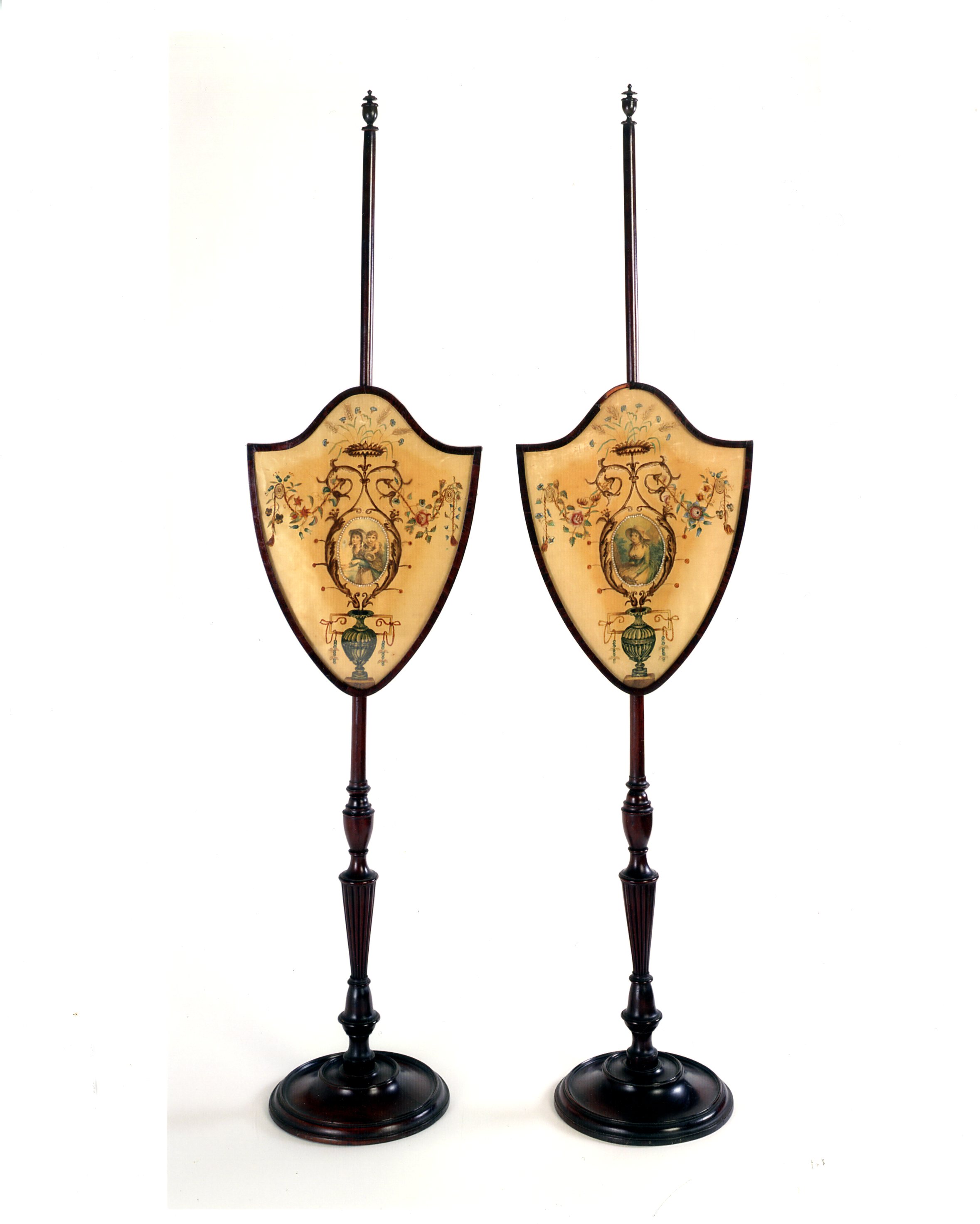
 This set of pole fire screens resided in the Long Room of Peace field when the National Park Service assumed stewardship of the site in 1946, 80 years ago this December. Family tradition states that they were originally owned by Abigail Adams, likely in the late 1700s or early 1800s. This period is often referred to as the Federal Period. At that time, fire screens were considered luxury items. Pole fire screens functioned as a tool of comfort and practicality by keeping a fire's direct heat off of the face.
Each screen has four components: a pedestal, a pole, a top finial, and a silk screen housed in a wooden frame. The silk screens feature hand-painted images of flourishes and blooming wheat emerging from an urn. The flourishes surround a center oval image lined with small pearl beads. Both shields depict a different pastoral scene at the center. The first screen shows a seated woman wearing a dress common in the 1780s and 1790s. The other screen depicts a woman carrying an infant in a sling on her back.
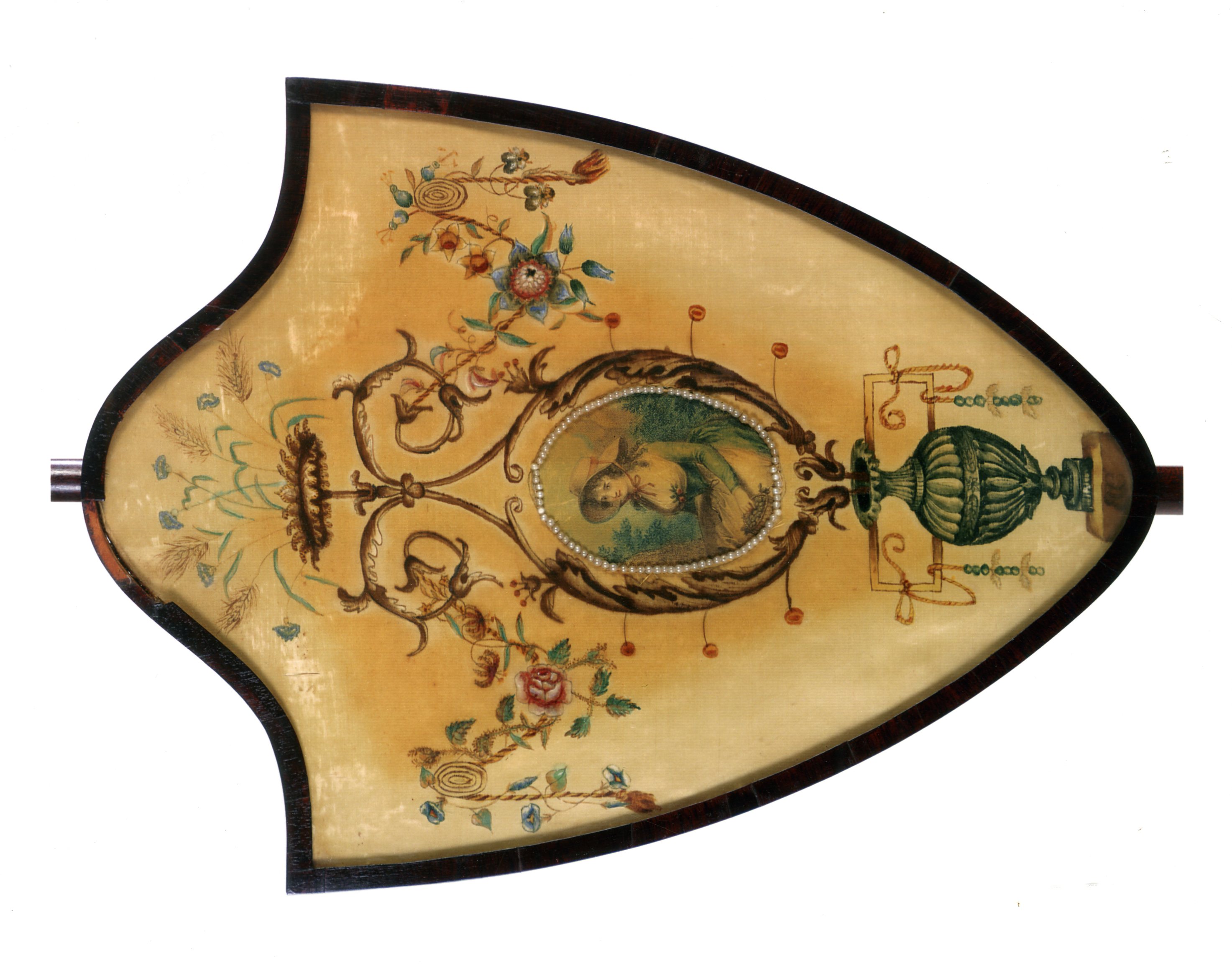
The use of fire screens began during the Medieval period to trap embers and sparks inside massive, open fireplaces.4 Over the following centuries, the shape and purpose of fire screens evolved. By the Chippendale Period of American furniture (1750-1780) pole fire screens became popular for their decorative and practical use. Practically, the pole’s design allowed the user to slide the screen up or down to match their height. Fire screens also provided a canvas for many women to display their skills in the domestic arts by embroidering and painting the screens.5 It is unlikely that Abigail painted these screens. The monogram “ECC” is painted at the base of the urn, most likely the initials of the craftsperson or painter.
The Adamses likely used these fire screens during cozy evenings by the fireplace. Pole screens kept the Adamses and their guests comfortable by shielding their faces from the heat of a roaring fire. The Adamses did not have modern comforts like central heat, but these fire screens show us that they prioritized making their home comfortable and fashionable.
Dimensions: The poles are 146 cm [57.48”] tall. The shield-shaped screens are 37 cm [14.56”] wide and 44 cm [17.32”] tall.
1. Edgar G. Miller, Jr., American Antique Furniture, Volume 1, (New York: Dover Publications, 1966), 51.
2. George Hepplewhite, The Cabinet-Maker and Upholsterer’s Guide, Third Edition. (New York: Dover Publications, 1969), 17.
3. Troy Segal, “How to Identify Hepplewhite Style Furniture,” The Spruce Crafts. August 13, 2019.
Miller, 51 & 52.
4. “Fireside Companions: Historical Fire Screens," Eldvarm. August 8, 2024.
5. William C. Ketchum, Jr., American Furniture: Chests, Cupboards, Desks, & Other Pieces. (New York: Chanticleer Press, 2000), 326.
Jonathan L. Fairbanks and Elizabeth Bidwell Bates, American Furniture, 1620 to the Present. (New York: Richard Marek Publishers, 1981), 139.