



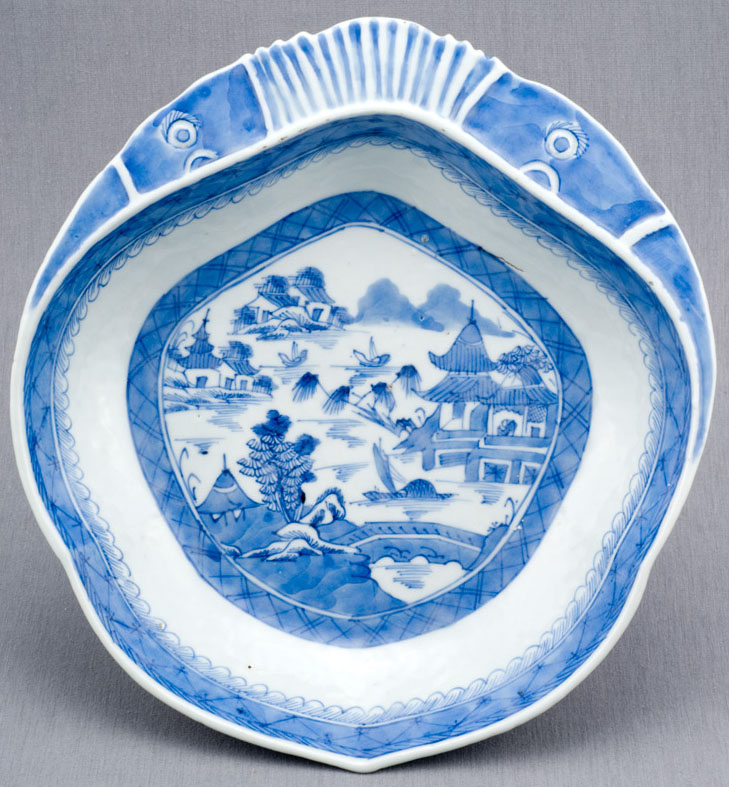
This blue and white Chinese export bowl is attributed to Abigail Adams and dated circa 1780. Such type of porcelain was first produced by the Chinese in the 1600s and 1700s. Chinese artisans began crafting what is known in the West as “hard past” porcelain. This type of porcelain was made from clay blended with the mineral kaolin and fired at 1400°C, resulting in durable glass-like vessels that resisted chips and cracking.
Chinese export porcelain had reached European port cities as early as the 1300s, becoming a highly valued luxury commodity. By the 1500s, as trade routes expanded, such exports circulated in increasing volume alongside tea, silk, ivory, and other goods. Blue-and-white tableware dominated the market. European nations developed their own porcelain manufacturing plants in the 1700s, making Chinese wares less fashionable in Europe. However, the pieces remained highly sought after in the American colonies, where such items were more difficult to acquire.
This bowl belongs to a larger set of Chinese export porcelain that is part of the museum collection on exhibit at Peace field. The entire service, consisting of cups and saucers, platters, plates, vegetable dishes, serving dishes of multiple sizes, covered custard cups, sauce boats, and bowls, were donated to the National Park Service by the Adams Memorial Society in 1946.
The Blue and white bowl is typical in its coloring and decoration with a river scene framed by trellis and cloud-band borders. However, it stands out having a unique shell shape with a double whale ear rim. Abigail may have used some of the export dishes like this bowl for the family’s meals at their home on the farm at Penn’s Hill and later at Peace field, the home she and John purchased in 1788. The bowl was also used at Peace field by multiple generations of the Adams family who lived at Peace field after John and Abigail.
John Adams’s diplomatic mission to the Netherlands in 1780 created an opportunity for Abigail Adams to obtain these coveted goods. While seeking loans and negotiating a commercial treaty, John became a supplier for the household needs—and entrepreneurial ambitions—of Abigail Adams. During their long separation, Abigail used her letters not only to stay connected but to request items that were scarce in Massachusetts. These goods, once obtained, would be sold to supplement her income at home and support the farm.
In this excerpt Abigail explained in a letter of November 24, 1780, to John who was stationed in Holland, she was forwarding bills and a detailed list of desired goods:
“I have twice before enclosed a set of Bills, received from Mr. Lowell for you. I venture to detain one hoping for an opportunity to send to Holland. I enclose it now together with a list of Articles if you think you can afford them to me…1 doz. Of blew and white china teacups and saucers….and half a doz. pint china Bowls…”
Abigail’s list extended well beyond ceramics to textiles, personal accessories, and household tools, all items she could not easily acquire locally. The following list appears on the back of the above letter to John:
…..26 yards of Dutch bed tick
2 Gray muffs and tippets
2 Bundles of english pins
2 sets of House Brushes
1 doz. of blew and white china tea cups and sausers
half a doz. pint china Bowls
half a doz. diaper table cloths 2, 5 Ells wide 2 four 2 three.
one Scotch carpet 4 yards square or 6 Ells.
half a doz. white gauze hankerchifs the same size that the black…
Dimensions: Length 26 cm [10"] ; Diameter: 24 cm [9"]
View Past Objects of the Month
1. Adams, Abigail to John Adams, November 24, 1780, Massachusetts Historical Society, Adams Family Papers.
2. Harris, Wilhemina. 1983. Adams National Historic Site: A Family’s Legacy to America. Washington, DC: U.S. Department of the Interior, National Park Service.
3. Holton, Woody. 2009. Abigial Adams. New York: Free Press.
4. Li, Xinxin, and Iarîna Savițkaia Baraghin. 2025. “Review of The Spread and Influence of Chinese Porcelain in Europe during the 17th–18th Centuries.”. Review of Artistic Education 29 (May): 288–92.
5. Sable, Charles. 2022. “Review of The China Trade in the 17th- and 18th-Centuries.” The Henry Ford. June 22, 2022.