



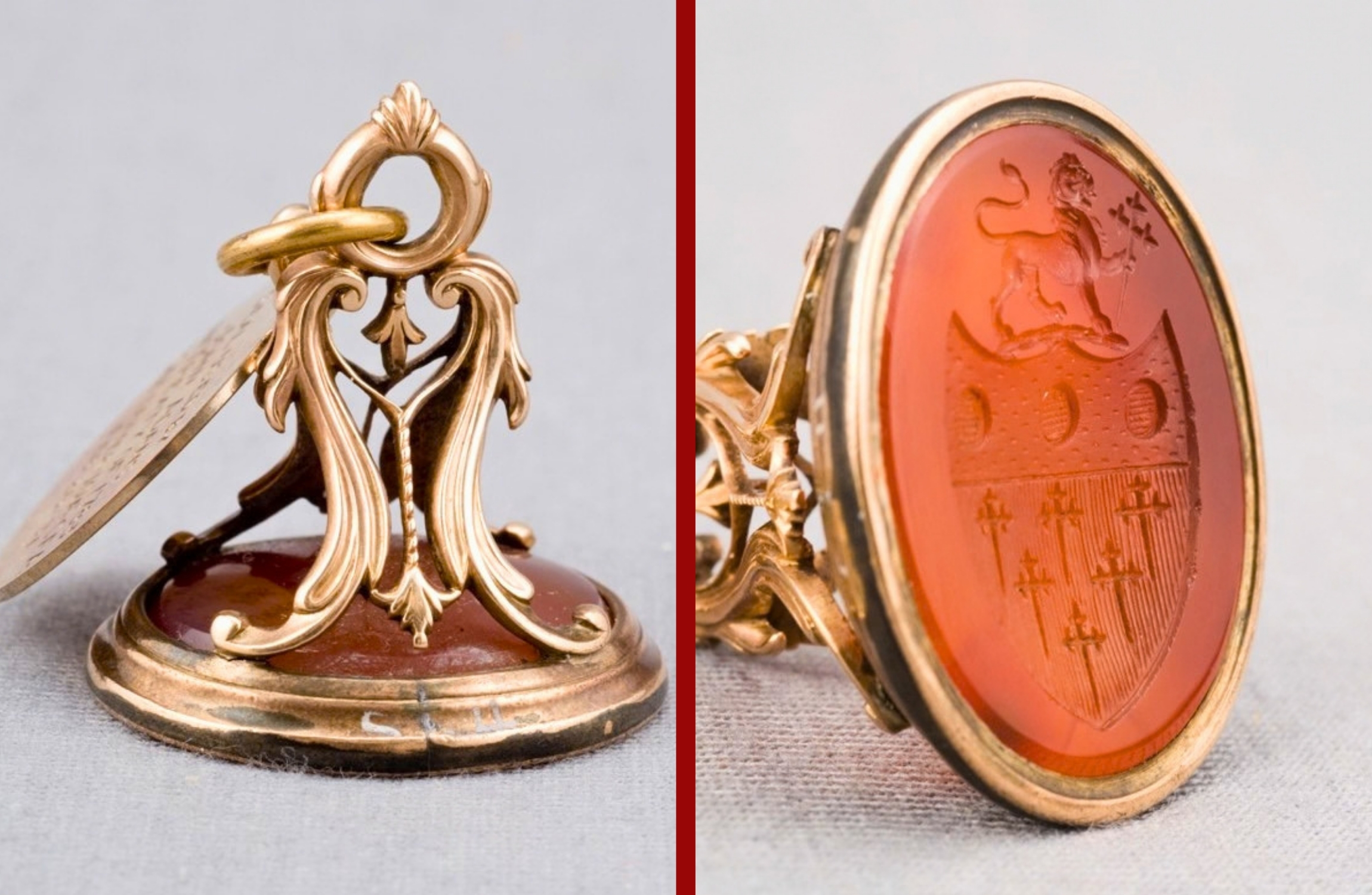
Left: The fob attached to the wax seal.
Right: The seal depicting the Boylston coat of arms.
In 1783, John Adams was one of the five ministers that wrote and signed the Treaty of Peace that ended the American Revolutionary War. When ministers would sign a treaty, they would affix a seal beside or under their name. At the time, John did not have a seal of his own. Henry Adams II shares: “When in 1783 John Adams, as one of the plenipotentiaries, signed the Treaty of Peace with Great Britain, having no seal of his own he used a seal of the Boylston family which he had inherited from his mother, Susanna Boylston (1708-1797).”
The seal is made from carnelian. Carnelian is a variety of chalcedony, a mineral in the quart’s family and this gives the seal its reddish color. It ranges in color from light orange to deep reddish-brown. In John Adams’ time the image of the seal was carved into a stamping instrument called a matrix. Hot wax was then pressed into the matrix and onto paper. The matrix could be put into a piece of jewelry or attached to a watch or ring. The Peace Treaty seal is attached to a gold fob. A fob is any small decorative object, such as a medallion, charm or ornament attached to a seal, pocket watch or key.
The history and usage of seals go back to ancient and medieval times. Seals were used throughout the colonial era and into the beginning of the nineteenth century. Because seals were unique to individuals, they could be used to confirm someone’s identity and to verify legal documents.
John Adams originally used the Boylston family seal as Minister of the American States to Holland. In this role, Adams issued passports to Americans in Europe. Adams designed his seal by taking his mother’s Boylston family seal. Adams added to the seal the same embellishments of feathers and roses with petals that fellow Minister Benjamin Franklin used on his seal. This design was then carved on wood.
John Adams gave the seal to his son, John Quincy Adams (1767-1848). John Quincy then passed it onto his son Charles Francis Adams (1807-1886). John Quincy Adams wrote to his son Charles Francis, Quincy, 27 October 1833:
In this letter to his son, John Quincy, shows us the importance of the Boylston Seal as a family relic and an object of family pride that continues to keep the memory of John Adams alive.“My Dear Son: With this I deliver to you my Father’s Seal which was affixed to two Treaties of Peace with Great Britain of 30 November 1782, and of 3 September 1783, by which the Independence of the United States of America was recognized and the War of the American Revolution was closed…. I now put it into your hands to be kept as a trust, until I shall call for it during the remainder of my life. After my decease you will retain it as your own property; but it is my desire that if your Son, this day baptized…. prove a descendant worthy of him whom the Seal first belonged, you should leave it to him to be transmitted down in like manner, so long as it shall please Heaven to continue the family and the name, as an admonitory Memorial of John Adams, one of the Chief Founders of the American Independence….” I am your Affectionate Father, John Quincy Adams
Dimensions: The seal is 2.5 cm long, 2.0 cm wide and 4.0 cm tall.
At time of posting, this object is available to view on a guided tour of Peace field. Tours are offered during our season (May 1 – October 31) and ticket reservations must be made in-person at the Adams NHP Visitor Center.
The Books of John Quincy Adams in the Boston Athenaeum With Notes on Books, Adams Seals and Bookplates, by Henry Adams Printed for Boston Athenaeum, 1938 (Boston) pp. 135-137.
Harris, Wilhemina. 1966-1968. Historic Furnishings Report of the Old House, Adams National Historic Site, Quincy Massachusetts, Volume VI, pp. 532-534.
Karakas, Candice. 2025. “The Meaning of Carnelian: Ignite Your Inner Fire.” Crystalline Dream. May 11, 2025.
“Secrets of the Seals | Beehive.” 2023. Masshist.Org. February 17, 2023.