



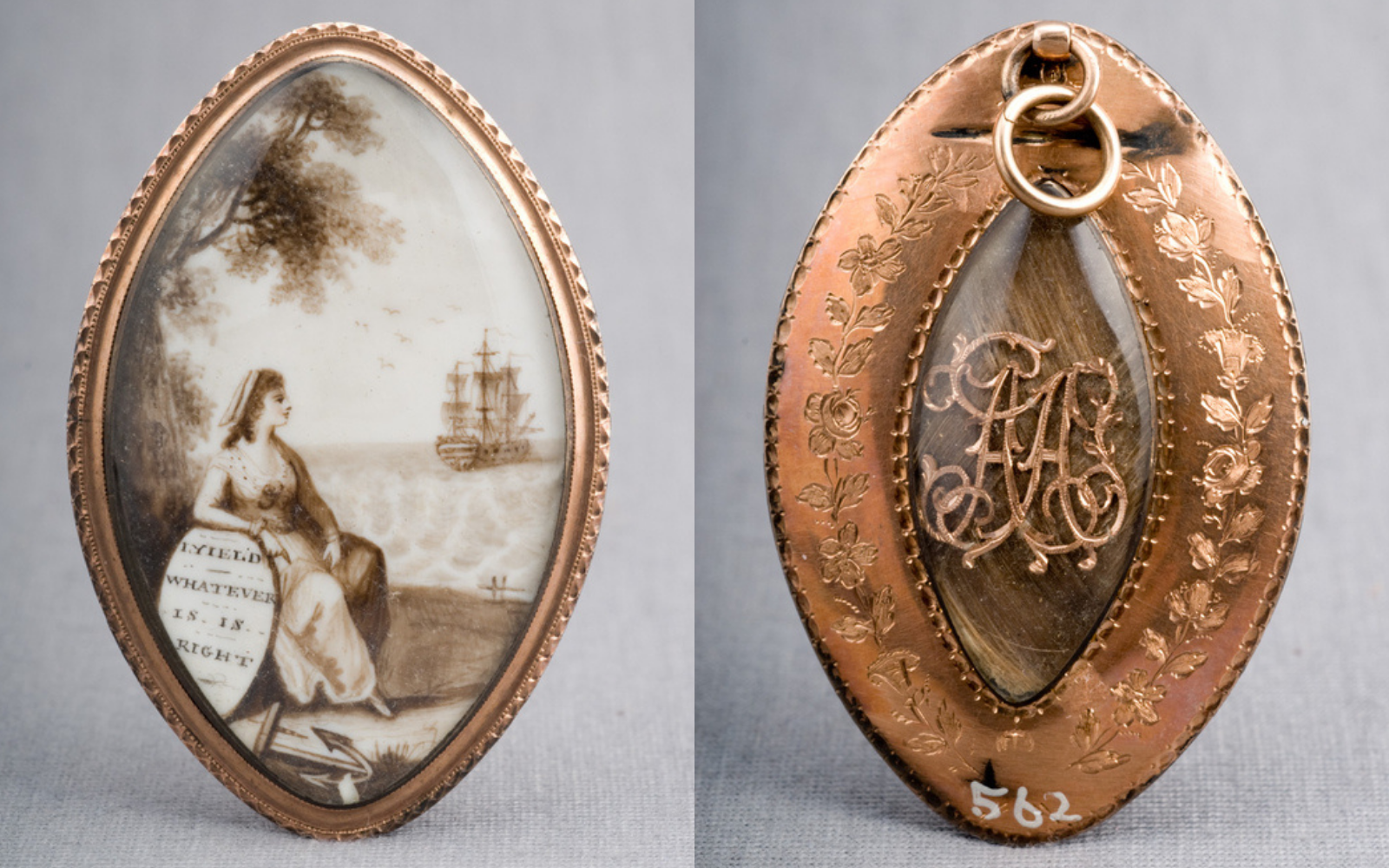
John gave this locket to Abigail when he left for Europe in 1779 to serve as a Peace Commissioner. The gold locket contains braided hair under a glass cover. An inscription inside reads, “Hair of John and Abigail.” The front of the locket shows a painted image on ivory of a woman looking out at the sea while holding a shield. The shield is inscribed with the words, “YIELD WHATEVER IS IN THE RIGHT.”
No one knows exactly where the locket came from. John may have bought it in Philadelphia while serving in the Continental Congress before leaving for Paris in February 1778. Even during the war, merchants were still selling goods at that time.
The locket may also have been bought in France. John was chosen to serve as a joint commissioner to France with Benjamin Franklin and Arthur Lee. He sailed to Paris with his young son, John Quincy, and arrived there on April 1, 1778.
More than a year later, John and John Quincy returned home in June 1779. While he was home, John wrote the Massachusetts State Constitution. John was In September, he was chosen to help negotiate peace and trade treaties with Great Britain. Before leaving again, he is believed to have given the locket to Abigail.
That December, John sailed back to France with his sons John Quincy, who was 12, and Charles, who was 9. During the trip, their ship, the La Sensible, developed a leak and had to stop in El Ferrol, Spain. From there, they traveled across northern Spain by carriage and donkey before arriving in Paris on February 9, 1780.
Abigail did not see John again until the summer of 1784, when she arrived in London after the war. The locket became a symbol of their many years apart and of John’s caring and emotional personality.
Lockets have been important throughout history since the 1400s. Men and women wore them as pendants, brooches, or rings that held portraits or scented cloth. By the 1600s, lockets became symbols of mourning and political beliefs. In the 1700s, new styles became popular, including “eye” lockets with painted eyes of loved ones. Hair placed inside lockets also became more decorative and visible.
Over time, lockets changed with fashion trends. In the 1980s, engraved Victorian-style lockets became popular again. In the 1990s, simple heart-shaped lockets were fashionable. In the 2000s, lockets often included birthstones and decorative gems.
British locket collector Sheherazade Goldsmith explained why lockets are still meaningful: “They’re heirlooms that represent a moment in time…walking in London I’d come across engraved silver hearts in Portobello Road antique stalls and wonder about the stories.”
As Goldsmith’s quote suggests, lockets remain popular because they hold personal stories and memories. Abigail’s locket tells its own story. The woman on the front of the locket is looking out to sea, which connects to John leaving for diplomatic work overseas. The image reminds us of Abigail once again saying goodbye to her husband. Inside the back of the locket is hair from both John and Abigail, helping Abigail feel that John was still close to her heart even when they were far apart.
Dimensions: The locket is 5.0 cm tall and 3.8 cm wide.
Grantham, Samantha. 2024. “Love and Mourning: What’s inside of a Locket? - Wenham Museum.” Wenham Museum. August 14, 2024.
Harris, Wilhemina. 1966-1968. Historic Furnishings Report of the Old House, Adams National Historic Site, Quincy Massachusetts, Volume X.
“History of the Locket | Lockets Past and Present.” n.d. With You Lockets.
Massachusetts Historical Society: Adams Family Timeline. 2025.
Rachel Church. 2023. “The Surprising History of the Locket.” Victor Mayer. February 20, 2023.