




NPS / Abi Farish Located in Washington, Iron, and Kane Counties in southwestern Utah, Zion National Park encompasses some of the most scenic canyon country in the United States. Within its 232 square miles are high plateaus, the Virgin River and its tributaries, and a maze of narrow, deep, sandstone canyons. Zion also has 2,000-foot Navajo Sandstone cliffs, pine- and juniper-clad slopes, and seeps, springs, and waterfalls supporting lush and colorful hanging gardens. With an elevation change of about 5,000 feet – from the highest point at Horse Ranch Mountain (at 8,726 feet) to the lowest point at Coal Pits Wash (at 3,666 feet) – Zion's diverse topography leads to a diversity of habitats and species. Desert, riparian (river bank), pinyon-juniper, and conifer woodland communities all contribute to Zion's diversity. Neighboring ecosystems – the Mojave Desert, the Great Basin, and the Rocky Mountains – are also contributors to Zion's abundance. 
The park has more than 1,000 species of plants ranging from tall, graceful cottonwoods growing along the river to towering pines and firs shading the higher elevations. Prickly pears, cholla, and yucca are among Zion's desert-adapted plants. The hanging gardens support brilliantly-colored Zion shooting-stars, scarlet monkeyflowers, and Western and golden columbines. 

NPS photo The natural and cultural resources within Zion National Park are studied and managed by the Resource Management and Research Division of the park. 
Geology
Zion's geology is both ancient and dynamic. 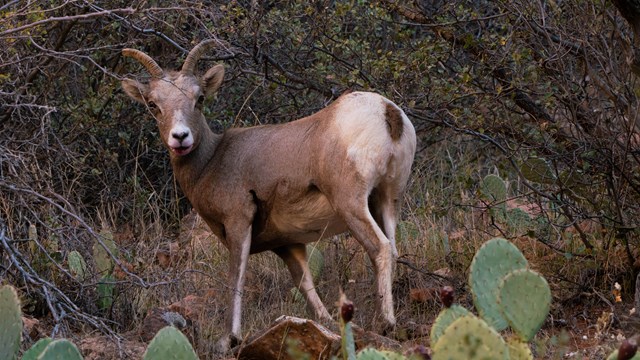
Animals
A variety of wildlife can be found in Zion. 
Plants
Zion National Park has a diversity of plant communities 
Zion Wilderness
83% of Zion is designated as Wilderness. 
Inventory and Monitoring
Scientists in Zion collect, interpret, and manage data to help manage and protect the park's resources. |
 |
|
Last updated: March 19, 2026