National Park Service LogoU.S. Department of the InteriorNational Park ServiceNational Park Service
National Park Service:  U.S. Department of the InteriorNational Park Service Arrowhead
Whitman Mission National Historic SiteBackhoe digging new streambed
view map
text size:largestlargernormal
printer friendly
Whitman Mission National Historic Site
Returning a Stream: The Doan Creek Restoration Project
Steelhead in irrigation ditch.

NPS photo

A rare sighting of a steelhead in the park's irrigation ditch, but there is no viable habitat to be found here. When Doan Creek is restored, steelhead and other fish will have a place to live and reproduce.

Water is Life! 

But who gets the water? In its natural state, Doan Creek offered ideal habitat for many species of plants and animals, including steelhead trout and salmon. Water is also life for people. Settlers diverted water from Doan Creek to provide irrigation for farmland. Doan Creek water was channeled into a straight, man-made irrigation “ditch,” leaving the original streambed dry. But this wasn't the only stream or river in the area that was altered. Dams and irrigation projects decreased habitat and access to spawning areas for fish. Since the time of the Whitmans, steelhead and salmon have experienced drastic population declines and have been declared threatened or endangered. Water and the adjacent riparian areas are critical to other animals as well, especially in the relatively dry Walla Walla valley.

A plan to restore fish habitat on park grounds started in 1998. As the idea developed upstream water users also got involved. Today, the park, several private landowners, other government agencies, Whitman College,  Walla Walla University, along with many volunteer groups, are working together on this project. Eventually there will be 3.1 miles of river habitat for fish and other wildlife. This will be accomplished while still providing enough water to other users.

 
Tall green grass recedes into the distance.

NPS photo

A deceptively lush looking field of invasive, non-native reed canarygrass.

Challenges

Creating a New Stream Bed
The “new” Doan Creek was carefully planned and constructed.

Good Plants vs "Bad" Plants
Non-native, invasive plants can take over an area, excluding the native plants and providing less food and shelter for native animals.

Measuring Vital Signs
Water needs to have certain characteristics in order to provide a good home for salmon and other fish.

Water Enough for All
The park wants to ensure that all of the water rights holders in the area receive their allotment of flow even as the old Doan Creek channel is restored.

 
Ditch with two small piles of wood in it.

NPS photo

At this moment the new creekbed is only a dry ditch with piles of debris, but in the future these piles will help create pools and riffles in the restored Doan Creek.

An Ugly Duckling . . . For Now

To restore a stream takes time, and it is not always pretty:

  • Invasive vegetation gets cleared leaving bare land.
  • Backhoes dig naked trenches.
  • Future riffles look like random piles of debris littering the barren landscape.
  • Mulch cloth, used to prevent the return of non-native invasive plants, makes ugly black scars.

But, each of these necessary steps is temporary and eventually the awkward days of transition will be forgotten.
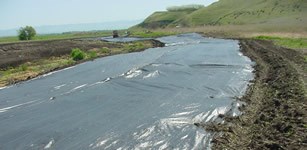
 
Shiny black cloth dominates the photo, beyond the cloth the ground is bare of vegetation.
NPS
Newly laid mulch cloth dominates the landscape like an ugly scar in 2006. This cloth will help prevent the re-establishment of the aggressive, invasive, non-native reed canarygrass. Eventually native shrubs and grasses will be planted through holes in the cloth.
 
A baby moose under a tree.

NPS

This baby moose and family spent part of summer 2006 on park grounds. Moose depend on riparian habitat.

A Brighter Future

It make look ugly during the restoration process, but like the Ugly Duckling, a swan will emerge. The sound of running water will return, lush vegetation will shade a gurgling stream, and thankful eyes will peer out from behind leaves.


We can't do it alone

Restoring the section of Doan Creek that is within the boundaries of the park is a huge project. The effort of many, many people has been involved. The National Park Service (NPS), Walla Walla County Conservation District (WWCCD), and Washington State Fish and Wildlife Service collaborated on the design of the restored Doan Creek. The actual construction of the stream was accomplished in 2005, with the help of many volunteers. The project was supervised by staff from the NPS , WWCCD, and Washington Fish and Wildlife. The Doan Creek restoration is an example of what can be accomplished through collaboration and lots of hard work.
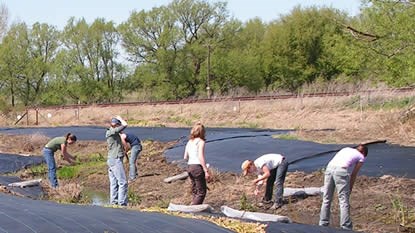
 
Four students and their leader plant willow and alder sticks on the banks of the new Doan Creek channel. The railroad tracks are immediately behind them.
NPS photo
In 2007, Whitman College students planted hundreds of live stakes, mostly of alder and willow. Some of these will eventually grow into trees that will shade the new stream. The black areas are mulch cloth, a specialized cloth barrier to prevent the growth of non-native, invasive plants.


Written with the help of Kari Martin, Spring 2007 Whitman College water-monitoring intern. Revised October 2008.
Oregon Trail Wagon  

Did You Know?
Wagons used on the Oregon Trail had to carry nearly 2000 pounds of supplies. They traveled 2000 miles or more to the Oregon Country. Most wagons were pulled by oxen as they could eat the prairie grass and survive without lots of food for lengthy periods.

Last Updated: October 25, 2008 at 19:17 EST