
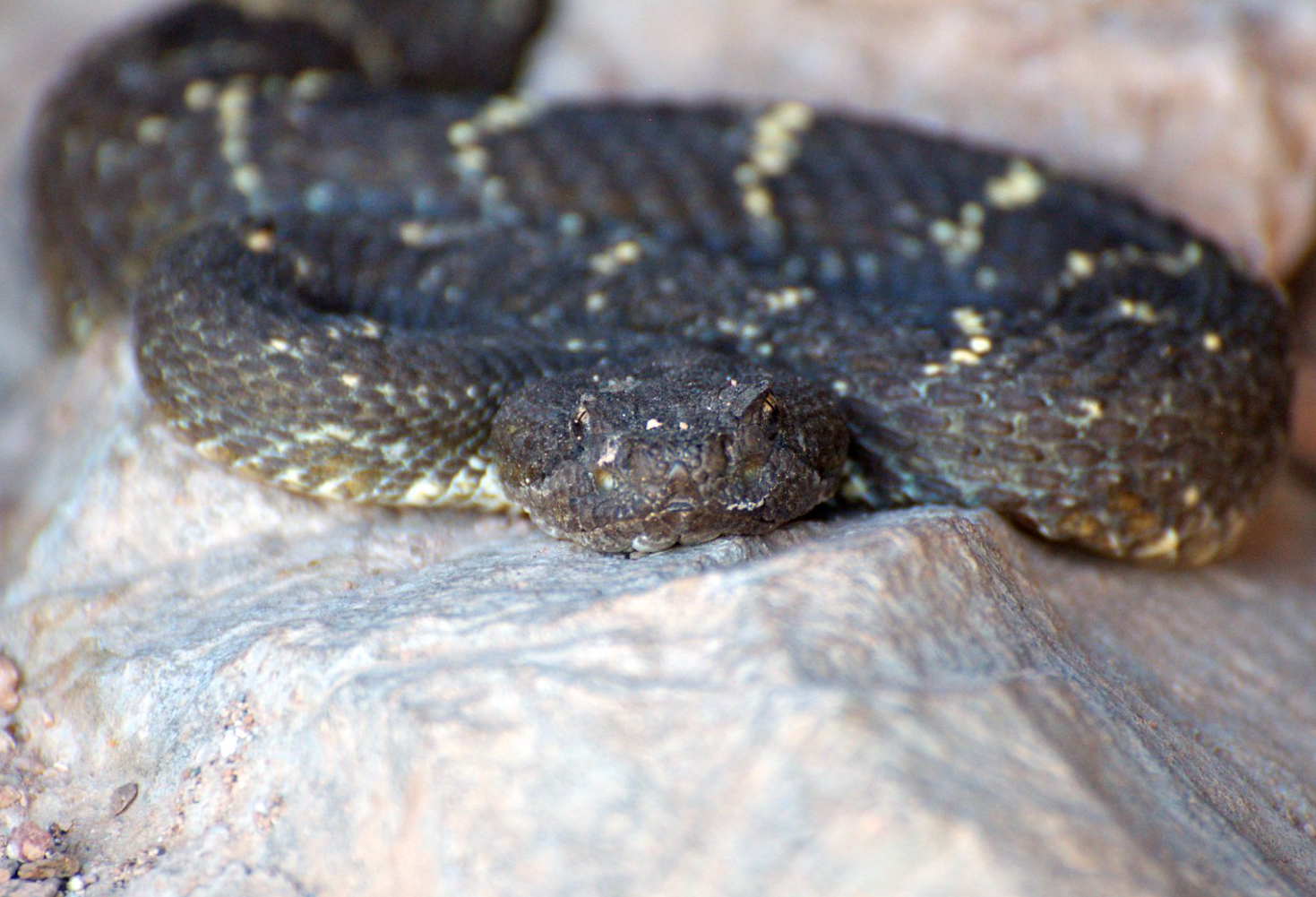
OverviewThe Arizona black rattlesnake (Crotalus viridis cerberus) makes its home at higher elevations in Arizona and far western New Mexico. The snake’s use of high-altitude habitat and its black coloration as an adult distinguishes it from other subspecies of the western rattlesnake (Crotalus viridis), which prefer lower elevations and range from tan to reddish in color as adults. These physical and habitat differences are also reflected in genetic differences that suggest that the Arizona black rattlesnake may be a new species of rattlesnake. Despite the species’ limited range, basic biological information needed to make management decisions is lacking for most Arizona black rattlesnake populations. To address this need, U.S. Geological Survey (USGS) scientists conducted research on the species in Arizona national park units from 2003 to 2005. The research examined relative population abundance, movement patterns, range requirements, dietary habits, and winter and summer habitat. Research in Arizona national parks was made possible through the support of the Western National Parks Association, Tonto National Monument, and the USGS Science Internships for Workforce Diversity Program. Importantly, the park-based research was used to augment a long-term mark-recapture study of the species that has been conducted by USGS biologists at sites near Flagstaff, Arizona, since 1999. USGS researchers were the first to conduct extensive studies of this species in the wild. Research FindingsPart of the research effort involved surveying Walnut Canyon National Monument, Saguaro National Park, and Tonto National Monument for Arizona black rattlesnakes. USGS biologists worked with park staff and volunteers of each park unit during the primary season the snakes were expected to be active, late March through early October. They survey teams systematically searched areas and recorded basic statistics for each rattlesnake encountered. These efforts resulted in the identification of a relatively small number of Arizona black rattlesnakes. For this reason, it was not possible for scientists to determine specific population numbers for individual park units. In terms of relative abundance, the research team estimated that the species was most abundant at the highest elevations in Saguaro National Park, less common in Walnut Canyon National Monument, and rare at the lower elevations in Tonto National Monument. Interestingly, the species appears to coexist with the Hopi rattlesnake (Crotalus virdis nuntius), a subspecies of the western rattlesnake, at Walnut Canyon National Monument. More extensive research activities took place at Tonto National Monument because park managers there needed information about the movement patterns and behavior of Arizona black rattlesnakes, which were frequenting wash areas used by visitors. Adult Arizona black rattlesnakes captured in Tonto National Monument were implanted with radio transmitters. The transmitters allowed scientists to track the movement of individual snakes. This project was the first radio telemetry study of the species. USGS research indicated that Tonto National Monument, which is located in the upper reaches of the Sonoran Desert, is apparently at the the lower elevation limit for the Arizona black rattlesnake, which tend to prefer moister and cooler habitats. Within the monument, the snakes made use of moist habitats and dense vegetation. Scientists were also able to determine that Arizona black rattlesnakes did not spend much time in developed areas like trail and visitor areas. The snakes are thought to travel through developed areas on their way to more natural areas that offer them more protection and denser cover. USGS research indicated that Arizona black rattlesnakes in the monument mate in late summer and fall, coinciding with summer rains. Scientists also witnessed a male snake coil in a tight circle completely on top of a female, a behavior known as "stacking", during courtship. This behavior had not previously been seen in Arizona black rattlesnakes. Another finding of interest is that female Arizona black rattlesnakes appear to produce four to five young. Scientists captured an adult female in May that was found to contain five ovulated eggs. The snake subsequently became pregnant and was presumed to have had four to five young in August. As is typical of other rattlesnake species, female Arizona black rattlesnakes appear to stay with their young until the young first shed their skins, approximately one or two weeks after birth. The hibernation period for rattlesnakes in Tonto National Monument lasts from late October through March, which is approximately two months shorter than the hibernation period observed for the species near Flagstaff, Arizona. The hibernation sites used by the rattlesnakes observed in Tonto National Monument, however, were similar to those used by the Flagstaff-area populations and featured slopes formed by rocky debris. Research ImplicationsArizona black rattlesnakes were found to be relatively rare within the three Arizona national park units in which USGS research was conducted. Additionally, the research indicated that the species prefers specific habitats during both the summer active season and the winter hibernation season. This information can be used by park managers who may want to examine conservation strategies for the Arizona black rattlesnake because of its apparent rarity in the parks. For example, fire management plans can restrict prescribed burns in rattlesnake habitat during the period when snakes leave their hibernation sites and when young are more vulnerable. In terms of managing possible rattlesnake-human conflicts, visitors could be alerted to the possibility of finding the snakes in certain habitats during the summer. If an Arizona black rattlesnake does need to be removed for safety reasons, then USGS research suggests that a fairly short-distance relocation of less than 50 m (164 ft) is preferable because of the fairly specific habitat needs of this rattlesnake. By better understanding rattlesnake behavior, park managers can not only reduce negative rattlesnake-human encounters, but also ensure that this fascinating creature has a place in Arizona national parks. For More InformationUS Geological Survey Fact Sheet (April 2006) Nowak, E., and J. Schofer. 2005. Initial surveys to locate Arizona black rattlesnakes (Crotalus viridis cerberus) in Arizona national parks and monuments: Layman report (04-14) submitted to Western National Parks Association, U.S. Geological Survey Colorado Plateau Research Station, 3 p. Nowak, E. 2006. Ecology of the Arizona black rattlesnake (Crotalus [virdis] cerberus) at Tonto National Monument, Arizona: Final report submitted to Desert Southwest Cooperative Ecosystem Studies Unit, U.S. Geological Survey, Colorado Plateau Research Station, 18 p. |
Last updated: June 3, 2022