-
Changes to Some Opening/Closing Dates for Services and Facilities – Check Back for Updates
Some of the opening/closing dates for facilities and visitor services in the parks have changed due to weather and/or other circumstances. See link for details and match to locations on the park map (under "Park Tools," bottom left, this page). More »
-
Road Construction Delays (if Entering/Exiting Hwy. 198)
Expect minimal construction delays on main road through parks (Generals Hwy) through June 2013 on weekdays generally from 7 a.m.-6 p.m. See link for schedule. Call for 24-hour road conditions info: 559-565-3341 (press 1, 1, 1). More »
-
Vehicle Length Limits Have Changed in Sequoia NP (if Entering/Exiting Hwy 198)
Planning to see the "Big Trees" in Sequoia National Park? If you enter/exit via Hwy. 198, please pay close attention to new vehicle length advisories for your safety and the safety of others. More »
-
You May Have Trouble Calling Us. Use the "Contact Us" Link (Bottom Left) to Send an E-mail.
We are experiencing technical problems receiving some incoming phone calls at the parks. We apologize for the inconvenience. Please keep trying to reach us or check this website for frequently-asked questions. The search box (top, right) may be helpful.
-
Prescribed Fires Planned at Ash Mountain/Sequoia National Park (Parks' South Entrance)
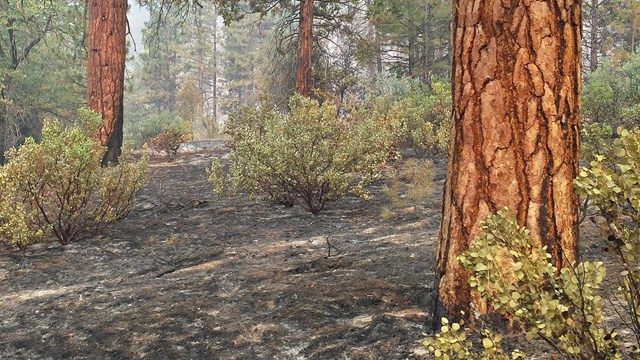
Fire crews will be working on hazard fuel reduction project at Ash Mountain (south entrance) starting May 23. There are nine small burn segments near the south entrance. The fire may be visible from the road and will produce smoke for very short periods.
Plants
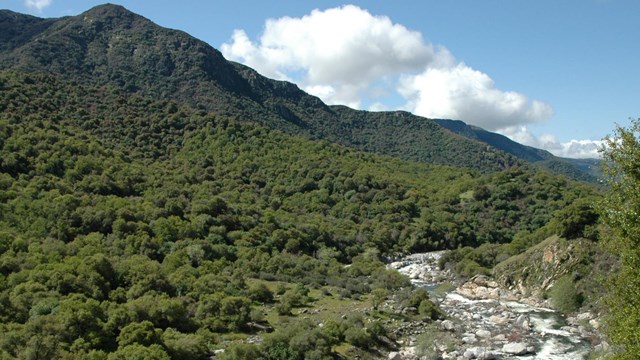
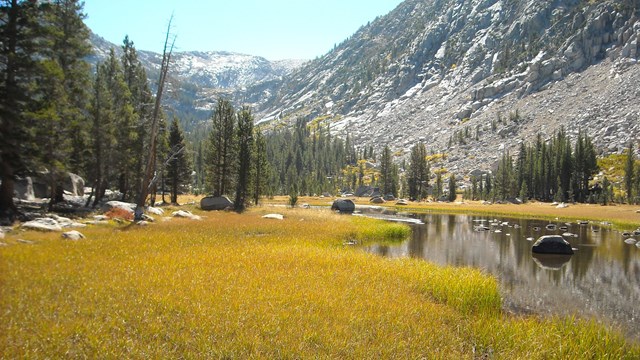
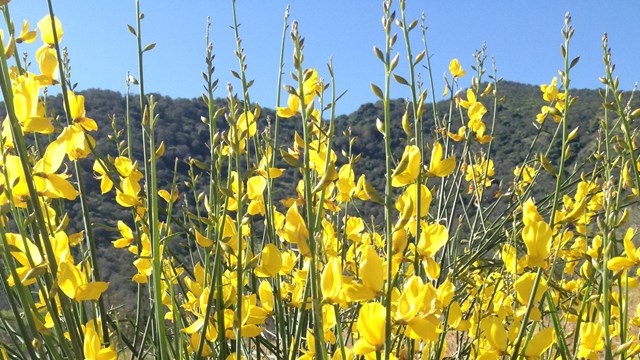
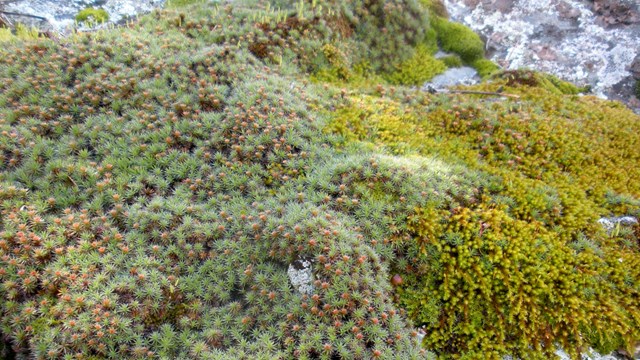
Extreme topographic differences and a striking elevation gradient (ranging from 1,360 feet (412 m) in the foothills to 14,494 feet (4,417 m) along the Sierran crest) create a rich tapestry of environments, from the hot, dry lowlands along the western boundary to the stark and snow-covered alpine high country. This topographic diversity in turn supports over 1,200 species (and more than 1,550 taxa, including subspecies and varieties) of vascular plants, which make up dozens of unique plant communities. These include not only the renowned groves of massive giant sequoia, but also vast tracts of montane forests, spectacular alpine habitats, and oak woodlands and chaparral. The richness of the Sierran flora mirrors that of the state as a whole--of the nearly 6,000 species of vascular plants known to occur in California, over 20% of them can be found within Sequoia and Kings Canyon National Parks. Along the western edge of the parks, the Great Central Valley gives way to blue oak savanna and a mosaic of chaparral types. Unlike most of the park vegetation, which is made up of plant species native to the region, the foothill grassland is primarily non-native annual grasses that were introduced to California during the mid-19th century and have subsequently become naturalized. The slow-growing, gnarled blue oaks that dot this landscape can be hundreds of years old.
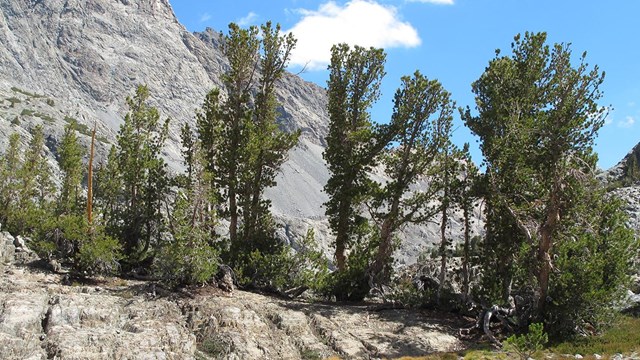
Red fir forests grow in pure stands in the mid to upper elevation forest belt (7,000 to 9,000 feet) of Sequoia and Kings Canyon National Parks. These stately trees typically form a dark forest with scant ground cover. USGS photo by Linda Mutch Above the upper-most edge of the montane forests, subalpine woodlands define the limit of tree life in the Sierra. In Sequoia National Park, these include the southernmost populations of foxtail pine, a close relative of the long-lived bristlecone pine which can be found in the White Mountains to the east. Downed pieces of foxtail wood can persist intact for thousands of years, preserved by the extremely cold and dry conditions that characterize the high elevations. To the north, stands of whitebark pine provide a critical food source for the ubiquitous Clark's nutcracker.
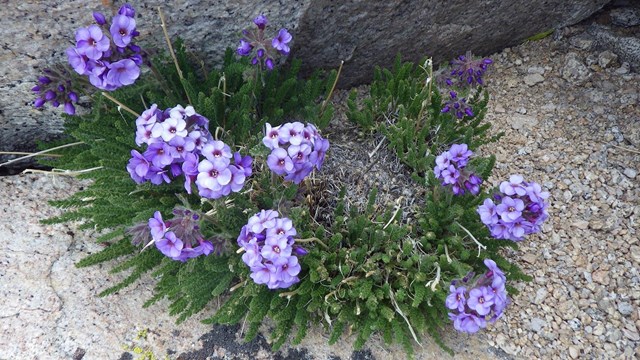
Foxtail pine grow in scattered stands on bare rocky slopes at high elevations. Exposed to extremes of temperature, unlimited sunlight, severe winds and storms, and long summer droughts, these trees have shapes sculpted by the elements. Photo by Anthony Caprio Where soils are too saturated or shallow to support tree growth, numerous meadows can be found in the montane, subalpine and alpine zones. Wet meadows support a remarkably diverse assemblage of grasses, sedges and wildflowers, which provide essential habitat for many small mammals, birds, and insects. Dryland meadows, too, are an important source of food and shelter for animals of the higher elevations. The parks’ vegetation management programs focus on understanding the parks’ flora and vegetation, protecting rare species, restoring natural fire regimes to forest and chaparral ecosystems, monitoring and controlling invasive non-native (exotic) plants, restoring disturbed habitats and landscapes, and monitoring and managing impacts from recreational and administrative uses. Brief overviews of these programs are found on the following pages, along with suggestions for additional sources of information. |
Did You Know?
Not all American black bears are black! Colors also include chocolate, brown, cinnamon, and even blonde. When you see a brown-colored bear in Sequoia and Kings Canyon parks, you are seeing a black bear, not a grizzly. Although a grizzly is on the state flag, none remain in the wilds of California.