

NPS Photo Prince William Forest Park contains the largest contiguous piedmont forest in the National Park Service. The park sits in a transitional zone between northern and southern climates. Throughout the park's 15,000 acres, discover seepage swamps, remote stands of eastern hemlock, and several populations of rare plants. As scientific surveys are conducted, other rare communities may be located. 
NPS Photo White Oak, Quercus albaWhite oak is a large growing tree that dominates the forest canopy. The acorns of this tree are a favorite of many wildlife species. Even early settlers would boil and eat them or grind them into flour. Early carpenters and modern loggers favor the wood for the construction of houses. Park builders used white oak to build the cabin camps here. 
NPS Photo Yellow Poplar, Liriodendron tulipiferaYellow poplar also goes by the name “tulip tree” since its flower resembles that of a tulip. Yellow poplars are the tallest-growing tree in the eastern United States. A straight trunk and light weight wood make this tree ideal for woodworking. Native Americans built canoes from Yellow populars trees.

NPS Photo Red Maple, Acer rubrumOne of the most dominant trees in the eastern United States because of the absence of forest fires in today’s forests, red maples are easy to identify. They have smooth bark and leaves which turn bright red in the fall. During the winter when the leaves are gone, the tree is still easy to spot with its red buds and opposite branching. Maple, ash, and dogwood are three other species which have opposite branching. 
NPS Photo Virginia Pine, Pinus virginianaOne of the most common species in Prince William Forest Park, Virginia pine is easy to identify--its flaky bark and two needles in a bundle are direct indicators. As a pioneer species, it is often the first tree to root on a site, enriching the soil and making it possible for other trees to grow. To re-hablitate the abandoned and polluted Cabin Branch Pyrite Mine site, the National Park Service planted 5,000 Virginia pines from 1995 to 1998. Today, the former mine site is full of lush plant life, thanks to Virginia pines' grip on the poor soil. 
NPS Photo Sassafras, Sassafras albidumThe roots and bark supply oil for perfumed soap and sassafras tea. It has also been used to flavor root beer. At one time, some people believed the bark acted as a cure for diseases. However, today's scientists find the roots and bark of the sassafras tree may have cancerous properties. 
NPS Photo American Beech, Fagus grandifoliaThe beautiful smooth bark of the American beech is easy to identify and can be compared to elephant skin. The leaves, which turn a bright yellow in fall, eventually brown and remain on the tree until spring. The tree's soft bark may become a target at times for humans carving graffiti on tree trunks. Daniel Boone left his mark on a beech tree while hunting in Tennessee writing "D. Boone Cilled A bar ON Tree In Year 1760". Throughout Prince William Forest Park, you'll see graffiti on beech trees. Please do not leave your mark on a tree. It is illegal and the trees are beautiful just the way they are. Carving through the bark on trees may also provide an opening for disease and parasites to infect the tree. These conditions may eventually kill the tree. 
NPS Photo Mountain Laurel, Kalmia latifoliaMountain laurel is poisonous to several different animals, including horses, goats, cattle, sheep, and deer. The honey which is made from mountain laurel pollen is believed to be poisonous. The wood has been used to make tool handles and tobacco pipes. 
NPS Photo American Holly, llex opacaBest known as "Christmas holly," this broad-leaved tree is a rarity in that it is also an evergreen. This unique characteristic makes it a favorite among birds. The American holly comes in a male and female form, with only the female trees growing berries. The male plant pollinates multiple females through bees. Don't pick the berries--they are harmful to humans if ingested. The holly was a favorite of George Washington. He wrote about it in his diary fairly often. He once wrote of transplanting many "little hollies" to his Mount Vernon home, only to write again a year later that they had all died. Washington often received small holly trees as gifts. The American holly can be spotted along the North Valley Trail. 
NPS Photo Red Oak, Quercus rubraThe Red oak is one of the largest and most important timber trees. One of the fastest growing of the oaks, it may grow as tall as 80 feet and attain a diameter of two to three feet. It has a wide, spreading crown with few far-reaching branches. The fruit is a large, broad, rounded acorn with a very shallow disk-like or saucer-shaped cup. Acorns provide a food source for numerous birds and animals including ruffed grouse, nuthatch, blue jay, wild turkey, red and gray fox, squirrels, bears, deer, and raccoons. You can see red oak along Farms to Forest Trail. 
NPS Image Sycamore, Platanus occidentalisSycamore is one of the most massive trees in Virginia and is fast-growing. Although suburban home-owners may find this tree a little messy, it is an asset to any forest. Carpenters use it to make furniture. This tree has bark that flakes off in rather large sections when the tree grows faster than the bark tissue can expand. Virginia landowners established large sycamore plantations on the coastal plains in the 1960s and 1970s. 
NPS Image Chestnut Oak, Quercus prinusOne of the oldest living chestnut oaks is called the “Washington Oak” located on the Hudson River. It is believed to be 800 to 1,000 years old. The saying “she threatened to tan our hides” originated with this species. People may have heard this growing up when they were misbehaving. A chemical called “tannin” is found in the bark, leaves, and wood of this tree. It is commonly used to tan raw animal skins, called hides, to make leather. Pioneers had several uses for acorns. Today, a typical button is made of a plastic or metal, but pioneers used the caps of acorns. The remainder of the acorn could then be dried and ground into a powder to be used as a sweet thickening agent for stew. 
NPS Image Black Tueplo, Nyssa sylvaticaDetested by lumberman for its interbraided and crosswoven grain, the black tupelo could not easily be downed by ax, wedge, or sledge. Black tueplo grows shorter as it grows older and begins to decay from the top down. When its strength can no longer bear its weight, the tops fall off. This unique quality made it a superb wood for the handles of heavy-duty tools that needed to absorb shock such as the ax. Black tupelo wood was also used in railroad ties. It was possibly used in the railroad system that came through the park to support the old Pyrite Mine. The wood would have been strong and durable enough to sustain the strains of the heavy loads of pyrite. This species has also been referred to as sourgum or black gum, and the Latin name means “water nymph of the forest”. See if you can find this tree along the Birch Bluff trail. 
NPS Photo Willow Oak, Quercus phellosWillow oak is a deciduous tree of the red oak family. It is native to eastern North America. The tree is notable for its leaves, which, unlike other oak trees, resemble the long green leaves of a willow tree. Willow oaks produce an abundance of acorns, which are enjoyed by wildlife such as squirrels and birds. Because of its striking height and fast growth, willow oak is often used as a landscaping tree. The leaves of the tree undergo a colorful change in the autumn. Several willow oaks can be found in the Pine Grove Picnic Area. 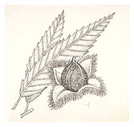
NPS image / Hsien-Min Yang American Chestnut, Castanea dentataChestnuts were picked and sold commercially to venders in New York. Commercial pickers looked for an easier way to harvest chestnuts and found a smaller tree growing in Asia. The Chinese chestnut tree grows shorter than the American variety, so the nuts were easier to pick. When the first Chinese chestnut tree was brought to New York City, chestnut blight came with them. American chestnuts were not resistant to this disease. This blight has completely obliterated the population of American chestnuts throughout North America. Look through the park and you may find a sapling or two which has not yet been attacked. Low Bush Blueberry, Vaccinium angustifoliumThis small shrub is common through out the park. Low bush blueberry is fire-tolerant, and its numbers often increase in an area following a forest fire. These wild blueberries are edible just like commercially grown variety. 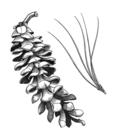
NPS Image / Charles R. Hazard White Pine, Pinus strobusThe white pine is easy to identify by looking for five needles in each vesicle bundle. Remember, the word "white" has five letters, so there are five needles in every white pine bundle. During colonial times, white pines were marked with arrows. These were designated as the king's trees to be used for the royal navy for building masts. This tree is known for its ability float on water. |
Last updated: October 22, 2023