
Safety FirstIn Emergency: Contact US Coast Guard Station Bodega Bay on VHF CHANNEL 16 or call 911 and ask for Marin County Dispatch. Report Oil and Chemical Spills: Call both response numbers below
Visit our Your Safety While Boating page for information on preparing for and remaining safe while boating in the Point Reyes area. 
Reserving a PermitThere is a fee and permit system for overnight camping within Point Reyes National Seashore, including camping on the beaches on the westside of Tomales Bay north of Tomales Bay State Park's northern boundary. Overnight beach camping is not permitted anywhere else on Tomales Bay or elsewhere within Point Reyes National Seashore. Camping FeesPlease visit the Camping Fees section on our Backcountry Camping for the current camping fees. Advance ReservationsReservations may be made online at Recreation.gov. Reservations may also be made by phone by calling toll free 877-444-6777 (TDD: 877-833-6777). Until further notice, Point Reyes National Seashore no longer has any permits that will be sold on a first-come, first-served, same-day basis. All camping permits must be reserved online through Recreation.gov in advance of arrival. All available campsites will be shown as reservable on Recreation.gov. Do not arrive or camp at Point Reyes National Seashore without a reservation. Party Size
We do not allow groups of more than six people to purchase multiple "BOAT A, 1–6 people" permit. Nor may parties of six or fewer people reserve "BOAT B, 7–14 people," "Marshall Beach Group 1," "Marshall Beach Group 2," or "Tomales Beach Group" permits. Camping Permits—No Check-In RequiredCampers do not need to check in at the Bear Valley Visitor Center until further notice. Print your Recreation.gov confirmation email and be prepared to show it to park rangers on Tomales Bay and at your camp on a beach. You may also want to download and store an electronic copy of the confirmation email on your phone or tablet. Cancellations and No ShowsPlease be courteous and cancel any nights of your reservation that you are unable to use. Review Recreation.gov's Rules & Reservation Policies page for more details. Permitted Modes of Transportation for Getting to Your "Campsite"There are no designated campsites along Tomales Bay. Instead, there are a number of beaches on which one may camp, if one has a boat-in camping permit. Campers on Tomales Bay beaches must arrive by boat, kayak, canoe, or other small watercraft (except for PWCs*), and may not drive, hike, bike, or ride horses to the beaches. If you do not have your own small watercraft, there are a few local Kayak Outfitters from which kayaks may be rented. Overnight parking for boat-in campers is prohibited within Point Reyes National Seashore (e.g., along the Pierce Point and L Ranch Roads and at the Marshall Beach Trailhead) and Tomales Bay State Park. * Personal water craft (PWC)—often referred to by the trademarked brand names Jet Ski™, WaveRunner™, or Sea-Doo™—are prohibited on Tomales Bay. 
Leave No TraceWith increasing visitor use, both day and overnight, it is important to minimize our impacts and Leave No Trace of our visits to wilderness, parks, and other special places. Trips that include awareness and the use of minimum impact practices conserve natural conditions of the outdoors which make the adventure enjoyable and allow others the same experience. Your backcountry permit is a signed contract between you and the National Park Service. It's an agreement to treat these public lands with respect by practicing Leave No Trace (LNT) techniques. Keep in mind that Leave No Trace camping goes beyond following the rules; it requires thoughtful judgement for each situation that comes up. SanitationDisposing of human waste in the bay or onto park beaches is prohibited. On Tomales Bay, there are vault toilets at Marshall Beach and Tomales Beach. If camping on other beaches, you are required to pack out all human waste using a portable toilet or similar commercially designed waste disposal containers that can be emptied into an RV dump station or pit toilet, or a GO anywhere toilet kit® (formerly sold as WAG® Bags). While there are restrooms at Hearts Desire Beach, Lawsons Landing, and Miller Boat Launch, a pit toilet at Indian Beach, and portable toilets at Chicken Ranch Beach, camping is prohibited at all of these locations. NEVER pump boat holding tanks into the bay or outhouses. Lawson's Landing at Dillon Beach (707-878-2443) is the closest place to pump out your tanks. (You cannot pump from the water but if you pull your boat out at this launch site, there is a dump station). A dump station is also available at Olema Campground (415-663-8106) along Highway 1 at Olema. Where to LaunchThere are three locations (listed in the order of proximity to Bear Valley) at which watercraft may be launched onto Tomales Bay and overnight parking is permitted: Tomales Bay Resort415-669-1389 Miller Boat Launch415-499-6387 Lawson's Landing707-878-2443 On the WaterMove gently through the water so that you do not disturb wildlife. For safety, paddle in groups if possible. Ensure that you are close enough to reach fellow paddlers quickly if trouble arises. Paddle close to shore or, if an open-water crossing is necessary, choose the most direct route. Always wear your personal flotation device. Visit our Your Safety While Boating page for more information. Where to CampOvernight boat-in camping is permitted on a number of the beaches on the west side of Tomales Bay within Point Reyes National Seashore. (Download the Tomales Bay Boat-in Camping Map. [2,632 KB PDF]) Did you reserve a Marshall Beach Group or the Tomales Beach Group permit?If you reserved the Marshall Beach Group 1, Marshall Beach Group 2, or Tomales Beach Group permit, you are required to camp on the beach specified by your permit, i.e., Marshall Beach or Tomales Beach. Did you reserve a "BOAT A, 1–6 people" permit or a "BOAT B, 7–14 people" permit and do you have a portable toilet?Yes.If you reserved a "BOAT A, 1–6 people" permit or a "BOAT B, 7–14 people" permit, you get to choose to camp on any of the beaches marked on the map as open for camping, i.e., "Boat-in camping permitted"—if you have a portable toilet (see the Sanitation section above). The beaches are available on a first-come, first-served basis. Keep in mind that many of the beaches are large enough for multiple parties, so you aren't guaranteed to have a beach all to yourself. However, if there is already a party camping on a small beach, please do not crowd them by coming ashore and setting up camp—keep paddling until you find a larger or unoccupied beach. No.If you do not have a portable toilet, you are required to camp at Marshall or Tomales Beach, where there are vault toilets that you will need to use. 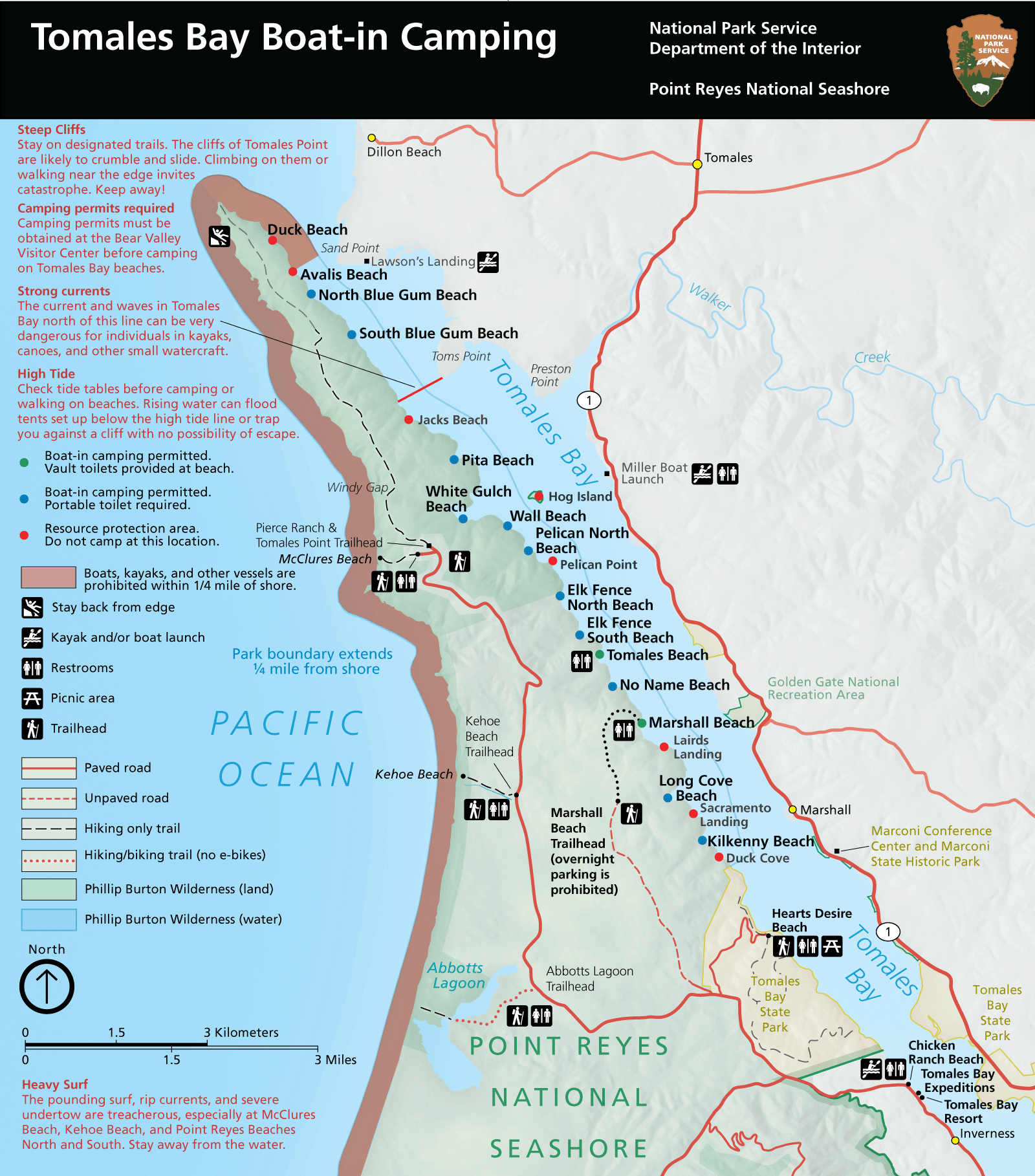
Some of the Tomales Bay beaches that are open for overnight camping to those who have a current and valid permit are (listed from south to north; GC = geographic coordinates):
Map of Tomales Bay Boat-in Campsites (2,632 KB PDF) Water for Cooking and DrinkingCarry water with you, as there are few water sources emptying into the bay on the west side. Boil, treat, or filter any water obtained from the park. If you wash dishes, be aware that all soaps can adversely affect water. Use biodegradable soap when possible. Do not dump wash/greywater in the bay; dispose of all dirty water 30 meters (100 feet) at least from any source of water. Food and Food StorageRaccoons, coyotes, and other animals can be very aggressive and will tear into backpacks, duffle bags, dry bags, tents, and kayaks to get at food and other scented items. And, since 2021, black bears appear to have decided to take up residence in Marin County, including Point Reyes. Therefore, all food, all trash, all toiletries, and all other scented items should be stored in portable bear-resistant food storage containers unless in immediate use. This includes, but is not limited to, all sealed or packaged food, sunscreen, soap, mosquito repellent, toothpaste, lip balm, deodorant, first aid kits, medications, and feminine products. As a general rule, if you put it in your mouth or on your skin, it should probably be stored in a bear-resistant food storage container. The container only works if it's closed and locked! Be sure to keep it closed and locked, even while you're around your campsite. Place the container on the ground in a flat, level area or in a depression in the sand to make it more difficult for animals to roll it away. Do not hang or attach anything to the container—ropes attached to the container may enable an animal to carry it away. Only store food on boats if the food is stored in secure, lockable cabinets. River otters have been known to climb onto boats. GarbageStore garbage in a portable bear-resistant container, such as your food storage containers. Pack out all trash, food scraps, and packaging. Food scraps tempt wildlife into camping areas and may endanger them and you. Glass Bottles and Glass ContainersLeave glass containers at home or in your vehicles. Possession of a glass container within fifteen meters (fifty feet) of any riverbank, lakeshore, or beach, or on the water, or in a vessel is prohibited. Broken glass from bottles or other containers pose a hazard to visitors who walk barefoot on the beaches of Tomales Bay or who go swimming. FiresGas camp stoves are the preferred means for cooking. Visitors planning to cook food over a beach fire or barbecue briquettes should come prepared with an alternative means (e.g., self-contained gas stove) of cooking in the event of a Spare the Air Alert or high, very high or extreme fire danger conditions.

For more detailed information and instructions, check out our Beach Fires page. Charcoal Fires
Back to Kayak Page ¦ Top of Page HikingThe Marshall Beach Trail is the only official park trail that leads from/to any of the park's beaches on Tomales Bay. It is 1.6 km (1 mile) long and ends at the Marshall Beach Trailhead at the north end of the L Ranch Road and doesn't connect with any other trails. Tomales Bay State Park has a small network of trails, some of which come down to the bay at Indian Beach, Hearts Desire Beach, Pebble Beach, and Shell Beach. Reminder: Camping is prohibited within Tomales Bay State Park. 
PetsAs of May 30, 2023, pets are not allowed on any of Point Reyes National Seashore's beaches along Tomales Bay. 
DronesLaunching, landing, or operating a remotely operated aircraft (aka "remotely piloted aircraft," "unmanned aircraft," or "drone") from or on lands and waters administered by the National Park Service within the boundaries of Point Reyes National Seashore is prohibited. If you observe drone use in Point Reyes National Seashore, please call park dispatch at 415-464-5170 or contact staff at the nearest Visitor Center as soon as possible. If you observe drone use in other National Park Service areas or if you find photographs or videos online or elsewhere that were illegally taken within National Park Service areas from drones, you can report the violation to the National Park Service tip line at 888-653-0009 or by email. Invasive Plants and AnimalsTo help prevent the spread of non-native plants and animals, please:
More Information
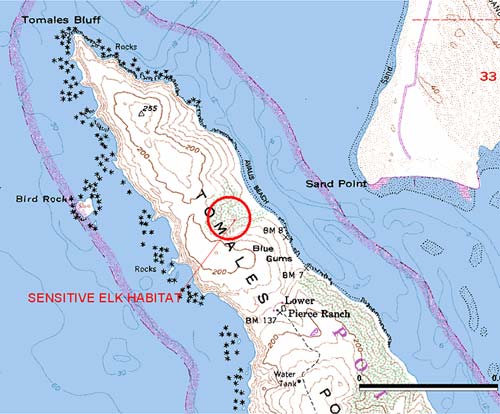
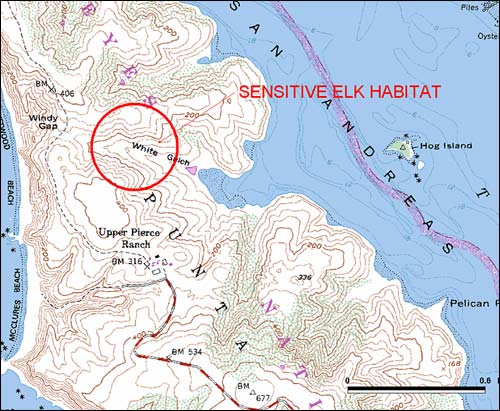
WildlifeOne of the joys of Tomales Bay and Drakes Estero is the frequent sightings of harbor seals, tule elk, and the many birds, but please respect the needs of wild animals and birds. Wildlife are sensitive to our presence and may change their behavior just by seeing humans. Disturbing wildlife when they are resting or feeding may be life threatening to them. Harbor SealsOn the water or beach, follow Marine Mammal Protection Act regulations: stay 91 meters (300 feet) away from whales, seals, and sea lions. Harbor seals are most sensitive during their pupping season, which is approximately March 1 through June 30, and as they molt in July and August. You may see apparently abandoned pups (i.e., baby seals), but do not disturb them. Usually, a parent is feeding nearby and has only left the pup for a brief period. The parent may abandon the pup if they sense humans nearby. If you are concerned about a marine mammal, contact the park dispatch office at 415-464-5170 or staff at park visitor centers to provide the location and condition of the animal To protect harbor seals from disturbance during the most crucial part of the pupping season, from March 1 through June 30 the National Park Service has closed the following areas to the public: Drakes Estero, Limantour Estero, Double Point, and the western most end of Limantour Spit. BirdsPelican Point, Duck Island, and the east side of Hog Island are closed to the public year round. During summer and fall, brown pelicans—which, up until 2009, was a federally listed endangered species—roost on islands and floats in the bay. Many other seabirds make their home on the bay as well. Keep at least 30 meters (100 feet) away. Visit the Seabird Protection Network website for tips on how to help protect nesting birds. Back to Kayak Page ¦ Top of Page Tule ElkTule elk generally do not come down onto the Tomales Bay beaches, but they may be seen from the water. Always keep your distance. If you encounter an elk, do not come between a cow and a calf, a bull and a group of cows, or between two bulls challenging each other. The rut season—when males are jockeying for position and attempting to gather females for breeding—occurs from July through September. The elk are most active during that period. Park biologists have noted elk calving and nursing in areas near Avalis Beach and White Gulch. To reduce the chance of disturbing the elk, stay on beaches and do not climb up onto the ridge. And if you plan to land at Avalis Beach, camp or use the extreme northern or southern ends of the beach. BioluminescenceMicroscopic, single-celled organisms called dinoflagellates produce and emit light through a chemical reaction process. When these organisms are moved by waves or by the paddle of a kayak or canoe, the light becomes visible, especially on dark nights. Learn more about dinoflagellates and bioluminescence. Marine Protected AreasOn May 1, 2010, a number of Marine Protected Areas went into effect within and adjacent to Point Reyes National Seashore, in part to better protect nesting birds. Per the Marine Life Protection Act (MPLA), the Point Reyes Headlands is closed to all vessels within 305 meters (1000 feet) of shore from Chimney Rock west to Longitude 123° 01.00'. Per the Superintendent's Compendium, from Longitude 123° 01.00' west to the Point Reyes Lighthouse the headlands is closed to all vessels within 91 meters (100 yards) of shore. There are also 91-meter (300-foot) special closures around Point Resistance and Double Point/Stormy Stack, per the MLPA. MultimediaKayakers and other visitors to Point Reyes may find our Wilderness Videos page to be of interest. There we feature multiple videos about the Phillip Burton Wilderness and Leave No Trace® outdoor ethics. Ahoy Boaters & Kayakers! Watch this short PSA from the Seabird Protection Network to learn about California's amazing seabirds and how you can help marine wildlife while enjoying the beautiful coast! Contact UsTo make, change, or cancel your camping reservations, log in to your Recreation.gov account, or call the Recreation.gov call center at 1-877-444-6777. Call center staff are available every day of the year from 7 am to 9 pm PT, except on Thanksgiving, Christmas, and New Year's Day. If you have non-emergency, park-specific camping questions that cannot be answered by reviewing the content above or on our Backcountry Camping and Campgrounds pages, please send an email to our Camping Desk. Again, DO NOT email the Camping Desk to make, change, or cancel reservations; contact Recreation.gov. |
 |
|
Last updated: August 12, 2024