
National Park Service LogoU.S. Department of the InteriorNational Park ServiceNational Park Service
National Park Service:  U.S. Department of the InteriorNational Park Service Arrowhead
Mississippi National River and Recreation AreaBald eagle flies through a blue sky.
view map
text size:largestlargernormal
printer friendly
Mississippi National River and Recreation Area
What caused the flood?
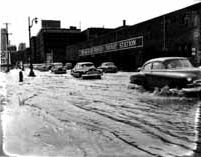
A flooded street.
Walter N. Trenerry Photo,
MN. Historical Society
The floodwaters of 1952 began with the weather of 1951. That year, extensive spring flooding, a damp summer, and early winter rainfall left the ground of the Upper Midwest unusually wet. When the temperature finally dropped below freezing, the ground frost which formed was unusually deep, becoming a barrier through which the spring meltwater of 1952 could not pass. The resulting runoff into area rivers was thus much larger than usual, causing many of the Mississippi's tributaries to flood by early April, inundating communities and farmland upriver from the Twin Cities. As these waters critically swelled the Mississippi, heavy rains and increased runoff from a weekend heat wave finally sent the river into flood stage in St. Paul on April 9th.
A slow and shallow section of Itaska.  

Did You Know?
At the headwaters of the Mississippi, the average surface speed of the water is 1.2 miles per hour. People typically walk 3 miles per hour.

Last Updated: August 15, 2006 at 12:22 EST