 |
 |
  |
|
|
|
|
 |
| view map |
 |
|
|
|
|
|
|
Great Basin National Park
Plan Your Visit
|
|
|
|
|
| |
 |
NPS PHOTO Endless opportunities for fun await skiers and snowshoers on Great Basin's snowy slopes.
Winter
When winter arrives in Great Basin National Park you experience the true meaning of solitude and silence. Frost delicately ornaments blades of grass along stream beds as water gently runs under sheets of ice. As snow accumulates on mountain peaks, mule deer begin their seasonal migration patterns, moving down to lower elevations. With the arrival of fresh powder brings the anticipation of winter recreation. Trails and roads are explored by a few adventurous visitors on skis and snowshoes. Just when you think you are alone, a series of paw prints in the snow provide alluring signs of an animal that was recently in that same place. With practice, using a guide book, you will be able to identify a wide range of tracks and patterns. Need some ideas? Check out our Ranger Minute videopodcast. If you are still puzzled, ask for help from a friendly ranger at a visitor center.
Jenny Hamilton Rock Squirrel finds a meal from the historical orchard.
Spring
With the arrival of the spring season comes a new beginning. The gradually warming temperatures awaken Rock Squirrels, and other critters, from their long sleep reminding them to forage. Even though days in the valley may be hot, there is generally snowpack in the high elevations. With the gradual melting of snow, streams dance down the mountain. Diversity explodes. Bouquets of Prickly-Pear Cacti, Indian Paintbrush, and Globe Mallow begin to dot the desert with shades of yellow, pink, red, and orange.
Kathy Billings A hiker stands under six-story tall Lexington Arch, and enjoys the view.
Summer
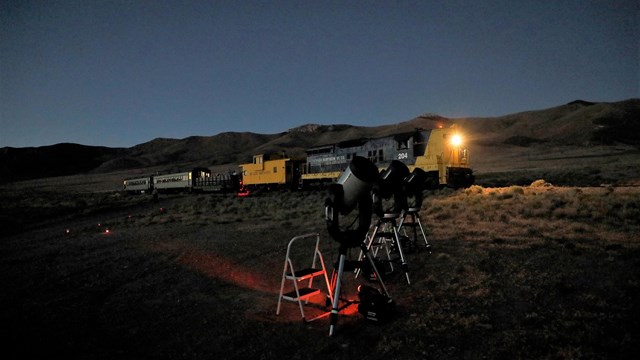
So arrives the season full of activity. Temperatures are comfortable with highs around 85 and lows 55 at 6,825 ft above sea level. Even the Yellow-bellied Rock Marmots who hibernate nine months out of the year reveal themselves to sunbathe on rocky outcrops. Fishermen practice their angler skills in creeks. Hikers enjoy moderate to strenuous hikes early in the day to avoid common afternoon thunderstorms. As darkness falls, anticipation arises for another activity: connecting with the night sky. Stargazers enjoy the best visibility of the Milky Way in the continental United States.
NPS Photo A September trip up the Wheeler Peak Scenic Drive is guaranteed to be a colorful one.
Fall
When autumn arrives, Great Basin National Park shows its colors, with groves of aspen trees dotting the mountains in hues of yellow and gold. The air is cool and crisp, uncrowded trails beg to be explored, and pine nuts are ready for picking. Great Basin National Park takes some effort to get to, but those who make the journey reap the rewards: spacious campsites, friendly and available staff, and the company of the oldest trees on Earth, the bristlecone pines.
| | |
|
|
|
|
|
You are exiting the National Park Service website
Thank you for visiting our site.
You will now be redirected to:
We hope your visit was informative and enjoyable.
|
| |  | | Did You Know? Great Basin National Park's mountain lions feed primarily on mule deer but also include porcupines, rabbits, bighorn sheep, beaver, elk, marmots, and small rodents in their diets. more... | | |
|
Last Updated: November 09, 2011 at 10:28 MST |