



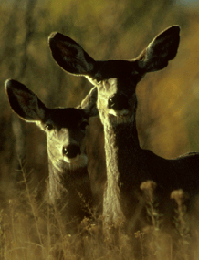
US FWS The vast expanses of sage brush and high desert that stretch across the Great Basin are home to many species of mammal. Of all the mammals in North America, 70% of species are represented here in the Great Basin. From the kangaroo rat, which can survive without ever drinking water, to the mountain lion that slips through the forest on silent paws, the variety of wildlife is astounding. Don't expect to observe all of these animals at once, as many are secretive and have a low population density. With a little luck, good timing, and patience, a wide variety of mammals may be seen as you hike or drive across the area.
The HuntersMountain LionsMountain Lions (pumas, cougars, wildcats, catamounts, panthers, etc.) average 6-8 feet in length and can weigh up to 250 lbs. These powerful animals can drag three times their own weight, jump up to 40 horizontal feet, 20 vertical feet or drop from 60 feet and land running. Incredibly solitary, cougars are found together only when a mother has young. Although they can be active at any time of day, they most commonly seen at dusk or dawn when they are hunting deer and elk. CoyotesCoyotes are a highly adaptable species, found in many areas. This ruddy (brown) and gray colored animal is dog-like in appearance. Unlike dogs, coyotes run with their tails down. Traveling in search of food sometimes up to distances of 400 miles, the coyote cruises at a speed of 25-30 mph. Coyotes eat nearly anything, from the meat of small mammals to insects and fruit. At dawn or dusk the coyote can be heard calling in a series of yelps followed by a long howl. BobcatsBobcats derive their name from their short, 3-6 inch 'bobbed' tail. Their coats are tawny brown with stripes and mottled spots. Their average weight varies from 14 to 68 lbs. Bobcats are the most common North American wildcat and generally hunt snowshoe hares and cottontail rabbits. BadgersBadgers are a formidable, if relatively small, presence across the Great Basin. Their bodies are flat and their coats are light brown in color, with white and black stripes across the head. They prey on rattlesnakes and seem to be unaffected by the venom except when bitten on the nose. Badgers only weigh up to 25 lbs but most creatures avoid them because of their skunk-like odor and large, powerful claws. If attacked, a badger will attempt to get to its burrow and block itself inside. An excellent digger, badgers can instantly build new burrows at a rate faster than a human can shovel. Badgers are valued in agricultural areas for their efficient pest control as they feed on rodents. Rabbits and RodentsBlack-tailed Jack RabbitThe black-tailed jack rabbit is a desert animal commonly seen in the sagebrush and pinyon communities. To withstand the heat of the desert sun, the rabbit spreads out its large, thin ears, releasing heat as blood travels through the veins. A popular prey for a variety of mammals and birds, the jack rabbit confuses the predator by zigzagging as it runs, and powerful back legs propel it to speeds of up to 30 mph. Kangaroo RatKangaroo rats are an amazing rodent able to live their entire lives without ever directly drinking water. The rats store food in cool, damp areas, which allows the grains to collect moisture. They live in a series of underground tunnels, and usually never stray more than 30 feet from their homes. Foraging for food with jumps of up to 9 feet, these rodents have tan coloration above and white below. Their long tails are also distinctive with white stripes along the sides. PackratsPackrats, also known as woodrats, are fascinating animals found in caves and cliffs. Their habit of collecting an odd assortment of objects in their nests helped to earn them their name. They have a strong affinity for shiny objects such as coins, keys, or spoons. Their nests are valuable tools for climate research, as the contents can be preserved for thousands of years. By looking at plant materials found in nests, climatologists can determine what plant communities existed around the nest in a specific era. A mixture of brown and gray, these rats are 11 ½ - 18 ½” in length, and have a bushy tail used for balance. When threatened, the packrat may stomp his feet, producing a low tapping noise. Yellow-bellied MarmotsYellow-bellied marmots are commonly found among rock piles up to 11,000 feet. Yellowish-brown in color with a yellow belly, marmots have white spots between the eyes and a bushy tail. Sometimes over 2 feet long, they weigh up to 10 lbs. Living in a rock shelter, marmots feed on a wide variety of greens, creating a layer of fat. This energy is used during hibernation which lasts from August to March. When frightened the marmot will issue a whistle sometimes described as its "song." UngulatesMule DeerMule deer, which earn their name from their large ears of about 6 inches in length, weigh from 100-475 lbs. The bucks’ antlers grow in response to age, health and diet; growth begins with two even branches that further branch somewhat randomly. Distinct also because of their large white rump patch with a black tail, these deer can be seen in great numbers in the early morning or at dusk. Groups usually consist of a doe with fawns and a few yearlings as they forage for plants of all sorts. PronghornWhile colloquially called the “American Antelope”, pronghorn do not belong to the antelope family, and are in fact more closely related to giraffes. They are easily spotted with their tan coats and sharp black horns. Their chest, sides, and rumps are a bright white, and their faces are marked with patches of black and white. The fastest land mammal in North America, the pronghorn has been clocked at speeds of up to 70 mph. Their distinctive herding instincts cause problems as they may swerve right into your car! Travelling in scattered bands, pronghorn can be seen active both day and night. ElkElk stand up to 5 feet at the shoulder, can be 9 feet in length and weigh anywhere from 450-1000+ lbs. These large animals are distinct with their yellowish-brown rump patches. Males have antler racks up to five feet long, and a short manes on their throats. Grazing vegetation, they travel in harems with up to 60 females for one male. Their telltale bugle can be heard as the males challenge one another during the rutting season in fall and to organize their herds. Primarily nocturnal, you are most likely to see them at dusk. BatsA variety of bats (such as big brown, Western big-eared, Mexican free-tailed, and several species of myotis) make the Great Basin their home while bat species in general make up 20% of the world’s mammals. The only mammals capable of true flight, bats have wings that are supported by bones that are structurally equivalent to the bones in our hands. The majority of bats are insectivores; bats of some species can eat over 600 mosquitoes in just one hour! Most bats find their food in flight using echolocation, a form of sonar. Enjoy Wildlife Safely!Animals are most enjoyably and safely observed from a distance. When left alone, animals relax and will let you watch as they go about their daily routines. Approaching animals not only disturbs them, but presents a danger to you. When cornered or afraid, the animal may attack in self-defense; this includes deer, rabbits and even chipmunks! |
 |
|
Last updated: December 22, 2025