



|
You are viewing ARCHIVED content published online before January 20, 2025.
Please note that this content is NOT UPDATED, and links may not work. For current information,
visit https://www.nps.gov/aboutus/news/index.htm.
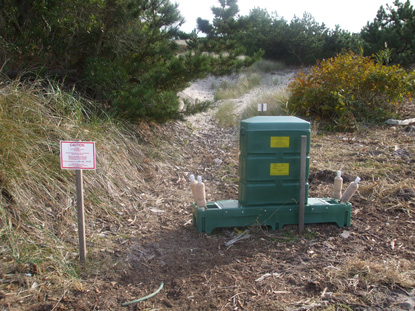
Contact: Paula Valentine, 631-687-4759 Contact: Michael Bilecki, 631-687-4760 Patchogue, New York—New York State's 4-Poster Tick Management Technology study will be permitted to continue for another year on Fire Island. On March 20, Superintendent Chris Soller of Fire Island National Seashore approved a scientific research and collecting permit for New York State Department of Environmental Conservation (NYS DEC) to test a total of four "4-Poster Tickicide" devices in two communities within the boundaries of the park. For 2009, the four devices will be installed at two sites in the Village of Saltaire and two sites in the community of Fair Harbor on Fire Island. The National Park Service (NPS) and NYS DEC arrived at a compromise on the number of devices used in the project, to try to reduce the amount of corn used to attract deer to the insecticide applicators. Another concern is the amount of pesticides applied to wildlife, which is also being monitored as part of this study. While this is not an NPS program, Fire Island National Seashore managers have been working within the constraints of NPS management policies to arrive at the compromise to allow the state’s research project within the park boundary. The purpose of the study is to address any technical concerns that the NYS DEC and NYS Department of Health may have concerning the use of the "Y-Tex 4-Poster Tickicide" device, which is patented by the U.S. Department of Agriculture and registered by the U. S. Environmental Protection Agency (EPA Reg. No. 39039-12). A primary goal is to determine the efficacy and risks associated with applying low levels of pesticides to white-tailed deer, a major host for blacklegged (deer) ticks and lone star ticks. These species of ticks are known to transmit diseases, including Lyme disease, to humans. This research project will help the state determine if these devices can be registered by NYS DEC for use within the State of New York. (In addition to the tests in two Fire Island communities, the devices are currently being tested at Shelter Island, and in Robert Moses State Park on Fire Island.) For more information about this project on Fire Island, contact the park's Chief of Resources Management Mike Bilecki, at 631-687-4760. For more information about Fire Island National Seashore, visit the park’s website at www.nps.gov/fiis.
# # #
|

Last updated: March 2, 2018