
-
More Park Facilities Reopen During May 2013
Watch Hill and Sailors Haven marinas open May 10. Limited ferry service from Sayville to Sailors Haven resumes May 13 and ferries from Patchogue to Watch Hill start on May 18. Remaining park facilities to reopen by May 25, 2013. More »
Threatened and Endangered Species
The piping plover is a small, stocky migratory shorebird that blends in with its sandy beach surroundings. From March to late July, piping plovers breed on Atlantic Coast beaches from Canada to Virginia. They return to the south Atlantic Coast, Gulf Coast, Bahamas and West Indies for the winter. Since 1986, Fire Island National Seashore-together with other federal, state, and local governments, volunteers, and private organizations-has been preserving and monitoring critical habitats and open spaces for the protection of threatened and endangered shorebirds and coastal plants. Two federally listed threatened and endangered (T & E) bird species are known to nest within Fire Island National Seashore. The piping plover (Charadrius melodus) is on the federal threatened and New York State endangered list. The roseate tern (Sterna dougallii) is federally and state endangered. The state-listed threatened least tern (Sternula antillarum) and the common tern (Sterna hirundo) also nest on Fire Island. The black skimmer (Rhynchops niger) and the osprey (Pandion haliaetus) are bird species of special concern in New York State. The bald eagle (Haliaeetus leucocephalus) was officially removed from the federally threatened list on August 8, 2007. Eagles continue to be protected by the 1940 Bald and Golden Eagle Protection Act and the 1918 Migratory Bird Treaty Act. Bald eagles are occasionally sighted in the national seashore. Its presence is recorded during the annual fall hawk watch by Fire Island Raptor Enumerators (FIRE) near the Fire Island Lighthouse. Of more than 30 species of reptiles (turtles and snakes) and amphibians (frogs, toads and salamanders) known to live within or visit Fire Island National Seashore, five are listed as New York State endangered species or species of special concern,
Threatened and endangered sea turtles and marine mammals occasionally visit Fire Island.
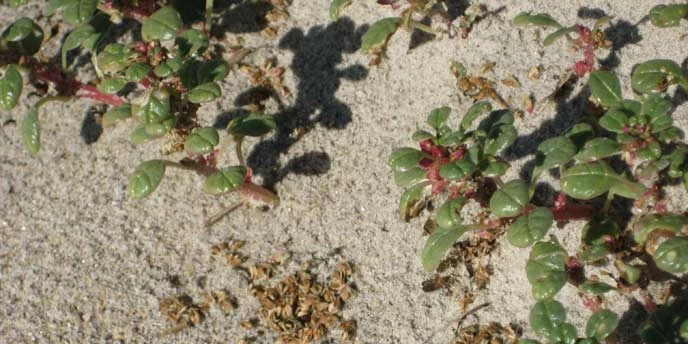
Seabeach amaranth is a small annual plant with rounded, waxy leaves and reddish stems. It grows low to the ground and colonizes beaches between the high tide line and the dune area. The seabeach amaranth (Amaranthus pumilus) is a federally threatened annual plant species that grows on some of Fire Island National Seashore's beaches. Symbolic fencing is also installed for the protection of seabeach amaranth on the beach. The seabeach knotweed (Polygonum glaucum) is a New York State rare plant that can be found on Fire Island.
Signs, symbolic fencing and exclosures around nests are some of the measures that are taken to ensure the survival of the federally threatened/state endangered piping plover. Fire Island National Seashore's piping plover monitoring and protection program begins in March with a restriction on driving, pets and kites on portions of the beach. Symbolic fencing is installed to mark suitable plover habitat. As nests are established, exclosures are constructed to protect both nest and eggs. After the chicks have fledged, restrictions on pets and kites are lifted, but the symbolic fencing is left in place for the protection of beach plants.
You Can Help
Three species of endangered whales may occur in the waters offshore of Fire Island: fin whale (Balaenoptera physalus), humpback whale(Megaptera novaeangliae) and northern right whale (Eubalaena glacialis). Five species of sea turtles have been documented around Fire Island, although none nest in the area. The Kemp's ridley turtle (Lepidochelys kempii), leatherback turtle (Dermochelys coriacea), and hawksbill turtle (Eretmochelys imbricata) are federally endangered species. The loggerhead turtle (Caretta caretta) and green turtle (Chelonia mydas) are federally threatened.
Sea turtles are not known to nest on Fire Island, but an occasional animal will wash ashore. Staff from the Riverhead Foundation assist National Park Service rangers in the recovery and examination of stranded marine animals. Occasionally, a threatened or endangered species will wash ashore, where it may be rescued or recovered by the Riverhead Foundation, one of Fire Island National Seashore's partner organizations. Cold-stunned sea turtles are particularly vulnerable. You Can Help
Learn More
Visit the National Park Service's Nature & Science web site to learn more about Threatened and Endangered Species.
|
Did You Know?
Several generations of Floyd family women planted trees around the William Floyd Estate's Old Mastic House. You can still see some of those same trees today. Several big trees are now more than 150 years old. More...
Piping Plovers
Birdwatching
Learn More About Fire Island Birds